
IRS-qualified appraisals supporting charitable donation deductions and Form 8283 compliance. AppraiseItNow appraises personal property, artwork, vehicles, boats, equipment, and business interests to substantiate non-cash contribution values.







Valuations by experienced appraisers across assets
.avif)
Joe Kattan

Anne Hay, ISA AM

Jason Dolph, CAGA

Ashley Innes, ISA AM

Justin Ramirez, ASA, ABV, CFA

Marnie Erkelens, CAGA

Raymond Ghelardi, ASA

Aron Blue
About AppraiseItNow's Charitable Donation Appraisal Services
A charitable donation appraisal establishes the fair market value of non-cash property donated to a qualifying organization, enabling donors to substantiate IRS deductions. The IRS requires a qualified appraisal for non-cash contributions exceeding $5,000 per item or group of similar items, with Form 8283 Section B completed and signed by both the appraiser and donee. Art valued over $20,000 or total donated property exceeding $500,000 requires the full appraisal attached to the return. Appraisals must be completed no earlier than 60 days before the donation date and no later than the tax return due date.
AppraiseItNow delivers USPAP-compliant charitable donation appraisals online and onsite across the United States, covering personal property, equipment, artwork, business interests, boats, automobiles, and inventory. Our mission is to deliver defensible, USPAP-compliant valuations with exceptional speed, professionalism, and client service.
What Does AppraiseItNow Appraise for Charitable Donation?
AppraiseItNow covers every major asset class that commonly requires a qualified appraisal for charitable donation purposes, including:
- Personal Property – jewelry, antiques, furniture, coins, collectibles, and household goods
- Equipment & Machinery – medical equipment, restaurant equipment, manufacturing machinery, and technology assets
- Fine Art – paintings, prints, sculpture, photography, and mixed media
- Business Interests – LLCs, S-corps, partnerships, fractional interests, and privately held stock
- Boats & Watercraft – sailboats, powerboats, yachts, jet skis, and personal watercraft
- Automobiles & Vehicles – cars, trucks, motorcycles, RVs, trailers, and classic vehicles
- Inventory – retail inventory, wholesale stock, raw materials, and finished goods
Who Does AppraiseItNow Serve?
- Individual taxpayers donating high-value personal property, collectibles, or artwork to museums, nonprofits, or charitable organizations
- Business owners contributing equipment, machinery, inventory, or business interests to qualifying charities
- Estate executors and trustees donating estate assets on behalf of a decedent or trust
- Financial advisors and CPAs coordinating qualified appraisals for clients with complex non-cash donation portfolios
- Collectors and dealers donating vehicles, boats, or fine art who need IRS-compliant documentation before filing
IRS Form 8283 Appraisals Required for Large Non-Cash Charitable Donations
Comprehensive qualified appraisals determining fair market value for non-cash donations exceeding $5,000, developed under USPAP standards and aligned with IRS Form 8283, Section B requirements.
What is IRS Form 8283?
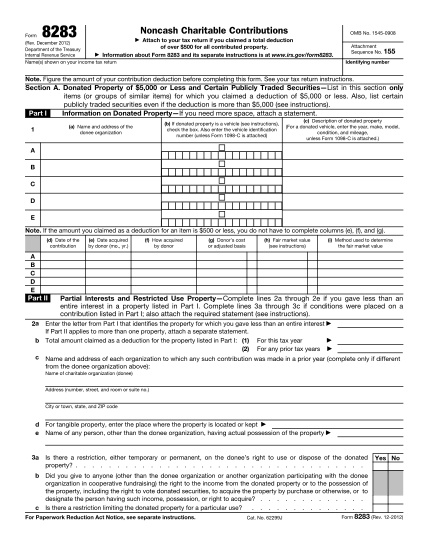
IRS Form 8283, Noncash Charitable Contributions, is required when a taxpayer claims a deduction for donated property exceeding $500, and it becomes significantly more detailed when the value of donated non-cash property exceeds $5,000.
For contributions over $5,000 (other than certain publicly traded securities), the IRS generally requires a Qualified Appraisal prepared by a qualified appraiser. In these cases, the donor must complete Section B of Form 8283, and the appraiser must complete and sign Part IV (Appraiser Declaration) to confirm the appraisal meets IRS standards.
AppraiseItNow Performs 8283 Appraisals
AppraiseItNow is an expert in preparing qualified appraisals for filing of IRS Form 8283. We work with donors and their advisors to establish defensible fair market value in accordance with USPAP and IRS requirements, including support for Form 8283, Section B reporting and the appraiser declaration in Part IV.
Our credentialed appraisers provide valuation support across major asset categories, including:
- Personal Property Appraisals
- Fine Art Appraisals
- Machinery & Equipment Appraisals
- Business Valuations
- Inventory Appraisals
- Bullion & Precious Metal Appraisals
- Vehicle Appraisals
- Cryptocurrency Appraisals
Whether the asset is readily marketable or complex and illiquid, we provide independent, well-supported fair market value opinions designed to withstand scrutiny and support proper charitable reporting.
5-Star Valuation Services, Loved by Hundreds
AppraiseItNow offers online appraisals and onsite appraisals in all 50 states including New York, California, Texas, and Florida.



What is a charitable donation appraisal?
A charitable donation appraisal is a qualified appraisal that determines the fair market value of non-cash property donated to a charity. The IRS requires it to substantiate deductions above certain thresholds, and it must be USPAP-compliant and prepared by a qualified appraiser for use with Form 8283.
When is a charitable donation appraisal required?
The IRS requires a qualified appraisal when a non-cash contribution exceeds $5,000 per item or group of similar items. Additional thresholds apply: non-publicly traded securities over $10,000, artwork over $20,000 requiring full appraisal attachment, and total donated property over $500,000 also requiring attachment. Form 8283 Section A applies for deductions between $500 and $5,000.
What types of assets need a charitable donation appraisal?
- Personal property: jewelry, antiques, furniture, coins, collectibles, and household goods
- Equipment and machinery: medical equipment, restaurant equipment, manufacturing machinery, and technology assets
- Artwork: paintings, prints, sculpture, photography, and mixed media
- Business interests: LLCs, S-corps, partnerships, fractional interests, and privately held stock
- Boats: sailboats, powerboats, yachts, jet skis, and personal watercraft
- Automobiles: cars, trucks, motorcycles, RVs, trailers, and classic vehicles
- Inventory: retail inventory, wholesale stock, raw materials, and finished goods
Who qualifies as an appraiser for charitable donation purposes?
A qualified appraiser must hold recognized professional designations, have verifiable experience with the specific property type, and have no financial conflict with the donor or donee. They cannot have appraised property for the donor or donee within the prior three years, cannot receive compensation tied to the appraised value, and must sign Form 8283 Part IV.
Are AppraiseItNow's charitable donation appraisals USPAP-compliant?
Yes. All AppraiseItNow appraisals are prepared in accordance with USPAP standards, which is a core IRS requirement for a qualified appraisal used to substantiate non-cash charitable deductions.
What information do you need to get started?
- Donor and donee names and the donation date
- Deed of gift or transfer documentation
- How and when the asset was acquired
- Provenance, condition reports, and sales history if available
- High-resolution photographs of the asset
- For vehicles and boats, mileage and condition documentation
- Any relevant deadlines for filing
How long does a charitable donation appraisal take?
Turnaround varies by asset type:
- Personal property: 7 to 10 days for remote appraisals; 2 to 3 weeks for onsite or larger collections; rush same-day or next-day service available
- Equipment and machinery: 7 to 10 days for remote appraisals; 2 to 3 weeks for onsite or larger collections; rush service available
- Artwork: 5 to 7 days for simple projects; 2 to 3 weeks for advanced assignments or large collections
- Automobiles: 3 to 5 days depending on complexity
- Boats: 3 to 5 days for standard appraisals; marine surveys typically take 3 to 5 weeks
- Business interests: 2 to 4 weeks; rush 7 to 10 day turnaround available
- Inventory: 2 to 4 weeks depending on size and complexity; rush service available
How much does a charitable donation appraisal cost?
Fees depend on asset type, scope, and complexity, visit our pricing page for a full breakdown of what to expect for your specific asset.
Can you appraise assets located anywhere in the US?
Yes. AppraiseItNow provides remote and onsite appraisals across the United States. Most asset types can be appraised remotely using photos and documentation, and onsite inspections can be arranged where needed.
Will my appraisal be accepted by the IRS?
AppraiseItNow appraisals are prepared to meet IRS qualified appraisal standards, including proper valuation date, documented methodology, appraiser credentials, and a non-contingent fee declaration. While no firm can guarantee acceptance in every case, following these standards significantly reduces the risk of challenge, disallowance, or penalty.
Do you buy, sell, or broker assets?
No. AppraiseItNow provides independent appraisals only. We have no financial interest in any transaction, which is a requirement for IRS-qualified appraisals and ensures our valuations remain objective.
How does the IRS treat similar items donated across multiple charities?
The IRS aggregates the value of similar items, such as all jewelry or all paintings, donated to different charities within the same tax year. If the combined value of a group of similar items exceeds $5,000, a qualified appraisal is required for the entire group, even if no single donation crossed the threshold on its own.
When must the appraisal be dated relative to the donation?
The qualified appraisal must be dated no earlier than 60 days before the donation date and no later than the due date of your tax return, including extensions. The fair market value must be determined as of the exact date of contribution.
How does Form 1098-C affect vehicle donation deductions?
When a donated vehicle is sold by the charity without significant use or improvement, the charity issues Form 1098-C reporting the sales proceeds, and your deduction is typically limited to that amount rather than the appraised fair market value. A qualified appraisal may still be useful for documentation, but the Form 1098-C often controls the deductible amount for vehicles over $500.
Do I need to attach the full appraisal to my tax return?
In most cases, no. You attach the Form 8283 appraisal summary, Section B for donations over $5,000, signed by both the appraiser and the donee. The full appraisal must be attached only when donating art valued over $20,000 or when total donated property exceeds $500,000, excluding inventory, publicly traded stock, and intellectual property.
What happens if my appraisal is dated more than 60 days before the donation?
The IRS will reject it as untimely, even if the appraisal is otherwise complete and accurate. The 60-day pre-donation window is a strict requirement, and an appraisal falling outside the allowable period cannot be used to substantiate the deduction.
What is the IRS Statement of Value, and do I need one?
For artwork valued over $50,000, donors may request an IRS Statement of Value as an alternative form of substantiation, which involves submitting a qualified appraisal, Form 8283 Section B, and a user fee to the IRS before filing. A qualified appraisal is still required as part of that process, and the IRS Art Advisory Panel reviews high-value art donations during audits. This option can provide additional protection but is not a replacement for obtaining a proper appraisal upfront.
APPRAISEITNOW APPRAISERS ARE BEST-IN-CLASS & CREDENTIALED BY LEADING APPRAISAL ORGANIZATIONS LIKE THE ISA, ASA, & MORE.




