
Charitable Donation appraisals in Nevada for personal property, equipment and machinery, fine art, business interests, boats and watercraft, automobiles and vehicles, and inventory. AppraiseItNow provides credentialed, USPAP-compliant Charitable Donation appraisals online and onsite across Nevada, including Las Vegas, Reno, and Henderson.
.png)





Credentialed, best-in-class appraisers across assets
.avif)
Joe Kattan

Anne Hay, ISA AM

Jason Dolph, CAGA

Ashley Innes, ISA AM

Justin Ramirez, ASA, ABV, CFA

Marnie Erkelens, CAGA

Raymond Ghelardi, ASA

Aron Blue
Frequently Asked
Questions
No Frequently Asked Questions Found.
About Charitable Donation Appraisals in Nevada
AppraiseItNow provides qualified charitable donation appraisals for Nevada donors contributing non-cash assets valued over $5,000, the IRS threshold requiring a qualified appraisal and a completed IRS Form 8283 for tax deduction purposes. Nevada's economy, shaped by gaming, hospitality, and high-net-worth individuals in Las Vegas and Reno, generates frequent donations of art, collectibles, business interests, and equipment that trigger these federal requirements. Our appraisals are USPAP-compliant and prepared to withstand IRS scrutiny. Our mission is to deliver defensible, USPAP-compliant valuations with exceptional speed, professionalism, and client service.
AppraiseItNow serves Nevada donors through both convenient online appraisals and onsite visits anywhere in the state. Our appraisal services in Nevada cover every major asset class, ensuring donors have the documentation they need before their tax filing deadline.
What Does AppraiseItNow Appraise for Charitable Donation in Nevada?
AppraiseItNow covers the full range of non-cash assets commonly donated by Nevada residents and organizations, including:
- Personal Property, including jewelry, antiques, furniture, coins, collectibles, and household goods
- Equipment & Machinery, including medical equipment, restaurant equipment, manufacturing machinery, and technology assets
- Fine Art, including paintings, prints, sculpture, photography, and mixed media
- Business Interests, including LLCs, S-corps, partnerships, fractional interests, and privately held stock
- Boats & Watercraft, including sailboats, powerboats, yachts, jet skis, and personal watercraft
- Automobiles & Vehicles, including cars, trucks, motorcycles, RVs, trailers, and classic vehicles
- Inventory, including retail inventory, wholesale stock, raw materials, and finished goods
Who Does AppraiseItNow Serve in Nevada for Charitable Donation?
AppraiseItNow serves individual donors, high-net-worth households, business owners, and nonprofit advisors across Nevada who need qualified appraisals to substantiate non-cash charitable contributions for federal tax purposes. This includes donors in the gaming, hospitality, and entertainment industries who frequently contribute valuable assets to Nevada-based charitable organizations.
IRS Form 8283 Appraisals Required for Large Non-Cash Charitable Donations
Comprehensive qualified appraisals determining fair market value for non-cash donations exceeding $5,000, developed under USPAP standards and aligned with IRS Form 8283, Section B requirements.
What is IRS Form 8283?
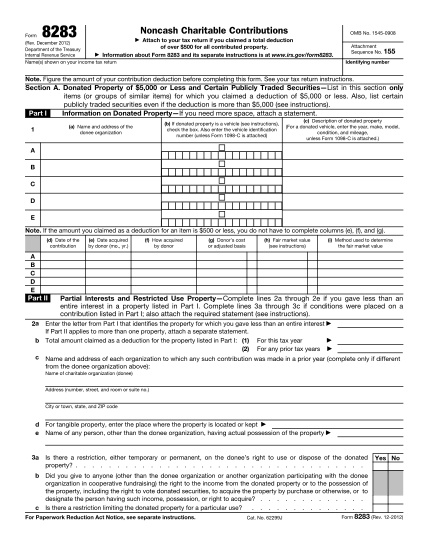
IRS Form 8283, Noncash Charitable Contributions, is required when a taxpayer claims a deduction for donated property exceeding $500, and it becomes significantly more detailed when the value of donated non-cash property exceeds $5,000.
For contributions over $5,000 (other than certain publicly traded securities), the IRS generally requires a Qualified Appraisal prepared by a qualified appraiser. In these cases, the donor must complete Section B of Form 8283, and the appraiser must complete and sign Part IV (Appraiser Declaration) to confirm the appraisal meets IRS standards.
AppraiseItNow Performs 8283 Appraisals
AppraiseItNow is an expert in preparing qualified appraisals for filing of IRS Form 8283. We work with donors and their advisors to establish defensible fair market value in accordance with USPAP and IRS requirements, including support for Form 8283, Section B reporting and the appraiser declaration in Part IV.
Our credentialed appraisers provide valuation support across major asset categories, including:
- Personal Property Appraisals
- Fine Art Appraisals
- Machinery & Equipment Appraisals
- Business Valuations
- Inventory Appraisals
- Bullion & Precious Metal Appraisals
- Vehicle Appraisals
- Cryptocurrency Appraisals
Whether the asset is readily marketable or complex and illiquid, we provide independent, well-supported fair market value opinions designed to withstand scrutiny and support proper charitable reporting.
5-Star Valuation Services, Loved by Hundreds
Can AppraiseItNow handle charitable donation appraisals in Nevada?
Yes, AppraiseItNow provides qualified appraisals for charitable donation purposes throughout Nevada, whether you are donating assets in Las Vegas, Reno, or anywhere else in the state. Our appraisers meet IRS standards and can support your deduction documentation from start to finish.
What kinds of assets can be appraised for a charitable donation?
We appraise a wide range of noncash assets for charitable donation purposes, including artwork, collectibles, jewelry, vehicles, business interests, cryptocurrency, equipment, and inventory. If you are unsure whether your asset qualifies, contact us and we can point you in the right direction.
Are your charitable donation appraisals USPAP compliant?
All of our appraisals follow the Uniform Standards of Professional Appraisal Practice, which is a requirement for IRS-qualified appraisals. This ensures your report meets the standards needed to support a noncash charitable deduction.
Why would a Nevada donor need a qualified appraisal for a charitable gift?
Nevada's economy generates a unique mix of donatable assets, from casino memorabilia and gaming equipment to high-value art and business interests tied to the hospitality industry. Any noncash donation exceeding $5,000 requires a qualified appraisal under IRS rules, and having a properly documented report protects your deduction if the IRS reviews your return.
Can I get a charitable donation appraisal done remotely if I am in Nevada?
Yes, many of our appraisals can be completed remotely using photographs, documentation, and digital records you submit online. For certain asset types, an in-person inspection may be recommended, but our team will let you know what is needed for your specific situation.
How much does a charitable donation appraisal cost in Nevada?
Fees depend on the asset type and scope of the assignment. Visit our pricing page for ranges or contact us.
How long does it take to receive a completed charitable donation appraisal?
Turnaround times vary by asset type:
- Vehicles: 3 to 5 days
- Personal property and equipment: 7 to 10 days
- Artwork: 5 to 7 days for simple projects, 2 to 3 weeks for complex assignments
- Business valuations: 2 to 4 weeks
- Inventory: 2 to 4 weeks
Who actually prepares the appraisal report?
Your report is prepared by a qualified appraiser who meets the IRS definition under Regulations section 1.170A-17, including verified education, professional appraisal training, and no prohibited financial interest in the donated property. We do not use automated tools or unqualified reviewers to produce your report.
Are there any Nevada-specific rules I need to know about for charitable donation appraisals?
Nevada does not have state-level appraisal requirements for charitable donations, so federal IRS rules apply uniformly to Nevada donors. Nevada law under NRS Chapter 82A addresses charity registration and solicitation, not donor appraisals, so your focus should be entirely on meeting IRS Publication 561 and IRS Form 8283 requirements.
What information do I need to provide to get started?
To begin, it helps to have a description of the asset, any purchase records or prior appraisals, the name of the receiving charity, and the anticipated or actual donation date. The more detail you can share upfront, the faster we can scope the assignment and get your appraisal underway.
Will my appraisal be accepted by the IRS for a Nevada-based charitable deduction?
Our appraisals are prepared to meet IRS qualified appraisal standards, including proper appraiser credentials, correct timing relative to the donation date, and the documentation required for IRS Form 8283 Section B. While no appraiser can guarantee IRS acceptance, a report that follows all applicable standards gives your deduction the strongest possible foundation.
How do federal IRS rules apply to Nevada donors making noncash charitable gifts?
Because Nevada has no state-specific appraisal rules for charitable donations, IRS Publication 561 and IRS Form 8283 govern the entire process for Nevada donors. A qualified appraisal is required for noncash property deductions over $5,000, and IRS Form 8283 Section B must be signed by both a qualified appraiser and the donee organization before you file.
Does donating cryptocurrency require a qualified appraisal in Nevada?
Yes, cryptocurrency is treated as property under IRS rules, not cash, so donations exceeding $5,000 require a qualified appraisal and IRS Form 8283 Section B, even if the asset originated on a Nevada-based exchange. Exchange price quotes are not sufficient because the IRS requires an independent appraisal that documents comparable sales and market adjustments.
What happens if I donate high-value art or collectibles worth more than $20,000 to a Nevada charity?
For art or collectibles exceeding $20,000, you must attach the full qualified appraisal to IRS Form 8283 and your tax return. Missing the filing deadline for the appraisal can result in a disallowed deduction, IRS scrutiny, or the need to file an amended return with a new appraisal.
How is fair market value determined for Nevada-specific assets like casino memorabilia or gaming equipment?
Assets tied to Nevada's gaming and tourism economy, such as vintage casino chips, signed memorabilia, or decommissioned gaming equipment, often have limited comparable sales data. A qualified appraiser addresses this by researching auction results, dealer markets, and adjusting for condition and rarity, then documenting all findings to support IRS Form 8283 Section B.
What is the correct timing for getting an appraisal done for a 2026 tax return?
For a 2026 tax return filed by April 15, 2027, or later with an extension, your qualified appraisal must be completed no earlier than 60 days before the donation date and no later than the return's due date including extensions. Appraisals cannot be backdated, so planning ahead around your actual donation date is essential.
APPRAISEITNOW APPRAISERS ARE BEST-IN-CLASS & CREDENTIALED BY LEADING APPRAISAL ORGANIZATIONS LIKE THE ISA, ASA, & MORE.




