
Charitable Donation appraisals in New Jersey for personal property, equipment and machinery, fine art, business interests, boats and watercraft, automobiles and vehicles, and inventory. AppraiseItNow provides credentialed, USPAP-compliant Charitable Donation appraisals online and onsite across New Jersey, including Newark, Jersey City, and Trenton.
.png)






Credentialed, best-in-class appraisers across assets
.avif)
Joe Kattan

Anne Hay, ISA AM

Jason Dolph, CAGA

Ashley Innes, ISA AM

Justin Ramirez, ASA, ABV, CFA

Marnie Erkelens, CAGA

Raymond Ghelardi, ASA

Aron Blue
Frequently Asked
Questions
No Frequently Asked Questions Found.
About Charitable Donation Appraisals in New Jersey
AppraiseItNow provides qualified charitable donation appraisals for New Jersey donors contributing non-cash assets valued above the IRS threshold of $5,000, where a qualified appraisal and completed IRS Form 8283 are required to substantiate the deduction. Donations of art valued at $20,000 or more require the full appraisal to be attached to the return, and all appraisals must be completed no earlier than 60 days before the donation date. Our mission is to deliver defensible, USPAP-compliant valuations with exceptional speed, professionalism, and client service.
AppraiseItNow serves clients throughout the Garden State with both remote and onsite appraisal options, making it easy to get a compliant valuation regardless of your location. Learn more about our appraisal services in New Jersey and how we can support your next charitable contribution.
What Does AppraiseItNow Appraise for Charitable Donation in New Jersey?
AppraiseItNow covers a wide range of asset types commonly donated by New Jersey individuals and organizations, including:
- Personal Property, including jewelry, antiques, furniture, coins, collectibles, and household goods
- Equipment & Machinery, including medical equipment, restaurant equipment, manufacturing machinery, and technology assets
- Fine Art, including paintings, prints, sculpture, photography, and mixed media
- Business Interests, including LLCs, S-corps, partnerships, fractional interests, and privately held stock
- Boats & Watercraft, including sailboats, powerboats, yachts, jet skis, and personal watercraft
- Automobiles & Vehicles, including cars, trucks, motorcycles, RVs, trailers, and classic vehicles
- Inventory, including retail inventory, wholesale stock, raw materials, and finished goods
Who Does AppraiseItNow Serve in New Jersey for Charitable Donation?
AppraiseItNow works with individual donors, business owners, estates, and nonprofit advisors across New Jersey who need IRS-compliant appraisals to support charitable deductions for non-cash contributions of all types.
IRS Form 8283 Appraisals Required for Large Non-Cash Charitable Donations
Comprehensive qualified appraisals determining fair market value for non-cash donations exceeding $5,000, developed under USPAP standards and aligned with IRS Form 8283, Section B requirements.
What is IRS Form 8283?
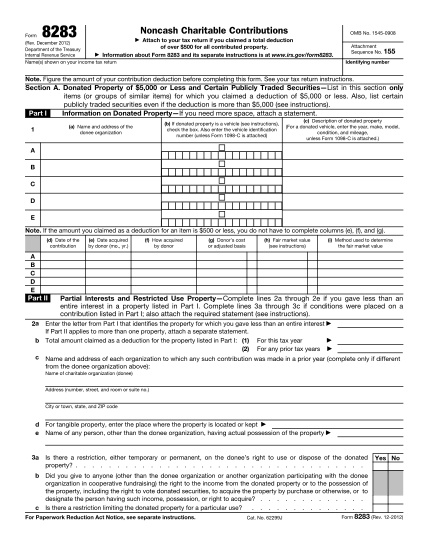
IRS Form 8283, Noncash Charitable Contributions, is required when a taxpayer claims a deduction for donated property exceeding $500, and it becomes significantly more detailed when the value of donated non-cash property exceeds $5,000.
For contributions over $5,000 (other than certain publicly traded securities), the IRS generally requires a Qualified Appraisal prepared by a qualified appraiser. In these cases, the donor must complete Section B of Form 8283, and the appraiser must complete and sign Part IV (Appraiser Declaration) to confirm the appraisal meets IRS standards.
AppraiseItNow Performs 8283 Appraisals
AppraiseItNow is an expert in preparing qualified appraisals for filing of IRS Form 8283. We work with donors and their advisors to establish defensible fair market value in accordance with USPAP and IRS requirements, including support for Form 8283, Section B reporting and the appraiser declaration in Part IV.
Our credentialed appraisers provide valuation support across major asset categories, including:
- Personal Property Appraisals
- Fine Art Appraisals
- Machinery & Equipment Appraisals
- Business Valuations
- Inventory Appraisals
- Bullion & Precious Metal Appraisals
- Vehicle Appraisals
- Cryptocurrency Appraisals
Whether the asset is readily marketable or complex and illiquid, we provide independent, well-supported fair market value opinions designed to withstand scrutiny and support proper charitable reporting.
5-Star Valuation Services, Loved by Hundreds
Does AppraiseItNow handle charitable donation appraisals in New Jersey?
Yes, AppraiseItNow provides qualified appraisals for charitable donations throughout New Jersey. Our appraisers meet IRS standards and can support your deduction documentation whether you are donating locally or to a national organization.
What kinds of assets can be appraised for a charitable donation in New Jersey?
We appraise a wide range of non-cash assets for charitable donation purposes, including artwork, antiques, collectibles, jewelry, vehicles, business equipment, and inventory. Each appraisal is tailored to the specific asset type and IRS documentation requirements.
Are your charitable donation appraisals USPAP compliant?
Yes, all of our appraisals follow the Uniform Standards of Professional Appraisal Practice, which is a core requirement for IRS-qualified appraisals. Our appraisers maintain independence from the transaction and adhere to USPAP guidelines throughout the valuation process.
Why would someone in New Jersey specifically need a charitable donation appraisal?
New Jersey has a high concentration of museums, universities, and nonprofit organizations that regularly receive significant non-cash gifts, from fine art to business equipment. Donors giving property valued above $5,000 must have a qualified appraisal to support their federal deduction, and New Jersey's conformity to federal itemized deduction rules means the same standards apply at the state level.
Can I get a charitable donation appraisal in New Jersey without an in-person visit?
Yes, many of our charitable donation appraisals can be completed remotely using photographs, documentation, and supporting records you provide. For certain asset types, an in-person inspection may be recommended, but we work to accommodate clients across New Jersey with flexible options.
How is pricing determined for a charitable donation appraisal?
Fees depend on the asset type and scope of the assignment. Visit our pricing page for ranges or contact us directly.
How long does a charitable donation appraisal typically take?
Turnaround times vary by asset type:
- Vehicles: 3 to 5 days
- Personal property and equipment: 7 to 10 days
- Artwork: 5 to 7 days for simple projects, 2 to 3 weeks for complex assignments
- Business valuations: 2 to 4 weeks
- Inventory: 2 to 4 weeks
Who actually prepares the appraisal report?
Your report is prepared by a credentialed appraiser with verified education and experience in valuing the specific type of property being donated. All of our appraisers meet IRS qualified appraiser standards and remain independent from the donation transaction.
Are there any New Jersey-specific rules I should know about for charitable donation appraisals?
New Jersey conforms to federal IRS rules for charitable donation appraisals without imposing additional state-specific requirements. This means the same IRS standards for qualified appraisals, timing, and IRS Form 8283 documentation apply to both your federal and New Jersey state returns.
What information do I need to provide to get started?
To begin, it helps to have a description of the donated item, any purchase records or prior appraisals, the name of the receiving charity, and the anticipated or actual donation date. The more detail you can share upfront, the faster we can scope the assignment and get started.
Will the appraisal be accepted by the IRS for my New Jersey tax filing?
Our appraisals are prepared to meet IRS requirements for qualified appraisals, making them suitable for supporting deductions on both your federal return and your New Jersey state return. We follow all procedural standards so your documentation holds up to IRS review.
Do I need separate appraisals if I donate similar items to multiple New Jersey charities on different dates?
No, a single qualified appraisal can cover the aggregate value of similar items donated across multiple New Jersey charities when the total exceeds $5,000, and it can be attached to IRS Form 8283 accordingly. Keep in mind that each donation over $250 still requires a separate written acknowledgment from the individual charity.
What is the difference between a qualified appraisal and the appraisal summary on IRS Form 8283?
A qualified appraisal is the full detailed report prepared by a credentialed appraiser, while the appraisal summary is Section B of IRS Form 8283, a condensed version signed by both the appraiser and the donee. For most New Jersey charitable donations, you attach the IRS Form 8283 summary to your tax return rather than the full report, though exceptions apply for high-value items.
I donated artwork worth $25,000 to a New Jersey museum. Do I need to submit the full appraisal report?
Yes, because the value exceeds the $20,000 threshold for art and collectibles, you are required to attach the full qualified appraisal report to IRS Form 8283 when filing your federal return. The appraisal summary alone is not sufficient in this case, and New Jersey follows these same federal requirements.
When does the appraisal need to be completed relative to my donation date?
The qualified appraisal must be completed no earlier than 60 days before the donation date and no later than the due date of your tax return, including any extensions. New Jersey follows federal IRS timing rules, so there are no separate state deadlines for most non-cash charitable gifts.
What happens if I skip the appraisal requirement for a donation over $5,000 in New Jersey?
Failing to obtain a qualified appraisal can result in the IRS denying your entire deduction, even if the value you claimed was accurate. Courts have consistently upheld this outcome, so procedural compliance is just as important as getting the valuation right.
Are any types of donations exempt from the qualified appraisal requirement in New Jersey?
Yes, certain assets are exempt from the $5,000 appraisal threshold, including publicly traded securities valued using quoted market prices and vehicles where the charity's sale price or standard tables are used instead. New Jersey conforms to these federal IRS exemptions without any state-level overrides.
APPRAISEITNOW APPRAISERS ARE BEST-IN-CLASS & CREDENTIALED BY LEADING APPRAISAL ORGANIZATIONS LIKE THE ISA, ASA, & MORE.




