









<h1>How to Get Your Saint Louis Crystal Chandelier Appraised</h1>
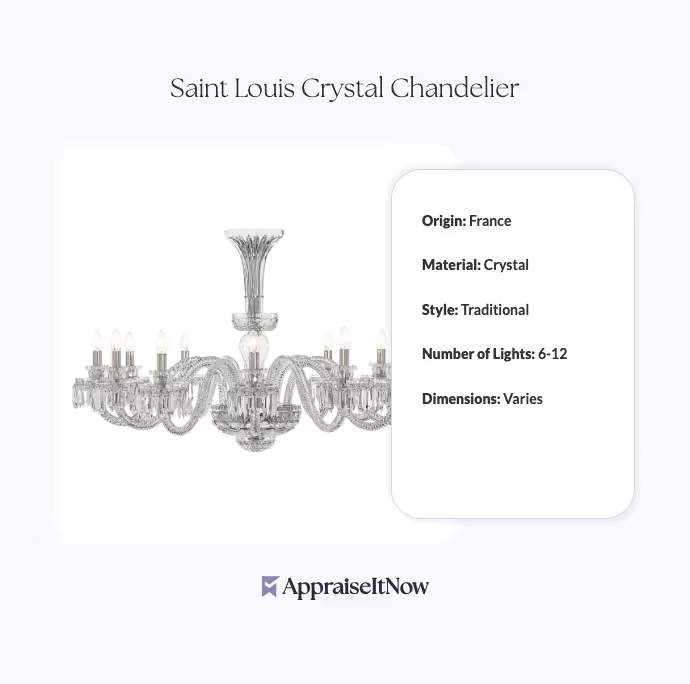
<p>The <strong>Saint Louis Crystal Chandelier</strong> represents a significant investment in both aesthetic beauty and collectible value. With estimated values ranging from <strong>$10,000 to $15,000</strong>, understanding the appraisal process ensures you receive fair market valuations whether you're buying, selling, or protecting your fixture through insurance.</p>
<h2>Understanding Saint Louis Crystal Chandeliers and Their Value</h2>
<p>Your Saint Louis Crystal Chandelier isn't just a lighting fixture—it's a piece of French craftsmanship dating back to the <strong>18th century</strong>. Saint-Louis, one of the world's most renowned glassmakers, built its reputation on exceptional materials and meticulous artisanal techniques. The <strong>intricate crystal prisms</strong> that characterize these fixtures refract light in ways that modern reproductions simply cannot replicate, creating a timeless elegance that collectors and interior designers actively pursue.</p>
<p>The value you're looking at stems from multiple factors working together. The rarity of vintage Saint Louis pieces combined with their proven demand in the decorator market means your chandelier holds tangible financial significance. Because these fixtures were produced in limited quantities with specialized craftsmanship, the market treats them as both functional art and collectible assets.</p>
<div class="callout tip"><p><strong>Market Insight</strong></p>
<p>Saint Louis chandeliers remain in steady demand despite design trends shifting toward minimalism, suggesting strong long-term value retention for well-preserved examples.</p></div>
<h2>How Authenticity Determines Your Chandelier's Worth</h2>
<p>Before any appraisal can establish value, determining whether your chandelier is genuine Saint Louis crystal versus quality glass is essential. This distinction alone can shift your valuation by thousands of dollars, making authentication the critical first step.</p>
<h3>Identifying Real Crystal vs. Glass</h3>
<p>Real crystal exhibits specific physical characteristics that distinguish it from standard glass. Saint Louis crystal contains lead oxide, which creates greater density and weight compared to ordinary glass. When you examine your fixture, genuine crystal shows a distinctive clarity and brilliance that catches light differently. The edges of authentic crystal pieces typically refract light into small rainbows, a phenomenon that mass-produced glass cannot replicate convincingly.</p>
<p>A simple weight test helps initial assessment—crystal is noticeably heavier than glass of equivalent size. Saint Louis pieces also produce a distinctive ringing tone when gently tapped, though this requires careful handling to avoid damage. Professional appraisers use more precise methods including specific gravity measurement and ultraviolet light examination to confirm authenticity beyond doubt.</p>
<div class="callout note"><p><strong>Authentication Consideration</strong></p>
<p>Documentation from the original retailer, manufacturer marks, or previous appraisals significantly strengthen your chandelier's value by establishing clear provenance.</p></div>
<h2>What Physical Marks Indicate Authenticity</h2>
<p>Your Saint Louis chandelier should display specific identifying marks that professional appraisers examine closely. The manufacturer typically inscribed identifying marks on the metal framework or crystal components, though these markings vary by production period. Early pieces may show "Saint Louis" etched into the crystal or stamped into the brass hardware, while later examples sometimes display only foundry marks.</p>
<p>The construction quality itself tells an authentication story. Saint Louis used hand-cut crystal prisms with precise tolerances that create visible geometric perfection when light passes through. Machine-cut reproductions show slight irregularities in these geometric patterns, which trained eyes detect immediately. The mounting hardware should also display period-appropriate craftsmanship—genuine pieces feature solid brass or bronze with hand-finished details rather than uniform machine-stamped components.</p>
<h2>The Role of Provenance and Age in Your Chandelier's Value</h2>
<p>Age significantly impacts Saint Louis chandelier valuations, but provenance—the documented ownership history—carries equal or greater importance. A chandelier from the <strong>1850s</strong> with clear documentation proving its pedigree commands premium pricing over an undocumented example from the 1920s, because collectors value certainty about historical significance and authenticity.</p>
<p>When professional appraisers evaluate your fixture, they examine the crystal prism design and brass framework style to narrow the production period. Saint Louis continuously refined its designs, and specific stylistic elements reflect particular decades. An <strong>18th or early 19th-century example</strong> represents the apex of rarity and value, while later Victorian or Art Deco-era pieces still command substantial prices within the collectible market.</p>
<p>The original purchase location and family history matter as well. A chandelier that hung in a notable French palace or belonged to a documented collector carries narrative value that extends beyond mere technical specifications. This is why you should compile any historical documentation, photographs, or correspondence related to your fixture's acquisition.</p>
<div class="callout tip"><p><strong>Provenance Strategy</strong></p>
<p>Gather auction catalogs, insurance documents, family letters, or any evidence showing your chandelier's ownership chain—these materials can increase appraised value by 15-25%.</p></div>
<h2>Key Factors Influencing Market Price</h2>
<p>Understanding what impacts Saint Louis chandelier valuations helps you prepare for professional appraisal. Condition stands as perhaps the most visible factor—a fully intact fixture with all original crystal prisms in pristine condition commands significantly higher prices than examples with missing or replaced components.</p>
<p><strong>Condition assessment includes:</strong></p>
<p>Your chandelier's condition dramatically affects its market positioning. Original crystal prisms in perfect clarity command premium pricing, while clouding, chips, or cracks proportionally reduce value. The brass or bronze framework should display appropriate patina without corrosion or structural damage. Missing prisms or replaced components—even with period-appropriate substitutes—lower valuations because collectors prioritize originality and authenticity.</p>
<p>The <strong>rarity of specific designs</strong> influences pricing considerably. Limited-production patterns or unusual chandelier sizes fetch premium prices, while common Victorian designs still sell well but at more moderate valuations. Chandeliers featuring innovative design elements or unusual crystal configurations command collector enthusiasm and higher market prices.</p>
<p>Restorations and repairs present nuanced valuation challenges. While professional restoration can enhance a chandelier's visual appeal and functionality, the process itself may reduce its value to purists seeking completely original examples. A chandelier with visible signs of careful professional restoration might appraise at 70-80% of an all-original equivalent, depending on restoration quality and historical documentation.</p>
<h2>Why Demand Remains Strong for Saint Louis Pieces</h2>
<p>Contemporary interior designers actively seek Saint Louis chandeliers for high-end residential and commercial projects, creating steady collector and professional demand. The fixtures work effectively in both traditional and eclectic modern settings, and their proven luminescence quality outperforms most contemporary crystal lighting fixtures.</p>
<p>Museums and institutional buyers also maintain active interest in documented Saint Louis pieces, particularly examples with exceptional provenance or unique design characteristics. This professional demand supports market values and suggests your chandelier represents a relatively stable collectible asset. The fixture's functional utility—it still works as an elegant light source—distinguishes it from purely decorative collectibles and supports broader market appeal.</p>
<h2>Preparing Your Chandelier for Professional Appraisal</h2>
<p>When you decide to seek professional appraisal services, proper preparation maximizes accuracy and ensures appraisers can properly evaluate your fixture. Begin by documenting your chandelier thoroughly through <strong>high-quality photography</strong> from multiple angles, capturing detail shots of identifying marks, crystal prism patterns, and framework construction. Professional photographs showing the fixture illuminated help appraisers assess light refraction and clarity.</p>
<p>Compile any documentation you possess—previous appraisals, insurance records, purchase receipts, family provenance information, or auction catalog references. Even informal documentation like family photographs showing the fixture in historical settings provides valuable context for professional appraisers evaluating authenticity and period placement.</p>
<p>Avoid cleaning your chandelier before appraisal using harsh methods that might disturb original patina or existing structural integrity. Light dusting is acceptable, but professional appraisers prefer evaluating fixtures in their current state, which better reveals restoration history and original material condition. If your chandelier has been previously restored, gather documentation about those restoration efforts, including who performed the work and what materials or components were involved.</p>
<div class="callout note"><p><strong>Documentation Tip</strong></p>
<p>Photograph any maker marks, signatures, or identifying stamps clearly—these images help online appraisers conduct preliminary research before scheduling detailed evaluations.</p></div>
<h2>What Appraisers Look For During Evaluation</h2>
<p>When a professional appraiser examines your Saint Louis chandelier, they conduct a systematic evaluation assessing multiple value components. They begin with authentication, confirming the fixture is genuine Saint Louis crystal through material testing and stylistic analysis. This foundational step determines whether subsequent valuation proceeds or requires discussion of reproductions versus genuine articles.</p>
<p>Next, appraisers examine <strong>crystal quality and clarity</strong>, looking for cloudiness, cracks, or internal inclusions that indicate age-related deterioration or previous damage. They assess prism geometry and count original versus replaced components, noting whether replacements used period-appropriate materials or modern substitutes. The framework receives similar scrutiny—appraisers evaluate construction method, hardware integrity, and any evidence of previous restoration or structural repair.</p>
<p>Appraisers also research <strong>comparable sales</strong> to establish current market positioning. They examine auction results from major houses handling French crystal lighting, private sale documentation when available, and pricing from specialist dealers. This market research grounds valuations in documented transactions rather than theoretical estimates, providing the accuracy you need for insurance or sale purposes.</p>
<p>Professional appraisers document their findings thoroughly, providing you with detailed reports explaining their valuation methodology. This documentation proves essential for insurance coverage, tax purposes, or when you decide to sell your chandelier. The appraisal report becomes your chandelier's financial biography, explaining what makes it valuable and how its worth compares to other market examples.</p>
<h2>Documentation and Evidence for Accurate Online Appraisals</h2>
<p>If you're using online appraisal services like <strong>AppraiseItNow</strong>, gathering the right documentation before submission accelerates the process and improves accuracy. High-resolution photographs from multiple angles provide appraisers the visual information needed for preliminary assessment. Close-up images of any identifying marks, signatures, or manufacturing stamps help establish authenticity even before detailed examination.</p>
<p>Written descriptions should be specific and thorough—include dimensions (height, width, number of prisms if countable), material composition details you've observed, condition notes, and any known history or previous appraisals. If your chandelier functions, mentioning its electrical status and any modifications from original condition matters for valuation purposes. Describe the crystal color (clear, amber-tinted, or colored glass) and frame material (brass, bronze, iron) with as much precision as possible.</p>
<p>For <strong>online appraisals</strong>, provide context about your chandelier's location and environment. Appraisers specializing in decorative arts and antiques understand regional market variations and can factor your location's collector density and decorator demand into their valuations. If you've previously had the fixture professionally cleaned or restored, that historical information strengthens the appraisal report's credibility.</p>
<h2>Professional Appraisal Standards and Costs</h2>
<p>Professional appraisals for Saint Louis chandeliers follow <strong>USPAP (Uniform Standards of Professional Appraisal Practice)</strong>, the gold standard for valuation accuracy and legal compliance. USPAP-compliant appraisals are accepted by insurance companies, courts, and financial institutions, providing documentation suitable for virtually any purpose you might need—sale documentation, insurance coverage, estate planning, or tax purposes.</p>
<p>The cost of professional appraisals varies based on complexity and evaluation method. Online appraisal services typically offer faster turnaround times at lower costs than in-person inspections, making them ideal when you need preliminary valuations or have a chandelier in excellent documented condition. In-person appraisals conducted by certified professionals command higher fees but provide hands-on authentication and detailed physical assessment that online methods cannot replicate.</p>
<p>AppraiseItNow connects you with certified appraisers credentialed by recognized organizations—<strong>AAA, ISA, ASA, CAGA, and AMEA</strong>—ensuring you receive evaluations from qualified experts. These appraisers understand the nuances of European decorative arts and can properly contextualize your Saint Louis chandelier within contemporary <a href="/types/antique-furniture">antique furniture</a> and <a href="/types/household-goods">fine household goods</a> markets.</p>
<div class="callout tip"><p><strong>Cost Consideration</strong></p>
<p>Investing in USPAP-compliant appraisal documentation now protects your interests should you sell later or need insurance coverage adjustment—the modest appraisal cost returns value many times over.</p></div>
<h2>When and Why to Get Your Chandelier Appraised</h2>
<p>You should obtain professional appraisal in several specific situations. If you're <strong>selling your chandelier</strong>, accurate market valuation ensures you don't accidentally underprice this significant asset. If you're <strong>purchasing</strong> a Saint Louis fixture, professional appraisal confirms authenticity and helps you negotiate fair pricing based on current market conditions. Insurance purposes represent another critical reason—your homeowner's policy may not adequately cover a fixture worth $10,000-$15,000 without separate documentation and specialized coverage.</p>
<p>Estate planning and asset division scenarios frequently require professional appraisals to establish clear valuations for distribution among heirs or to calculate estate tax obligations. If your chandelier has been stored long-term or underwent previous restoration, updated appraisals reflect current condition and market values, which change over time. The appraisal becomes your documented proof of value for legal or financial purposes.</p>
<h2>Finding Comparable Sales and Market Values</h2>
<p>When researching Saint Louis chandelier values independently, examining comparable auction results provides concrete market data. Major auction houses like <strong>Christie's, Sotheby's, and Bonhams</strong> regularly handle French crystal chandeliers and publish results online. These documented sales show what similar fixtures actually sold for recently, providing more reliable data than asking prices or theoretical estimates.</p>
<p>Specialized dealers in <a href="/types/antique-artwork">antique artwork</a> and European decorative pieces maintain market knowledge and sometimes publish pricing information. Regional antique markets and trade publications focused on collectible lighting occasionally feature Saint Louis pieces and their realized prices. This research, combined with professional appraisal, grounds your understanding in actual market transactions rather than speculation.</p>
<p>Online marketplaces showing asking prices provide useful context but remember—asking price differs significantly from realized sale price. Your professional appraiser synthesizes available market data into a defensible valuation grounded in USPAP standards and supported by recent comparable transactions.</p>
<h2>Selling Your Saint Louis Chandelier</h2>
<p>When you're ready to sell, understanding your appraisal's role in the sales process matters considerably. A detailed professional appraisal establishes your chandelier's authenticity and condition, supporting your asking price and building buyer confidence. Whether you pursue private sale, consignment through a specialist dealer, or auction house placement, the appraisal documentation becomes your foundation for negotiations.</p>
<p>Interior designers and decorators represent a significant buyer demographic, particularly for chandeliers in excellent condition. These professionals value documented appraisals as they help clients understand quality justifications and authenticate significant purchases. Museums and institutional buyers also respect formal appraisal documentation when evaluating acquisition opportunities.</p>
<p>Private collectors seeking specific Saint Louis designs or production periods form another key market segment. These dedicated enthusiasts often research thoroughly and appreciate detailed appraisal reports explaining provenance, period dating, and value positioning. Your professional appraisal helps serious collectors assess whether your chandelier represents good value within their collecting parameters.</p>
<div class="callout note"><p><strong>Key Takeaway</strong></p>
<p>A certified appraisal of your Saint Louis Crystal Chandelier provides the authentication, valuation documentation, and market positioning you need whether buying, selling, insuring, or simply understanding the true worth of this elegant French treasure.</p></div>