









<h1>How to Get Your Pueblo Pottery by Maria Martinez Appraised</h1>
<p>If you own a piece of Pueblo pottery by Maria Martinez, you're holding one of the most significant examples of Native American artistic achievement in modern times. These iconic black-on-black vessels, valued between <strong>$3,500 and $5,000</strong> for quality pieces, represent far more than decorative objects—they embody generations of cultural mastery, technical innovation, and historical importance. Understanding how to properly appraise your piece ensures accurate valuation for insurance, sale, or collection documentation purposes.</p>
<h2>Understanding Maria Martinez and San Ildefonso Pueblo</h2>
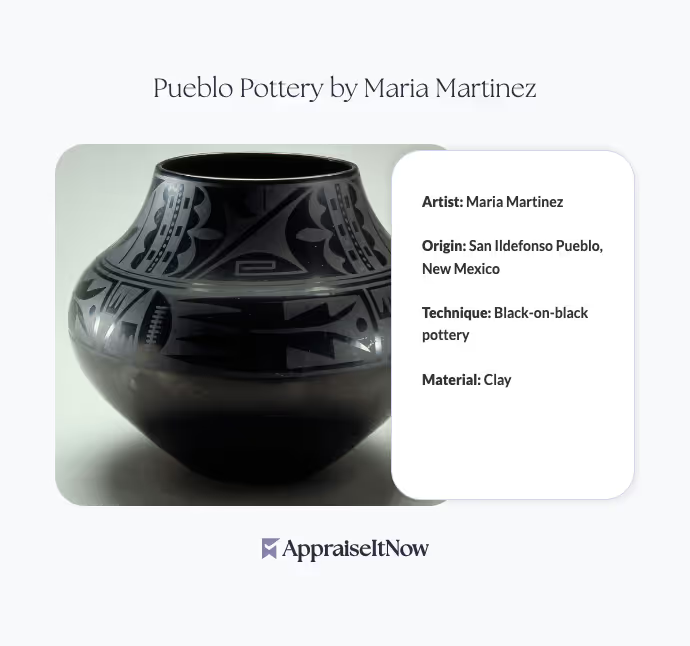
<p>Maria Martinez was a legendary <strong>Tewa potter from San Ildefonso Pueblo in New Mexico</strong>, whose revolutionary approach to traditional pueblo pottery transformed the entire field of Native American ceramics. Beginning in the 1920s, she developed and perfected the signature <strong>black-on-black pottery style</strong> that became synonymous with her name and her pueblo's international reputation. Unlike many potters before her, Martinez achieved unprecedented levels of technical mastery, creating vessels with mirror-smooth surfaces and intricate matte-finish patterns that seemed to float above the polished black ground—a technique that remains extraordinarily difficult to replicate.</p>
<p>The significance of her work extends beyond mere technique. When collectors and institutions ask "Who are the famous Native American potters?", Maria Martinez consistently ranks as the preeminent answer, having inspired countless artists throughout the American Southwest and established San Ildefonso as the global center for pueblo pottery innovation. Her influence shaped contemporary Native American art markets and elevated indigenous artistic traditions to recognized fine art status within mainstream collecting circles.</p>
<div class="callout tip"><p><strong>Historical Context</strong></p>
<p>Maria Martinez's work in the early 20th century occurred during a period of intense cultural suppression, making her achievement in reviving and evolving traditional techniques particularly remarkable and valuable.</p></div>
<h2>What Makes Maria Martinez Pottery Valuable</h2>
<p>Several interconnected factors drive the strong market demand and prices for authentic Maria Martinez pieces. Her pieces were <strong>produced in extremely limited quantities</strong>, with approximately <strong>500 pieces estimated to exist worldwide</strong>—a scarcity that fundamentally shapes market dynamics. Each vessel required months of painstaking handwork, from gathering clay and minerals to firing using traditional pueblo techniques that demanded precise environmental control and intimate material knowledge.</p>
<p>The technical excellence visible in her work distinguishes Maria Martinez pieces from other pueblo potters. Her <strong>intricate patterns and mirror-smooth surfaces</strong> represent a level of craftsmanship that collectors recognize immediately. The black-on-black style itself—achieved through specific firing techniques that create the distinctive matte pattern against the high-gloss black background—requires mastery that most potters never fully develop. When considering questions about pottery value generally, understanding this technical complexity explains why quality examples command premium prices in the broader market of <a href="/blog/appraising-fine-porcelain-and-ceramics-valuing-delicate-artistry">ceramics and fine porcelain appraisals</a>.</p>
<p>Her pieces also carry profound <strong>cultural and historical significance</strong> that transcends typical decorative arts valuation. Maria Martinez's work documented in museum collections, major exhibitions, and scholarly publications represents a crucial moment when Native American artistic traditions achieved formal recognition within mainstream institutional frameworks. This dual significance—combining exceptional technical skill with deep cultural importance—creates value that appeals both to serious collectors and institutions focused on <a href="/blog/evaluating-cultural-heritage-appraisals-of-indigenous-art-and-artifacts">indigenous art and cultural heritage</a>.</p>
<h2>How to Identify Authentic Maria Martinez Pottery</h2>
<p>Proper authentication represents the foundation of accurate appraisal. Maria Martinez signed her pieces with variations that changed over her long career. Early pieces bear simple signatures reading "Maria," while later examples frequently include her husband Julian's name—"Maria & Julian"—acknowledging his crucial role in developing the distinctive firing techniques that made the black-on-black style possible. Some pieces also include pueblo notation or design signatures, adding layers of authentication for experts evaluating <a href="/blog/unveiling-the-world-of-tribal-art-appraising-masks-sculptures-and-textiles">tribal art and ethnographic artifacts</a>.</p>
<p>Authentic pieces display specific technical characteristics that counterfeiters struggle to reproduce consistently. The <strong>smooth, almost glass-like finish</strong> of genuine Maria Martinez work reflects years of hand-polishing with traditional implements. The <strong>matte-finished patterns</strong> show perfect integration with the polished ground—not painted on, but created through differential firing that requires mastery of pueblo kiln conditions impossible to achieve casually. Genuine pieces typically weigh more than imitations, reflecting the density achieved through traditional clay preparation and hand-building techniques.</p>
<p>The overall <strong>form and proportion</strong> of authentic pieces reveal decades of cultural tradition refined through countless generations. Collectors familiar with pueblo pottery immediately recognize the distinctive rim forms, shoulder curves, and overall silhouettes characteristic of San Ildefonso work from the Martinez era. Pieces lacking these subtle but unmistakable formal qualities raise immediate authentication concerns.</p>
<div class="callout note"><p><strong>Authentication Challenge</strong></p>
<p>The increasing value of Maria Martinez pieces has unfortunately created a market for sophisticated fakes. Professional appraisers use multiple authentication methods including clay analysis, firing pattern examination, and signature verification to establish genuine attribution.</p></div>
<h2>Key Features Affecting Your Piece's Value</h2>
<p>When evaluating a Maria Martinez pottery piece for appraisal, several specific characteristics determine its position within the $3,500-$5,000 market range or potentially higher for exceptional examples.</p>
<p><strong>Condition</strong> represents the most immediate value factor. Original surfaces showing appropriate patina and minimal restoration command premium prices. Pieces with cracks, repairs, or extensive handling damage see significant value reduction, sometimes dropping 30-50% below comparable undamaged examples. Professional conservators can assess whether conservation work was performed appropriately or whether damage requires disclosure during valuation.</p>
<p><strong>Size and form</strong> influence market appeal and value trajectory. Large vessels and distinctive shapes command higher prices than small bowls, reflecting both material investment and technical difficulty. Plates, jars with lids, and sculptural forms achieve particular collector interest and pricing premiums compared to standard bowl forms.</p>
<p><strong>Pattern complexity</strong> and visual impact affect desirability among collectors. Pieces with intricate geometric designs showing exceptional technical precision command higher prices than simpler geometric patterns. The relationship between matte-finish pattern and polished background—how effectively the design "reads" against the black ground—influences aesthetic assessment and market positioning.</p>
<p><strong>Provenance documentation</strong> significantly impacts appraisal value and saleability. Pieces with clear ownership history, exhibition records, or publication documentation in scholarly works can achieve 20-30% premiums over comparable pieces lacking such documentation. Any connection to museums, private collections of note, or scholarly attention deserves inclusion in appraisal reports.</p>
<h2>The Role of Professional Appraisal</h2>
<p>A professional appraisal serves multiple crucial functions beyond establishing a price estimate. Qualified appraisers bring specialized knowledge of <strong>Maria Martinez work specifically</strong>, understanding the evolution of her technique, signature variations across different periods, and market dynamics affecting pueblo pottery values. They can distinguish between pieces created by Maria herself, those produced by family members trained in her techniques (which often command lower but still significant prices), and contemporary works influenced by her legacy.</p>
<p>For insurance purposes, a detailed appraisal provides documentation that insurers require before offering coverage. This proves particularly important given the value range—pieces worth $3,500-$5,000 or more typically qualify for specialized fine arts or collectibles riders on homeowner policies. The appraisal document becomes your proof of ownership, condition, and value should you ever need to file a claim.</p>
<p>When considering <a href="/types/personal-property">personal property</a> valuations more broadly, pueblo pottery requires specialists who understand both the technical aspects of ceramic authentication and the cultural significance affecting market value. AppraiseItNow connects you with <strong>credentialed appraisers</strong> holding certifications from organizations like AAA, ISA, and ASA who specialize in Native American art and <a href="/blog/appraising-ethnographic-artifacts-evaluating-cultural-heritage-for-institutions">ethnographic artifacts</a>.</p>
<div class="callout tip"><p><strong>Professional Value</strong></p>
<p>A certified appraisal from a qualified expert provides the documentation necessary for insurance coverage, estate planning, and potential future sale while ensuring your piece receives appropriate care and handling recommendations.</p></div>
<h2>Understanding Maria Martinez's Artistic Evolution</h2>
<p>The question "How old is pueblo pottery?" encompasses centuries of tradition, but Maria Martinez's specific contributions span roughly 1920 to 1980, creating distinct periods that affect market value. Her earliest pieces from the 1920s-1930s remain particularly prized, representing the moment she achieved breakthrough technical mastery and international recognition. Pieces from her middle period (1940s-1960s) show refined maturity and represent her most prolific production phase. Later pieces (1970s-1980s) demonstrate sustained excellence though sometimes command slightly lower prices due to increased availability.</p>
<p>This chronological dimension matters because collectors often seek pieces from specific periods based on artistic development, historical interest, or collection focus. Understanding your piece's approximate creation date through signature style, form evolution, and documentation helps appraisers position it accurately within the broader Maria Martinez market.</p>
<p>Her influence extended through her family members who became accomplished potters in their own right. Her daughter-in-law Popovi Da, who collaborated extensively with Maria on later pieces, created significant work commanding strong prices in the market. Understanding these family connections—reflected in signatures like "Maria Popovi" on collaborative pieces—affects appraisal and market positioning. The broader context of <a href="/blog/exploring-the-role-of-regional-styles-in-art-appraisals-understanding-local-markets">Native American pottery traditions</a> reveals how María's work represents both individual genius and cultural continuity.</p>
<h2>What the Patterns of Pueblo Pottery Mean</h2>
<p>The geometric designs adorning Maria Martinez's black-on-black pottery represent more than aesthetic choices—they encode cultural knowledge, ceremonial significance, and individual artistic expression. Traditional pueblo pottery patterns often derive from natural forms like corn, rain clouds, or lightning, abstract representations of cosmological concepts, or purely geometric explorations of line and form. Understanding these patterns adds depth to appreciation while confirming authenticity to trained appraisers.</p>
<p>The question of what pueblo pottery patterns signify varies by specific pueblo and family tradition. Maria Martinez's particular design vocabulary drew from San Ildefonso traditions while reflecting her individual artistic innovations. Some collectors and scholars research specific pattern meanings as part of understanding their pieces' cultural context, though appraisers primarily focus on technical execution and formal characteristics when determining value.</p>
<h2>Caring for Your Maria Martinez Pottery</h2>
<p>Proper maintenance of your piece between appraisals preserves both its condition and market value. The question "How do you clean pueblo pottery?" deserves careful attention—harsh cleaning methods can damage the delicate polished surfaces that make Maria Martinez work distinctive. Professional conservation recommends gentle dry dusting with soft brushes or cloths and avoiding water or commercial cleaning products that risk compromising the finish.</p>
<p>Display recommendations matter equally. Stable temperature and humidity conditions prevent the stress cracks that can develop from environmental fluctuations. Avoiding direct sunlight protects the deep black patina from fading. Supporting pieces appropriately when displayed prevents pressure-related damage to delicate areas. These preservation considerations directly impact future appraisal values, making proper care a worthwhile investment.</p>
<h2>Getting Your Piece Professionally Appraised</h2>
<p>The appraisal process for Maria Martinez pottery typically begins with documentation gathering. Bring any provenance information you possess—purchase receipts, exhibition catalogs, family history, or previous appraisals. Take clear photographs from multiple angles in good natural lighting, capturing any signatures, markings, or distinctive surface features.</p>
<p>Your appraiser will conduct a detailed visual examination, often including magnification to assess surface characteristics and firing patterns invisible to casual inspection. They'll measure dimensions and assess weight relative to form. For pieces where authentication questions exist, appraisers may recommend additional testing including clay analysis or thermoluminescence dating, though such procedures are typically reserved for high-value pieces or contested attributions.</p>
<p>The resulting appraisal report provides a detailed description, condition assessment, authentication statement, market value estimate, and methodology explanation. This document becomes your reference for insurance purposes, estate planning, or future sale negotiations. Whether your piece requires simple documentation or more complex authentication and valuation, professional appraisal services ensure accurate, defensible market positioning based on current collector demand and comparable sales data.</p>
<div class="callout note"><p><strong>Key Takeaway</strong></p>
<p>A professional appraisal of your Maria Martinez pottery piece provides essential documentation for insurance, establishes accurate market value, and ensures proper authentication. This investment in professional expertise protects both your financial asset and the cultural significance of work created during a pivotal moment in Native American artistic achievement.</p></div>