









<h1>How to Get Your Hosokawa Micron ACM Mill Appraised</h1>
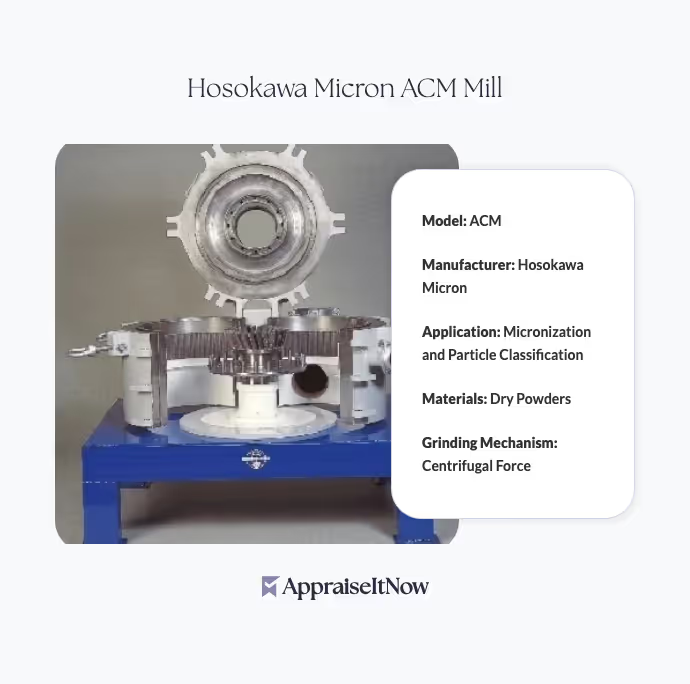
<p>If you own or manage a Hosokawa Micron Advanced Centrifugal Mill (ACM), understanding its current market value is essential whether you're considering a sale, seeking financing, managing insurance coverage, or planning for asset disposition. With typical values ranging from <strong>$100,000 to $150,000</strong> for used units, a professional appraisal becomes a strategic investment that protects your financial interests and provides documented evidence of your equipment's worth.</p>
<h2>Why Your Hosokawa Micron ACM Requires Professional Valuation</h2>
<p>The Hosokawa Micron ACM isn't a commodity—it's a highly specialized piece of industrial equipment with patented centrifugal grinding technology that demands expertise to value correctly. When you're exploring <a href="/types/equipment-and-machinery">equipment and machinery appraisal</a> services, you need appraisers who understand both the technical capabilities and market demand for precision milling equipment used in pharmaceuticals, specialty chemicals, and advanced materials manufacturing.</p>
<p>Unlike straightforward assets, your ACM's value depends on multiple technical factors, current market conditions, and specific use-case demand. A general equipment appraiser may miss critical value drivers that a specialist recognizes. Your mill's centrifugal force mechanism, ability to handle temperatures up to 300°C, and capacity to produce particles as small as 1 micron represent engineering capabilities that directly translate to financial value in the resale market.</p>
<div class="callout tip"><p><strong>Professional Insight</strong></p>
<p>Mills introduced in 1985 with proven service records often command stronger valuations than newer competitors lacking established track records in demanding applications.</p></div>
<h2>Key Factors That Influence Your ACM's Market Value</h2>
<p>Understanding what appraisers evaluate helps you prepare comprehensive documentation and realistic expectations for your valuation. The factors determining whether your Hosokawa Micron mill falls toward the $100,000 lower end or approaches $150,000 involve both machine-specific details and market dynamics.</p>
<p><strong>Machine condition and operational history</strong> represents the first major value driver. Your ACM's actual usage patterns, maintenance consistency, and any downtime or repairs directly impact its current state. Appraisers examine whether your mill operates continuously for 24/7 production cycles as designed, or if it's been used intermittently, stored, or recently refurbished. Mills with documented preventive maintenance schedules and minimal emergency repairs typically achieve valuations at the higher end of the range.</p>
<p><strong>Matching original components and functional capabilities</strong> matter significantly. Your ACM's precision controls for particle size distribution, calibration accuracy, and energy-efficient operation all contribute to valuation. If your mill includes original documentation showing it still achieves its design specifications—producing uniform granulometry and handling temperature-sensitive materials effectively—appraisers incorporate this performance verification into their analysis.</p>
<p>The question of comparable sale data and market demand creates another valuation layer. Since the ACM isn't mass-produced commodity equipment, appraisers specializing in <a href="/types/food-processing-equipment">food processing equipment</a> and <a href="/types/chemical-equipment">chemical equipment</a> rely heavily on recent comparable sales, auction results, and documented market inquiries to establish fair market value. Geographic location, industry activity levels in your region, and the specific materials your mill processes all influence what willing buyers currently pay.</p>
<h2>Documentation That Strengthens Your ACM Appraisal</h2>
<p>Professional appraisers require specific evidence to establish reliable valuations. Gathering these materials before your appraisal appointment accelerates the process and supports more defensible conclusions. Think of documentation like the foundation of a building—without it, everything built on top stands on uncertain ground.</p>
<p>Your <strong>serial number and equipment identification</strong> serves as the starting point. Appraisers verify the model designation, year of manufacture, and manufacturing location, cross-referencing these details against known production records. For your Hosokawa Micron ACM, the serial number on the equipment nameplate should match documentation and support your specific model configuration.</p>
<p><strong>Maintenance logs and service records</strong> provide compelling evidence of how well your mill has been operated and cared for. Complete maintenance documentation demonstrates your commitment to preserving the equipment's value and performance. These records help appraisers determine whether your ACM represents a well-maintained, reliable asset or one potentially requiring investment in restoration.</p>
<p><strong>Technical specifications documentation</strong> including original manuals, equipment datasheets, and calibration records validates your mill's design parameters and current operational capabilities. If you possess calibration records showing your mill still meets design specifications for particle size distribution, these documents support stronger valuations than claims without supporting evidence.</p>
<p><strong>Spare parts inventory</strong> associated with your ACM contributes to overall valuation. Appraisers sometimes adjust values based on available replacement components—high-value spare parts might be considered as part of the equipment's worth, while incomplete component sets might justify downward adjustments.</p>
<div class="callout note"><p><strong>Documentation Priority</strong></p>
<p>Serial numbers, maintenance records, and original equipment documentation are the most valuable evidence. Even partial records strengthen your appraisal more than equipment with no documentation history.</p></div>
<h2>Understanding How Appraisers Value Industrial Milling Equipment</h2>
<p>When you invest in a professional appraisal, three valuation methodologies come into play. The approach or combination of approaches your appraiser selects depends on your equipment's specific characteristics and the appraisal purpose.</p>
<p>The <strong>market approach</strong> compares your Hosokawa Micron ACM to recently sold comparable mills, adjusting for condition differences, features, and market timing. Since the ACM isn't traded daily like commodities, comparable sales data can be limited, but specialized appraisers maintain access to auction results, broker listings, and documented private transactions. This methodology typically anchors to your $100,000–$150,000 range based on recent transactions in the industrial milling market.</p>
<p>The <strong>cost approach</strong> evaluates the expense of replacing your mill with comparable new equipment, then subtracts depreciation for age, wear, and functional obsolescence. If new ACM mills currently cost $250,000 to $350,000 installed, and your mill has depreciated over its service life according to industry standards, this approach might suggest values in your established range. However, the cost approach works best when combined with market data rather than in isolation.</p>
<p>The <strong>income approach</strong> applies when your equipment generates revenue—for example, if you operate a contract milling service and your ACM's processing capacity translates directly to customer billings. In these cases, appraisers analyze the expected income your mill will generate over its remaining useful life, then discount that future income to present value. This approach often yields higher valuations for productive, revenue-generating equipment than market or cost approaches alone, which is why understanding your specific use case matters to appraisers.</p>
<div class="callout tip"><p><strong>Valuation Approach</strong></p>
<p>Most industrial equipment appraisals employ the market approach as the primary methodology, supported by cost or income analyses when relevant to your specific situation.</p></div>
<h2>Addressing Condition Issues That Affect Value</h2>
<p>Your Hosokawa Micron ACM's current condition directly translates to valuation adjustments. Appraisers factor in visible wear, corrosion, missing components, and outdated or malfunctioning controls when establishing fair market value. Understanding how these issues affect pricing helps you anticipate your appraisal outcome and make informed decisions about pre-appraisal maintenance investments.</p>
<p>Wear and corrosion represent common considerations in industrial equipment valuation. Surface rust, discolored paintwork, or accumulated dust from decades of operation typically results in modest downward adjustments—perhaps 5-10%—if the equipment remains fully functional. However, significant corrosion affecting critical components like grinding chambers or classification systems can justify 15-30% reductions because remediation costs become substantial.</p>
<p>Missing components or parts require careful assessment. If your ACM has a broken gauge, disconnected sensor, or damaged control panel, appraisers evaluate repair costs. If correcting the issue costs $2,000 to $5,000, they might deduct roughly that amount from the valuation. Equipment with incomplete component sets—for instance, missing some of the modular components the ACM was designed with—may see 10-25% reductions depending on criticality and replacement availability.</p>
<p>Outdated controls present an interesting valuation scenario. Older ACM mills with analog gauges and mechanical controls may actually appeal to operators who prefer proven, simple systems over newer digital interfaces prone to compatibility issues. Conversely, if control system obsolescence prevents achieving design performance specifications, appraisers factor in upgrades or compatibility concerns into their analysis.</p>
<h2>Finding Qualified Appraisers for Industrial Equipment</h2>
<p>Selecting the right appraiser matters tremendously. You want someone with credentials demonstrating USPAP compliance and professional standing, combined with specific expertise in industrial milling equipment or at minimum <a href="/types/heavy-machinery">heavy machinery</a> and <a href="/types/lab-equipment">lab equipment</a> valuation. The difference between a generalist appraiser and a specialist often shows clearly in valuation conclusions—specialists recognize market subtleties and technical factors that generalists miss.</p>
<p>Look for appraisers holding credentials from recognized professional organizations. The <strong>American Society of Appraisers (ASA)</strong>, <strong>International Society of Appraisers (ISA)</strong>, and <strong>American Association of Professional Appraisers (AAPA)</strong> maintain member directories and ethics standards that protect your interests. These organizations require continuing education, adherence to USPAP standards, and professional accountability that casual valuators don't provide.</p>
<p>Your appraiser should demonstrate specific experience with food processing or industrial milling equipment. Ask directly about their familiarity with Hosokawa Micron products, their access to comparable sales data, and their track record with similar valuations. An appraiser who has valued three other ACM mills in the past two years brings practical market knowledge that someone without this specific background cannot match.</p>
<div class="callout note"><p><strong>Appraiser Selection Tip</strong></p>
<p>Request references from previous clients who had similar industrial equipment appraised, and verify credentials through the appraiser's professional organization directory.</p></div>
<h2>Remote Versus On-Site Appraisals</h2>
<p>The question of whether your ACM appraisal requires an on-site inspection or can proceed through remote/desktop methodology depends on several factors. Understanding these distinctions helps you plan appropriately and understand potential limitations of different appraisal approaches.</p>
<p><strong>On-site inspections</strong> provide appraisers direct access to your equipment for hands-on assessment of condition, operational capabilities, and actual specifications. Your appraiser can verify serial numbers, examine wear patterns, listen to operational sounds that reveal mechanical condition, and test functional elements. For high-value equipment like your ACM, particularly when the appraisal will support insurance, financing, or legal purposes, on-site inspection represents best practice that courts, lenders, and insurers expect.</p>
<p><strong>Remote appraisals</strong> proceed based on photographs, descriptions, maintenance records, and documentation you provide. While more economical and faster, remote appraisals carry limitations—they cannot verify actual equipment condition beyond what photographs show, cannot hear operational sounds revealing mechanical issues, and cannot independently confirm component specifications. Remote methodology works acceptably for straightforward assets with clear market data, but industrial equipment valuations typically benefit from direct inspection.</p>
<p>For your Hosokawa Micron ACM, particularly if valuation will support insurance claims, lender requirements, or estate settlement, budget for on-site appraisal. The modest additional cost—typically a few hundred dollars—is negligible compared to the risk of undervaluation if remote assessment misses critical condition factors.</p>
<h2>Timeline and Fee Structures for Professional Appraisals</h2>
<p>When planning your appraisal, understanding typical timelines and fee structures helps you budget appropriately and set realistic expectations. Professional appraisers typically charge between $500 and $2,500 for industrial equipment valuations, depending on equipment complexity, travel distance, and urgency.</p>
<p><strong>Turnaround time</strong> varies based on appraiser workload and complexity. A straightforward appraisal of well-documented equipment might require 5-7 business days from inspection to report delivery. More complex valuations requiring research into comparable sales, market analysis, or technical investigation might require 10-14 days. Rush services are available for additional fees when urgent timelines are required for financing deadlines, insurance claims, or litigation support.</p>
<p>Fees typically reflect the appraiser's time investment. An appraiser charging $150-$200 hourly might spend 3-5 hours on your ACM appraisal, resulting in $450-$1,000 in fees, plus travel if on-site inspection is required. More complex valuations requiring comparable sales research or specialized expertise might command $1,500-$2,500. Always obtain written fee quotes before engaging an appraiser so no surprises emerge when invoicing occurs.</p>
<div class="callout tip"><p><strong>Fee Transparency</strong></p>
<p>Ask whether quoted fees include report revision requests, travel costs, and whether the appraiser revises conclusions if your equipment's condition differs from initial documentation.</p></div>
<h2>Appraisal Purpose and Report Format Variations</h2>
<p>Your appraisal report will be structured differently depending on its intended use. Understanding these distinctions ensures your appraisal serves your specific needs without unnecessary cost for elements you don't require.</p>
<p><strong>Lender valuations</strong> emphasize conservative, defensible conclusions supporting financing decisions. Appraisers focus heavily on comparable sales data, current market conditions, and downward adjustments for any uncertainties. These reports typically run 10-20 pages with detailed market analysis justifying the valuation conclusion.</p>
<p><strong>Insurance valuations</strong> establish replacement cost or agreed-upon values for coverage purposes. These reports typically emphasize condition documentation through photographs and detailed specification verification, supporting insurance companies' underwriting decisions. Format is relatively concise—usually 5-10 pages—with emphasis on condition and functional capability rather than extensive market analysis.</p>
<p><strong>Estate and tax valuations</strong> require detailed analysis supporting fair market value conclusions for tax authority purposes. These reports are comprehensive, typically 20-30 pages, with extensive supporting documentation, market analysis, and detailed reasoning for valuation conclusions. Appraisers following IRS guidelines for valuation report requirements generate the most rigorous documentation under this category.</p>
<p><strong>Litigation support valuations</strong> may require even more detailed analysis if disputes arise regarding equipment value. Courts expect comprehensive documentation, detailed photographs, and clear reasoning that withstands cross-examination from opposing parties' experts. These reports often exceed 30 pages and may include expert testimony preparation.</p>
<p>When requesting your appraisal, clearly state its intended purpose so your appraiser structures the report appropriately for your needs. Many appraisers offer report formats at varying complexity levels with corresponding fee differences.</p>
<h2>Market Changes and Value Fluctuation Factors</h2>
<p>Your Hosokawa Micron ACM's value doesn't remain static. Several external factors cause market valuations to shift over time, sometimes significantly. Understanding these dynamics helps you time selling decisions and understand why valuations change between periodic appraisals.</p>
<p><strong>Commodity price fluctuations</strong> directly impact demand for milling equipment. When pharmaceutical ingredient costs spike, manufacturers invest in more efficient milling and classification to maximize yield from expensive raw materials. These periods typically see increased demand and higher equipment values. Conversely, commodity price declines reduce urgency for efficiency investments, potentially softening equipment valuations.</p>
<p><strong>Supply chain disruptions</strong> create interesting valuation effects. During periods when new equipment delivery times extend to 6-12 months, used equipment valuations often rise as manufacturers seek immediate capacity. The COVID-19 pandemic provided clear examples of how supply chain issues can support used equipment values. When supply chains normalize and new equipment becomes readily available, used equipment demand may decline.</p>
<p><strong>Regulatory changes</strong> affecting pharmaceutical manufacturing, food processing, or chemical production can shift ACM demand. New environmental regulations requiring specific waste handling or emissions control might drive demand for updated equipment. Conversely, regulatory changes favoring alternative processing methods might reduce demand for milling technology specifically.</p>
<p><strong>Technological evolution</strong> in competing equipment affects your ACM's market position. If manufacturers introduce significantly more efficient classification systems or introduce equipment using fundamentally different technology, older mills like the ACM may see valuation pressure. However, the ACM's proven track record and robust design have maintained market relevance since 1985, suggesting lower obsolescence risk than equipment based on rapidly evolving technologies.</p>
<p>Recognizing these value drivers helps you make strategic timing decisions about selling, insurance coverage levels, and equipment investment decisions. Professional appraisers factor current market conditions into their analyses, so periodic revaluations—ideally every 2-3 years—keep your documentation current.</p>
<h2>Moving Forward With Confidence</h2>
<p>A professional appraisal of your Hosokawa Micron ACM Mill provides far more than a single number—it supplies documented evidence of your equipment's worth, supporting financing applications, insurance coverage decisions, estate planning, and potential sale transactions. With values ranging from $100,000 to $150,000, the investment in a thorough, professional valuation pays for itself through confidence and accurate documentation.</p>
<p>When you're ready to move forward, connect with certified appraisers through professional organizations like ASA or ISA who specialize in <a href="/types/equipment-and-machinery">industrial equipment</a> and <a href="/types/heavy-machinery">manufacturing equipment</a>. Provide comprehensive documentation including maintenance records, serial number verification, and detailed descriptions of your mill's current condition. Whether your appraisal supports a pending sale, insurance coverage needs, or asset management purposes, USPAP-compliant documentation from credentialed professionals ensures your valuation withstands professional and legal scrutiny.</p>
<div class="callout note"><p><strong>Key Takeaway</strong></p>
<p>A certified USPAP-compliant appraisal of your Hosokawa Micron ACM Mill establishes reliable market value documentation, protects your financial interests, and provides professional-grade evidence suitable for lending, insurance, tax, and transaction purposes.</p></div>