









<h1>How to Get Your Cuppone Mixer SP40 Appraised</h1>
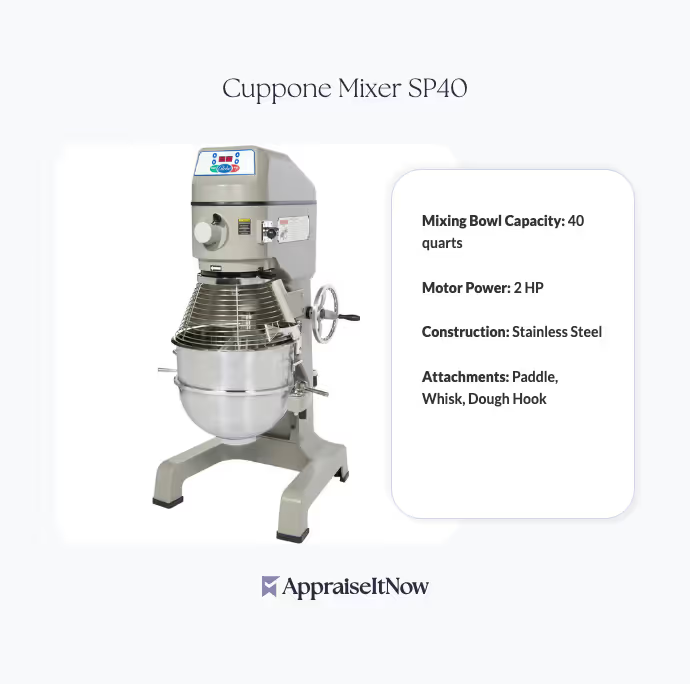
<p>The Cuppone Mixer SP40 is a commercial-grade food mixer engineered for serious bakeries and commercial kitchens. If you own one of these Italian-made powerhouses, understanding its value—currently estimated between <strong>$20,000 and $30,000</strong>—requires professional appraisal expertise. Whether you're selling, financing, insuring, or settling an estate, a certified appraisal provides the documentation you need.</p>
<h2>Understanding Your Cuppone Mixer SP40's Market Position</h2>
<p>Your SP40 represents a rare piece of equipment. Introduced in 1990 and manufactured in Italy, only <strong>500 units were produced globally</strong>, making it a specialized asset with a defined collector and commercial market. The mixer features a <strong>40-quart capacity bowl</strong>, commercial-grade planetary mixing action, and <strong>NSF certification</strong> for food service use, backed by a 5-year manufacturer warranty when new.</p>
<p>What makes the SP40 particularly valuable? Its robust <strong>stainless steel construction</strong> and proven reliability in professional kitchens distinguish it from lighter-duty models. The planetary mixing action—a hallmark of quality commercial equipment—ensures consistent, thorough mixing of large dough batches, heavy batters, and specialty ingredients. At <strong>395 lbs</strong> with dimensions of 23.5 x 27.6 x 53.2 inches, it occupies a sweet spot between portability and capacity that many commercial operations still seek today.</p>
<div class="callout tip"><p><strong>Equipment Insight</strong></p>
<p>The SP40's scarcity and Italian manufacturing heritage contribute significantly to its valuation, particularly among independent bakeries seeking reliable legacy equipment.</p></div>
<h2>Key Valuation Factors for Your Mixer</h2>
<p>Professional appraisers of <a href="/types/food-processing-equipment">food processing equipment</a> consider multiple factors when determining your SP40's worth. Understanding these elements helps you prepare documentation and maximize your appraisal accuracy.</p>
<p><strong>Condition and maintenance history</strong> form the foundation of equipment valuation. A well-maintained SP40 with documented service records, regular cleaning logs, and no major repairs will command premium pricing near the $30,000 range. Documentation of adherence to FDA and HACCP cleaning standards—critical for food-safety compliance—directly impacts marketability and value. Equipment that clearly meets sanitary food-safety requirements positions better in the resale market because buyers avoid potential regulatory complications.</p>
<p>The mixer's operational status matters considerably. Does it run smoothly? Are all attachments present and functional? Have bearings, seals, or motors required replacement? These mechanical factors influence where your SP40 falls within the $20,000-$30,000 range. Spare parts availability and manufacturer support also affect long-term marketability—the SP40's established presence in professional kitchens means parts remain relatively accessible compared to discontinued models.</p>
<p>Specialized appraisers examining <a href="/types/restaurant-equipment">restaurant equipment</a> also evaluate whether your mixer exhibits cosmetic wear, surface rust, or damaged control panels. Minor cosmetic issues typically reduce value modestly (5-10%), while significant mechanical or structural problems can reduce worth substantially.</p>
<div class="callout note"><p><strong>Valuation Perspective</strong></p>
<p>Equipment with matching serial numbers and original documentation—particularly proof of NSF certification and warranty records—typically achieves higher appraisal values.</p></div>
<h2>Technical Specifications That Drive Value</h2>
<p>The SP40's specific technical configuration directly influences appraisal outcomes. Its <strong>commercial-grade planetary mixing action</strong> represents the gold standard for food preparation equipment, providing superior performance compared to single-speed mixers. The 40-quart capacity occupies a valuable market niche—large enough for wholesale operations yet manageable for mid-sized bakeries.</p>
<p>Manufacturing year and production details matter in specialized equipment markets. As a 1990s-era model, your SP40 sits at an interesting intersection: old enough to be established and proven, yet recent enough that parts compatibility and technical support remain viable. This positioning differs from much older equipment where technical support becomes complicated or unavailable.</p>
<p>Geographic and market factors significantly influence demand and pricing for <a href="/blog/food-processing-equipment-appraisal-what-you-need-to-know">commercial food processing equipment</a>. Urban areas with dense concentrations of independent bakeries, artisan food producers, and catering operations typically support stronger demand and pricing than rural markets. International considerations also factor in—your SP40's Italian heritage appeals to operations seeking European-manufactured equipment, potentially opening export markets that appreciate legacy equipment.</p>
<h2>Documentation Required for Accurate Appraisal</h2>
<p>Professional appraisers need specific information to provide accurate valuations. Gathering this documentation before your appraisal streamlines the process and often results in more thorough assessments.</p>
<p><strong>Essential documentation includes</strong> serial numbers (clearly photographed), original purchase receipts or registration if available, maintenance records showing regular servicing, and any warranty documentation. High-resolution photographs from multiple angles—showing both cosmetic condition and mechanical components—help appraisers assess condition remotely or validate field observations.</p>
<p>If your SP40 underwent significant repairs or component replacements, documentation of those services strengthens the appraisal. Conversely, if you lack maintenance records, professional appraisers can often assess condition through mechanical inspection and typical wear patterns for equipment of this age and production volume.</p>
<div class="callout tip"><p><strong>Documentation Best Practice</strong></p>
<p>Video demonstrations of the mixer's operation—showing smooth motor function, planetary action, and control response—provide valuable documentation that complements still photography.</p></div>
<h2>Comparable Sales and Market Research</h2>
<p>Understanding recent comparable sales helps you anticipate your appraisal range. Where can you find these comps? Auction sites specializing in restaurant equipment, dealer listings from commercial kitchen equipment resellers, and industry-specific equipment reseller networks provide visibility into market transactions. Looking at what similar models have sold for recently—particularly other 1990s SP40 models in comparable condition—gives realistic expectations.</p>
<p>The <a href="/types/food-processing-equipment">commercial food processing equipment market</a> tends toward slower turnover than consumer equipment, meaning fewer recent sales data points exist. This scarcity of comparable transactions sometimes creates valuation challenges. Professional appraisers address this through multi-approach methodology—combining cost approach analysis (replacement value of equivalent new equipment), market approach (recent sales of comparable used models), and sometimes income approach for lease or rental scenarios.</p>
<p>National versus local markets create different pricing dynamics. Major equipment liquidators operating nationally might offer slightly lower prices due to volume processing, while local dealers serving regional bakeries may position premium pricing for quickly available, proven equipment. Understanding your market context helps interpret appraisal results appropriately.</p>
<h2>Professional Appraisal Approaches for Your SP40</h2>
<p>Appraisers use multiple approaches to establish fair market value for commercial food equipment like your Cuppone mixer. The <strong>cost approach</strong> estimates what a new equivalent mixer would cost, then deducts for age, wear, and obsolescence. For the SP40, this often anchors valuations around the $20,000-$30,000 range when compared against modern commercial mixer pricing.</p>
<p>The <strong>market approach</strong> examines recent sales of comparable used SP40 models and equivalent mixers, establishing value through what actual buyers have paid. This approach works well for established, widely-used equipment like the SP40, though limited global production (500 units) means fewer comparable sales than for mass-produced models.</p>
<p>The <strong>income approach</strong> applies when equipment generates revenue—for instance, if your mixer operates in a commercial rental kitchen or catering business. This approach calculates value based on earning potential, which may apply if you're considering appraisal for business valuation purposes related to <a href="/types/business-assets">business assets</a>.</p>
<p>Professional appraisers combine these approaches, weighting each based on available data and your specific appraisal purpose. Whether you need valuation for sale, financing, insurance, tax purposes, or estate distribution, the appraiser tailors their analysis to your transactional use case.</p>
<h2>Why Professional Appraisals Matter for Commercial Equipment</h2>
<p>Understanding the difference between "what I think it's worth" and certified appraisal value protects you in transactions. Professional appraisals provide legally defensible documentation accepted by financial institutions for equipment financing, insurance companies for coverage validation, and tax authorities for depreciation calculations.</p>
<p>For commercial food processing equipment specifically, appraisals addressing food-safety compliance standards carry additional weight. Equipment verified as meeting current FDA and HACCP standards appeals to buyers seeking compliance certainty, often justifying premium pricing within your SP40's valuation range.</p>
<p>When selling used commercial equipment, a certified appraisal from an independent professional strengthens negotiating position with serious buyers while protecting you from underpricing. When financing equipment through lenders, many institutions require independent appraisals as collateral documentation. Insurance companies similarly require professional valuations for equipment coverage, ensuring replacement value accuracy if loss occurs.</p>
<p>Estate situations particularly benefit from professional appraisal—tax authorities may require documented valuations for probate proceedings, and beneficiaries deserve confidence that property distributions reflect fair market value.</p>
<div class="callout note"><p><strong>Key Takeaway</strong></p>
<p>A certified appraisal of your Cuppone Mixer SP40 provides accurate market documentation essential for buying, selling, financing, insuring, or estate purposes. Professional expertise in food processing equipment valuation ensures your $20,000-$30,000 asset is properly positioned and documented for whatever transaction you pursue.</p></div>