









<h1>How to Get Your Doyon Mixer BM80 Appraised</h1>
<p>If you own a Doyon Mixer BM80 or are considering purchasing one, understanding its current market value is essential. Whether you're evaluating it for sale, insurance, financing, or estate planning purposes, a professional appraisal provides the documentation and credibility needed to make informed decisions. The Doyon BM80 typically ranges from <strong>$10,000 to $15,000</strong> in today's market, but the exact value depends on multiple factors specific to your equipment.</p>
<h2>Why You Need a Professional Appraisal for Commercial Mixers</h2>
<p>A Doyon BM80 is far more than a kitchen appliance—it's a significant <a href="/types/restaurant-equipment">commercial equipment asset</a> that requires specialized valuation expertise. Unlike general <a href="/types/equipment-and-machinery">equipment and machinery</a> appraisals, commercial food processing equipment demands knowledge of both technical specifications and market dynamics specific to the foodservice industry.</p>
<p>Professional appraisals serve different purposes depending on your situation. Are you seeking financing against the equipment? Lenders require certified valuations to establish collateral value. Planning an estate distribution? Courts and beneficiaries need documented fair market value. Replacing damaged equipment for insurance claims? You'll need replacement cost appraisals that account for the condition and market availability of comparable units. Understanding which appraisal purpose applies to your situation helps ensure you receive the right documentation.</p>
<h2>Key Factors That Determine Your BM80's Value</h2>
<p>The Doyon BM80's market value depends on several interconnected factors that professional appraisers evaluate systematically. Age represents a starting point—first introduced in 1995, the BM80 has remained largely consistent in design, meaning older units don't necessarily lose value as quickly as some equipment. However, hours of use and maintenance history dramatically affect pricing within the $10,000-$15,000 range.</p>
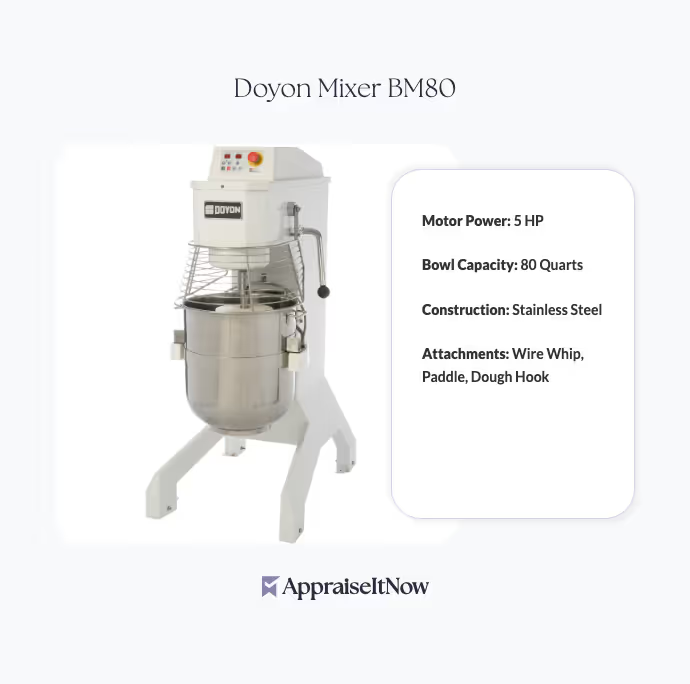
<p>Your mixer's condition directly translates to value. The 5-HP motor and stainless steel bowl construction are built for longevity, but working mechanisms require assessment. Does the swivel-style bowl lift operate smoothly? Are the wire whip, paddle, and dough hook attachments present and functional? Professional appraisers inspect these mechanical components, test motor function, and verify that all 80-quart capacity systems operate within manufacturer specifications. A unit showing heavy usage but with documented maintenance records may hold value better than an older, neglected mixer.</p>
<p>Compliance and safety certifications also influence market value. The BM80's NSF certification for food service isn't just a regulatory checkbox—it's a major selling point. Equipment lacking proper certifications faces serious marketability challenges, even if mechanically sound. When evaluating your mixer, ensure NSF documentation is available, as this certification significantly impacts both value and purchaser confidence for <a href="/types/food-processing-equipment">food processing equipment</a>.</p>
<div class="callout tip"><p><strong>Appraisal Insight</strong></p>
<p>Mixers with complete original documentation, maintenance records, and proof of regular servicing typically command 15-25% premiums over units lacking paperwork, regardless of actual condition.</p></div>
<h2>Understanding Market Comparables for Used Commercial Mixers</h2>
<p>Establishing accurate value requires access to reliable comparable sales data. Where can you find this information? Industry auctions, dealer resale records, equipment exchanges, and liquidation sales provide the benchmarks that professional appraisers use to position your Doyon BM80 within current market ranges.</p>
<p>The BM80 occupies a unique market position. It's neither cutting-edge technology nor obsolete equipment—it's proven, reliable workhorse machinery that professional kitchens actively seek. Recent sales data shows consistent demand at the $10,000-$15,000 range, with variation based on condition and location. Units in major metropolitan areas with active restaurant equipment dealers often achieve higher prices than identical mixers in rural markets with limited buyer pools.</p>
<p>Technical specifications directly correlate with market value in ways that surprise non-specialists. Your BM80's variable mixer speed ranging from 40 to 300 RPM represents significant capability—this range accommodates everything from delicate whisking to heavy dough mixing. The removable 80-quart stainless steel bowl isn't just convenient; it's a design feature that professional kitchens specifically value because replacement bowls are relatively accessible and affordable. Equipment designed for easy maintenance and part replacement commands premium market positioning.</p>
<h2>How Age and Maintenance History Impact Pricing</h2>
<p>The question of how age affects value requires nuanced analysis for commercial equipment. Unlike consumer appliances that depreciate rapidly, commercial mixers designed and maintained properly often appreciate or stabilize in value over time. A well-maintained 20-year-old BM80 may hold value better than a poorly maintained five-year-old mixer.</p>
<p>Documentation becomes your greatest asset here. Maintenance records demonstrating regular oil changes, bearing inspections, motor testing, and component replacement create a narrative of responsible stewardship. Professional appraisers specifically request these records because they answer critical questions about remaining useful life and predictable repair costs. A mixer with documented maintenance often receives a 20-30% value premium compared to an equivalent unit with no service history.</p>
<p>Repair records similarly demonstrate value. Has the equipment required motor replacement? Recent bearing service? New bowl? These represent investments in the mixer's future performance. Rather than devaluing the equipment, documented repairs actually increase confidence in its ongoing functionality. Conversely, equipment showing wear without evidence of maintenance raises red flags about imminent repairs, directly reducing appraisal values.</p>
<h2>Compliance and Safety Considerations Affecting Marketability</h2>
<p>Health code compliance isn't just regulatory compliance—it's a value driver for <a href="/types/beverage-equipment">commercial food service equipment</a>. Your Doyon BM80's NSF certification means it meets stringent food safety standards that regulatory agencies require. Loss of this certification or inability to verify it significantly reduces marketability, even for equipment in perfect mechanical condition.</p>
<p>Local health codes vary by jurisdiction, and some municipalities have specific equipment requirements. Professional appraisers in your region understand local regulatory environments and how they affect buyer pools. A mixer that's perfectly compliant in one state might face restrictions in another, directly impacting its value in your local market.</p>
<p>Sanitation standards also influence equipment lifespan calculations. Stainless steel construction like your BM80's bowl and frame isn't just about durability—it's about cleanability and corrosion resistance required for food service environments. Regular cleaning and maintenance preserve both the equipment's function and its compliance status, making these records valuable documentation during appraisal.</p>
<h2>Appraisal Methods and Documentation Standards</h2>
<p>Professional appraisers use standardized methodologies to ensure consistency and credibility. For <a href="/types/restaurant-equipment">restaurant equipment</a>, the three primary appraisal approaches are the market comparison approach (what comparable BM80s have sold for recently), the cost approach (replacement cost minus depreciation), and the income approach (for equipment generating revenue). Your appraiser typically uses the market comparison approach as the primary method, supported by cost analysis.</p>
<p>USPAP (Uniform Standards of Professional Appraisal Practice) compliance ensures your appraisal meets legal and professional standards. Whether you need the appraisal for insurance, financing, litigation, or estate purposes, a USPAP-compliant report provides credibility that informal valuations cannot match. AppraiseItNow works with credentialed appraisers holding certifications from organizations including <strong>AAA, ISA, ASA, CAGA, and AMEA</strong>—designations that specifically qualify professionals to value food processing and commercial kitchen equipment.</p>
<div class="callout note"><p><strong>Standards Matter</strong></p>
<p>USPAP-compliant appraisals are accepted by courts, lenders, insurance companies, and tax authorities, providing protection and credibility for your valuation regardless of intended use.</p></div>
<p>Documentation requirements for your BM80 appraisal typically include high-resolution photographs from multiple angles (top, sides, front, back, and detail shots of serial numbers and manufacturer plates), written descriptions of condition, technical specification verification, and serial number documentation. Some appraisers request video walkthroughs showing equipment operation. The more comprehensive your documentation, the stronger your appraisal's defensibility.</p>
<h2>Value Definitions: Choosing the Right Appraisal Type</h2>
<p>Different situations call for different value definitions, and understanding which applies to your purpose ensures you receive appropriate documentation. <strong>Fair market value</strong>, the most common standard, represents the price at which your BM80 would sell between a willing buyer and willing seller on the open market—this suits most general valuations and insurance purposes.</p>
<p><strong>Orderly liquidation value</strong> differs significantly, representing what you'd receive selling the equipment at auction with reasonable marketing time—typically 20-30% below fair market value. If you're liquidating a restaurant or food production facility, this value definition provides realistic expectations. Conversely, <strong>replacement cost</strong> represents what a buyer would pay to acquire equivalent new equipment, useful for insurance claims and replacement planning. Your BM80's substantial depreciation from new (likely under $25,000 initially) makes replacement cost significantly higher than used market value.</p>
<p><strong>Insured value</strong> represents the coverage amount your insurance policy should include to adequately protect the equipment. This often differs from fair market value because it must account for replacement availability and market conditions at the time of loss. Professional appraisers help determine which value definition matches your specific situation and provide the appropriate documentation.</p>
<h2>Shipping, Logistics, and Real-World Value Impacts</h2>
<p>An often-overlooked factor affecting commercial mixer values is logistics. Your Doyon BM80 weighs over 550 pounds and requires specialized handling, crating, and potentially heavy equipment freight services. These substantial logistics costs reduce effective sale prices, particularly for remote buyers. Professional appraisers account for these market realities when establishing comparable values, as they reflect what actual buyers in different geographic regions pay.</p>
<p>Local availability also influences buyer behavior. In major metropolitan areas with multiple restaurant equipment suppliers, buyers have alternatives and may demand lower prices. In regions with limited equipment availability, the same BM80 might command premium pricing because replacement options are scarce. Your appraiser considers regional market dynamics and typically establishes values for your specific geographic area.</p>
<h2>Choosing the Right Appraiser for Food Processing Equipment</h2>
<p>Not all appraisers qualify to value commercial mixers effectively. You need professionals with demonstrated experience in <a href="/blog/the-essential-guide-to-food-processing-equipment-appraisal">food processing equipment</a> valuation. Look for appraisers who understand commercial kitchen operations, equipment capabilities, and market dynamics specific to the foodservice industry.</p>
<p>Professional credentials matter significantly. Appraisers affiliated with established organizations like <strong>AAA (American Association of Appraisers), ISA (International Society of Appraisers), or ASA (American Society of Appraisers)</strong> maintain ethical standards, continuing education requirements, and professional liability insurance. These credentials indicate commitment to accuracy and professional accountability.</p>
<p>Experience with commercial equipment specifically matters more than general real property appraisal credentials. An appraiser experienced with real estate may understand property valuation but lack the specialized knowledge about equipment specifications, parts availability, and foodservice industry practices that your Doyon BM80 appraisal requires. When selecting an appraiser, verify their specific experience with commercial kitchen equipment and ask for references from previous clients in the foodservice industry.</p>
<div class="callout tip"><p><strong>Selection Criterion</strong></p>
<p>Ask potential appraisers directly: "How many Doyon commercial mixers have you appraised?" Specific experience with your equipment model indicates qualified expertise.</p></div>
<h2>Time and Cost Considerations for Appraisals</h2>
<p>Professional appraisal fees and timelines vary based on appraisal scope and methodology. On-site appraisals, where the appraiser physically inspects your BM80, typically cost $300-$600 and require one to two hours on-site. Desktop or virtual appraisals, using photographs and descriptions you provide, cost less ($200-$400) but offer less certainty and may not be acceptable for litigation or significant insurance claims.</p>
<p>Turnaround times typically range from three to seven business days for standard appraisals, with rush services available for premium fees. If you need your appraisal for an imminent sale, financing application, or insurance claim, discuss timelines upfront with your appraiser. Rush services might require an additional 20-30% fee but ensure you receive documentation when needed.</p>
<h2>Why Parts Availability and Manufacturer Support Matter</h2>
<p>Doyon's continued existence and parts availability significantly support your BM80's market value. Unlike equipment from defunct manufacturers, your mixer benefits from accessible replacement components, repair manuals, and technical support. This parts availability reduces buyer concern about repair costs and future maintenance challenges, directly supporting resale value and market demand.</p>
<p>The equipment industry shows that items from established manufacturers with ongoing support command premiums over equivalent equipment from companies that have ceased operations. Your Doyon BM80, manufactured by a company that continues operating and supporting legacy equipment, maintains marketability advantages over comparable mixers from defunct producers.</p>
<hr />
<div class="callout note"><p><strong>Key Takeaway</strong></p>
<p>Your Doyon Mixer BM80's market value of $10,000-$15,000 reflects its proven reliability, commercial capability, and continued demand within the foodservice industry. A professional USPAP-compliant appraisal provides the documented valuation, detailed condition assessment, and market analysis necessary for confident selling, financing, insurance, or estate planning decisions. By selecting an appraiser experienced with commercial food processing equipment and providing comprehensive documentation, you ensure accurate valuation that protects your interests and reflects your equipment's true market position.</p></div>