









<h1>How to Get Your Retsch Mill ZM 200 Appraised</h1>
<p>The Retsch Mill ZM 200 represents a significant investment for laboratories, pharmaceutical companies, and research facilities worldwide. Whether you're evaluating this precision instrument for purchase, sale, insurance purposes, or tax documentation, understanding the appraisal process ensures you receive an accurate valuation that reflects its true market value. Current market estimates for the ZM 200 range from <strong>$30,000 to $40,000</strong>, though individual valuations depend on multiple condition and documentation factors specific to your equipment.</p>
<h2>Understanding the Retsch Mill ZM 200's Value Drivers</h2>
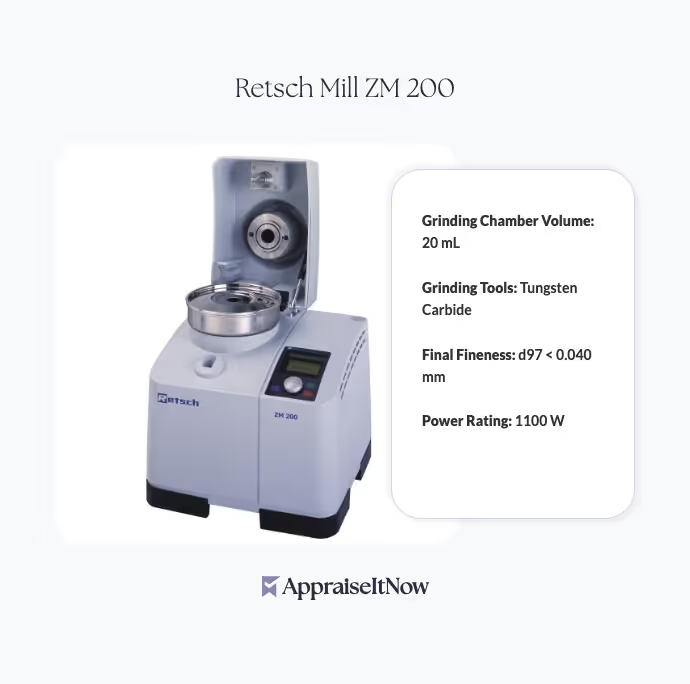
<p>The ZM 200 has held its position as a premier laboratory milling solution since its introduction in <strong>1995</strong>, commanding consistent demand across chemistry, pharmaceuticals, agriculture, mining, and material science sectors. Its ability to achieve ultra-fine particle sizes down to <strong>d97 < 0.040 mm</strong> (40 microns) positions it as essential equipment for researchers and quality control professionals requiring reproducible, precise results.</p>
<p>What makes your specific unit valuable extends beyond its technical capabilities. The ZM 200's robust engineering and versatile grinding tool compatibility mean well-maintained examples retain strong resale appeal. Understanding which factors most affect resale value—age, operational hours, maintenance history, and included accessories—helps you prepare comprehensive documentation that professional appraisers need to establish fair market value accurately.</p>
<div class="callout tip"><p><strong>Appraisal Insight</strong></p>
<p>Equipment that demonstrates consistent maintenance records and calibration certificates typically commands valuations at the higher end of the market range.</p></div>
<h2>Key Factors Affecting Your ZM 200's Appraisal Value</h2>
<h3>Condition and Operating History</h3>
<p>When appraisers evaluate your Retsch Mill ZM 200, they examine operating hours and maintenance documentation as critical value indicators. Unlike consumer equipment where age primarily determines worth, laboratory instruments benefit from professional servicing that extends their functional lifespan. Your equipment's condition grade—whether it operates at full specifications or requires minor repairs—directly influences its market positioning.</p>
<p>Professional appraisers assess mechanical function, calibration accuracy, and any signs of component wear. They'll verify whether the powerful drive system performs as specified and whether the ergonomic design shows normal use wear or abuse-related damage. Cosmetic wear on the housing, while less critical than mechanical function, still factors into overall valuation. Missing parts or nonfunctional components require detailed documentation in appraisal reports, as specialized replacement parts can be expensive or difficult to source.</p>
<h3>Documentation and Certifications</h3>
<p>The documentation you provide significantly impacts appraisal accuracy. Your ZM 200's serial number, calibration certificates, and complete service records create a verifiable history that appraisers use to establish authenticity and functional reliability. Export-related documentation becomes particularly important if your equipment includes any special certifications or regional compliance modifications.</p>
<p>AppraiseItNow and similar certified appraisal services work with <a href="/types/lab-equipment">lab equipment specialists</a> who understand the specific documentation requirements for precision instruments. They recognize that calibration records prove your equipment maintains the stated fineness specifications, while service histories demonstrate proper maintenance by qualified technicians.</p>
<h2>Market Dynamics and Secondary Market Availability</h2>
<p>The Retsch ZM 200 appears with varying frequency on the secondary market, which influences how appraisers establish comparable values. Unlike mass-produced equipment, specialized laboratory mills attract a defined collector base of researchers, educational institutions, and quality control facilities seeking reliable fine-grinding solutions.</p>
<p>Regional demand, local availability, and shipping costs all play roles in final valuation. Equipment located near research centers or pharmaceutical hubs may command slightly different values than units in remote areas. International units with export restrictions or certifications require appraisers to factor in compliance documentation that affects marketability. These location-based and logistical considerations help appraisers determine Fair Market Value (what a willing buyer would pay), Replacement Value (new unit cost), and Forced Liquidation Value (quick-sale pricing) for your specific situation.</p>
<div class="callout note"><p><strong>Market Reality</strong></p>
<p>Shipping costs for heavy laboratory equipment like the ZM 200 can represent 10-15% of total value, influencing regional pricing variations.</p></div>
<h2>Documentation You'll Need for Accurate Appraisal</h2>
<p>To support a comprehensive and defensible appraisal, compile the following documentation:</p>
<p>Your ZM 200's <strong>serial number and original purchase documentation</strong> establish baseline authenticity. <strong>Calibration certificates</strong> and <strong>service records</strong> verify that your equipment maintains specifications—particularly the critical fineness achievement claims. <strong>Photographs from multiple angles</strong>, including close-ups of any markings, serial number plates, and the control interface, help appraisers conduct remote preliminary evaluations. For equipment with <strong>original accessories</strong> (grinding sets, sieves, controllers), include documentation proving their compatibility and condition.</p>
<p>Professional appraisers working with <a href="/types/equipment-and-machinery">equipment and machinery</a> valuations need this documentation to support their findings, whether for insurance purposes, tax deductions, financing applications, or estate settlements. Clear chain-of-custody records, original receipts, and any warranty or service agreements enhance credibility and typically result in more favorable valuations when conditions support them.</p>
<h2>Choosing the Right Appraiser for Your Equipment</h2>
<p>Not all appraisers possess the specialized knowledge required for precision laboratory instruments. When selecting someone to value your Retsch Mill ZM 200, verify their credentials and experience with similar equipment. Look for appraisers holding designations from recognized organizations—<strong>AAA (American Association of Appraisers), ISA (International Society of Appraisers), ASA (American Society of Appraisers), CAGA (Canadian Association of Gem Appraisers), or AMEA (American Machinery and Equipment Appraisers)</strong>.</p>
<p>Appraisers specializing in <a href="/types/food-processing-equipment">food processing equipment</a> and <a href="/types/chemical-equipment">chemical equipment</a> understand how industrial and laboratory milling equipment valuations work. They'll recognize that a ZM 200 with recent calibration and full-service records justifies valuations approaching the $40,000 upper range, while older units with incomplete maintenance histories may settle toward $30,000.</p>
<p><strong>USPAP compliance</strong> (Uniform Standards of Professional Appraisal Practice) ensures your appraisal report meets legal and financial institution standards. Whether you need the valuation for insurance claim documentation, tax depreciation schedules, or commercial financing, a USPAP-compliant appraisal provides defensible, professional-grade documentation.</p>
<div class="callout tip"><p><strong>Credential Check</strong></p>
<p>Certified appraisers specializing in laboratory equipment can typically complete detailed valuations within 2-4 weeks, providing comprehensive condition assessments and market analysis.</p></div>
<h2>Handling Equipment Concerns in Your Appraisal</h2>
<p>If your Retsch Mill ZM 200 shows cosmetic wear, missing accessories, or nonfunctional components, professional appraisers handle these transparently in their reports. Rather than ignoring such issues, they document and factor them into adjustments. A unit missing its original control system might see a $2,000-5,000 reduction in value, while purely cosmetic wear typically affects valuation minimally if mechanical function remains intact.</p>
<p>Nonfunctional components require honest assessment. If your ZM 200's drive system struggles to achieve specified fineness, appraisers adjust the valuation accordingly and note repair cost estimates. This transparency actually protects you—buyers and insurance companies appreciate knowing exactly what they're acquiring rather than discovering hidden problems later.</p>
<h2>Specialized Considerations for Laboratory Equipment</h2>
<p>Unlike <a href="/types/antique-furniture">antique furniture</a> or <a href="/types/memorabilia-and-collectibles">collectible memorabilia</a>, laboratory equipment valuations incorporate technical performance standards. Appraisers familiar with the ZM 200 understand that <strong>recent servicing or included accessories</strong> directly impact value. A unit that recently underwent recalibration, with matching grinding sets and controllers included, justifies valuations toward $38,000-40,000. Basic equipment without accessories settles closer to $30,000-32,000.</p>
<p>The question of how included accessories affect value matters significantly. Original Retsch grinding sets, stainless steel bowls, and digital controllers that ship with the ZM 200 when new represent real replacement costs if missing. Appraisers price these accurately when documentation proves their original inclusion and current functionality.</p>
<h2>Turnaround Times and Appraisal Costs</h2>
<p>Professional appraisals for equipment like your Retsch Mill ZM 200 typically require 2-4 weeks from initial contact to final report delivery. While expedited services exist (sometimes available within 5-7 business days), rushed appraisals may sacrifice the thorough analysis that supports higher valuations. Typical appraisal fees for specialized <a href="/types/chemical-equipment">chemical and laboratory equipment</a> range from $300-800 depending on complexity and whether the appraiser needs to examine the equipment in person.</p>
<p>When considering appraisal costs for insurance or financing purposes, remember that professional documentation typically costs far less than the valuation disputes or underinsurance problems that result from amateur assessments. A certified appraisal for your ZM 200 represents a sound investment in documentation accuracy and protection.</p>
<h2>Purpose-Specific Valuations</h2>
<p>Your appraisal purpose influences which value approach the appraiser emphasizes. For <strong>insurance replacement</strong> scenarios, appraisers focus on what it would cost to replace your ZM 200 with comparable new equipment—currently around <strong>$35,000-45,000</strong> for a new unit, supporting valuations near the high end for well-maintained used equipment. For <strong>tax depreciation</strong> or <strong>estate purposes</strong>, Fair Market Value (what a willing buyer would pay in an open market) applies, typically <strong>$30,000-40,000</strong> depending on condition.</p>
<p>If you're financing or liquidating equipment, Forced Liquidation Value (quick-sale pricing) might reflect <strong>$20,000-28,000</strong>, accounting for aggressive discounting needed to move equipment rapidly. Professional appraisers explain these distinctions clearly and apply the valuation method appropriate to your specific situation.</p>
<h2>Insurance and Documentation Requirements</h2>
<p>For <strong>insurance purposes</strong>, your appraisal report should explicitly state whether it's intended for replacement cost coverage or actual cash value determination. Detailed condition descriptions, serial number verification, and current market analysis give your insurance company confidence in the valuation. When you file a claim involving your Retsch Mill ZM 200, comprehensive appraisal documentation significantly streamlines the settlement process.</p>
<p>For <strong>tax purposes</strong>, certified appraisals provide the documentation required by the IRS when claiming equipment donations or depreciation deductions. These reports need USPAP compliance and appraiser credentials that survive audit scrutiny. Similarly, <strong>estate planning</strong> appraisals establish the equipment's value for inheritance distribution and estate tax calculations.</p>
<div class="callout note"><p><strong>Key Takeaway</strong></p>
<p>A certified appraisal of your Retsch Mill ZM 200 provides essential documentation for insurance coverage, tax compliance, and financial transactions while ensuring you understand the current market value of this precision laboratory instrument. Professional appraisers specializing in <a href="/types/lab-equipment">lab equipment</a> and <a href="/types/equipment-and-machinery">equipment and machinery</a> bring expertise that transforms raw specifications into defensible valuations within the <strong>$30,000-40,000</strong> market range, protecting your investment and supporting your business decisions with confidence.</p></div>