









<h1>How to Get Your Wysong Press Brake MTX Appraised</h1>
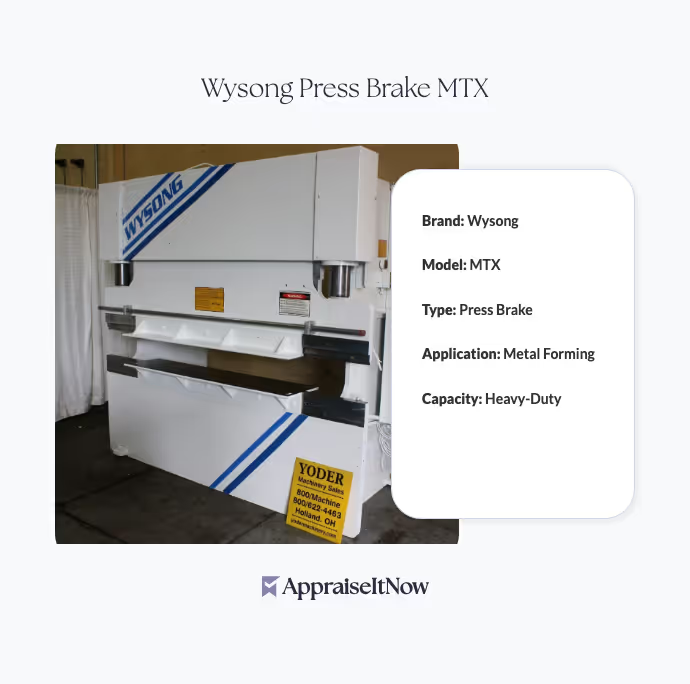
<p>The Wysong Press Brake MTX is a workhorse in industrial metal fabrication, combining precision engineering with robust construction to handle demanding production environments. Whether you're evaluating its worth for resale, insurance coverage, financing, or asset management purposes, understanding the appraisal process ensures you receive an accurate, defensible valuation. With current estimates ranging from <strong>$50,000 to $80,000</strong>, getting a professional appraisal is essential for protecting your investment and making informed business decisions.</p>
<h2>Understanding Your Wysong Press Brake MTX's Market Value</h2>
<p>The Wysong Press Brake MTX has maintained strong market demand since its introduction in <strong>1985</strong>, establishing itself as a reliable piece of <a href="/types/metalworking-equipment">metalworking equipment</a> valued across fabrication shops, manufacturing facilities, and tool-and-die operations. The market for this equipment reflects several key factors that influence final appraised values. Recent sales comparable (comps) for Wysong MTX models in the U.S. market show consistent pricing within the $50,000-$80,000 range, though actual values depend significantly on specific machine configuration, hours of operation, maintenance history, and local market conditions.</p>
<div class="callout tip"><p><strong>Valuation Driver</strong></p>
<p>A well-maintained Wysong MTX with documented service records and low operating hours can command values at the upper end of the market range.</p></div>
<p>The hydraulic power system and advanced digital controls that define the MTX model represent substantial technological advantages over older mechanical press brakes. These features directly translate to value retention because they reduce operator fatigue, improve precision, and enable faster cycle times—all factors that matter to buyers in today's competitive manufacturing landscape.</p>
<h2>Key Specifications That Influence Appraisal Value</h2>
<p>When appraisers evaluate your Wysong Press Brake MTX, they examine technical specifications that directly impact what buyers will pay. <strong>Tonnage capacity</strong>, <strong>bed length</strong>, <strong>CNC control sophistication</strong>, <strong>back gauge precision</strong>, <strong>tooling condition</strong>, and <strong>manufacturing year</strong> represent the primary value drivers for industrial press brakes. A machine with higher tonnage capacity, longer working bed, and advanced CNC controls will command premium pricing compared to basic models with manual operation.</p>
<p>Operating hours matter considerably—a lightly-used MTX with under 5,000 hours operates in a different market segment than a machine with 20,000+ hours. Similarly, the condition of the hydraulic system determines not just functionality but safety compliance and operational cost expectations for the buyer. Appraiser evaluation includes pressure testing, seal condition assessment, and verification that all safety interlocks function properly.</p>
<p>The back gauge system's accuracy directly affects product quality and production efficiency. Machines with high-precision CNC back gauges that can repeat accuracy within 0.005 inches command substantially higher values than those with older manual back gauge systems. Your appraiser will test gauge repeatability and document any calibration drift as part of the comprehensive condition assessment.</p>
<h2>Documentation and Evidence That Strengthen Your Appraisal</h2>
<p>Professional appraisers specializing in <a href="/types/heavy-machinery">heavy machinery</a> require specific documentation to establish credibility and defensibility of their valuations. For your Wysong MTX, compile the <strong>serial number</strong> prominently displayed on the machine frame, as this connects your equipment to factory specifications and original manufacturing details. Original <strong>OEM manuals and operation guides</strong> provide technical documentation that appraisers use to verify specifications and understand the machine's original capabilities.</p>
<p><strong>Maintenance records</strong> represent some of your most valuable documentation. These prove that your MTX received proper care and help justify higher valuations. Detailed service logs showing hydraulic fluid changes, seal replacements, electrical component servicing, and preventive maintenance demonstrate responsible ownership. <strong>Inspection reports from qualified technicians</strong> add third-party credibility—these might include pressure tests, seal condition assessments, or structural integrity evaluations.</p>
<p>High-quality <strong>photographic evidence</strong> documenting the machine from multiple angles, close-ups of control panels, hydraulic pump assemblies, and bed surfaces help remote appraisers or distant buyers evaluate condition. Many contemporary appraisals now include <strong>video walkthroughs</strong> showing the machine's operation, cycling speed, precision alignment, and overall functionality. This multimedia documentation often supports valuations by 10-15% compared to static photos alone.</p>
<h2>Choosing Between On-Site and Remote Appraisals</h2>
<p>Your situation determines whether an on-site inspection is necessary versus a desktop appraisal conducted with photographs and documentation. Remote appraisals work well when your Wysong MTX has been recently serviced, maintains detailed documentation, and the appraiser needs valuation primarily for insurance or internal accounting purposes. A qualified appraiser with extensive <a href="/types/equipment-and-machinery">equipment and machinery</a> experience can conduct a credible desktop assessment using high-resolution images, maintenance records, and specification documentation.</p>
<p>However, an on-site inspection becomes essential when structural or mechanical concerns exist, the machine's condition is unclear from documentation, or the appraisal will support significant financing, litigation, or insurance claims. On-site appraisers conduct hydraulic pressure tests, cycle the press under load to verify operation, assess electrical systems, check for corrosion or structural damage, and perform precision measurements that cannot be accomplished remotely. These inspections typically cost more but provide courts, lenders, and insurance companies with maximum confidence in the reported valuation.</p>
<div class="callout note"><p><strong>Appraisal Selection</strong></p>
<p>Appraisers following USPAP standards can justify remote valuations supported by quality documentation, but complex or high-value situations warrant on-site expert evaluation.</p></div>
<h2>Valuation Approaches for Industrial Press Brakes</h2>
<p>Professional appraisers apply different valuation methodologies depending on your intended use for the appraisal. <strong>Fair market value</strong> assessments estimate what a willing buyer would pay a willing seller in an open market transaction—this represents the most common approach for resale or insurance coverage. <strong>Orderly liquidation value</strong> determines what the machine might bring in a controlled sale over 60-90 days, typically running 70-85% of fair market value. <strong>Forced liquidation or distressed sale value</strong> applies to quick auctions or bankruptcy situations, often reaching only 50-70% of fair market value.</p>
<p><strong>Insurance replacement value</strong> calculates what it would cost to replace your MTX with equivalent new or comparable used equipment, potentially exceeding fair market value if sourcing comparable used equipment proves difficult. <strong>Collateral value for lending</strong> sits between fair market and liquidation value, typically at 60-75% of fair market value, since lenders require some equity cushion. Your appraiser should clarify which methodology applies to your specific situation, as this fundamentally shapes the reported figure.</p>
<h2>Depreciation Schedules and Remaining Useful Life Assessment</h2>
<p>Industrial press brakes like your Wysong MTX typically maintain productive capacity for 20-30 years with proper maintenance, though economic obsolescence and technological advancement may reduce market value before mechanical failure occurs. Appraisers assess <strong>remaining useful life</strong> by examining technological currency, market demand for the machine's specifications, and physical condition.</p>
<p>A 1985 MTX model in 2024 has historical age of 39 years, but remaining useful life depends on whether manufacturers still offer parts, whether comparable modern equipment commands significantly higher prices for additional capabilities, and whether your machine still meets industry standards for precision and efficiency. Machines with highly specialized tooling or configurations may have shorter remaining useful life if the market for products requiring that specific setup has declined. Conversely, robust general-purpose machines often retain strong useful life estimates because they adapt to diverse applications.</p>
<p>Depreciation calculations typically assume accelerated decline during the first 5-10 years of service, then slower decline as machines stabilize into typical useful life patterns. Your appraiser will document the condition assessment's impact on useful life—a well-maintained MTX might show another 15+ years of productive capacity, while a deferred-maintenance machine might estimate only 5-8 years remaining before major rebuilding becomes necessary.</p>
<h2>Appraisal Fees, Timelines, and Professional Credentials</h2>
<p>Appraisal fees for industrial equipment vary based on <strong>machine complexity, location accessibility, and urgency</strong>. A straightforward remote appraisal of your Wysong MTX might cost $400-800 and require 3-5 business days turnaround. On-site inspections typically run $800-1,500 plus travel expenses, with 5-7 day completion timelines. Rush appraisals for financing or litigation support cost premium fees but compress turnaround to 1-2 days.</p>
<p>Your appraiser should hold credentials demonstrating <a href="/blog/a-comprehensive-look-at-metalworking-equipment-appraisal">metalworking equipment expertise</a>. Look for designations including <strong>AAA (American Association of Appraisers)</strong>, <strong>ISA (International Society of Appraisers)</strong>, <strong>ASA (American Society of Appraisers)</strong>, <strong>CAGA (Certified Appraisers Guild of America)</strong>, or <strong>AMEA (American Machinery Equipment Appraisers)</strong>. These credentials require demonstrated experience, continuing education, and adherence to <strong>USPAP (Uniform Standards of Professional Appraisal Practice)</strong>, the ethical framework governing all professional appraisals in the United States.</p>
<div class="callout tip"><p><strong>Credential Check</strong></p>
<p>Verify that your appraiser's credentials specifically cover industrial equipment and machinery—some appraisers specialize in personal property or real estate rather than equipment.</p></div>
<h2>Factors Affecting Your Specific MTX's Value</h2>
<p>Beyond base specifications, several situational factors influence your Wysong Press Brake MTX's final appraised value. <strong>Upgrades and modifications</strong> add value if they improve functionality or precision—modern CNC retrofits, improved hydraulic systems, or updated electrical controls can command 5-15% premiums. <strong>Spare parts availability</strong> affects buyer confidence; MTX owners appreciate machines where OEM parts remain readily obtainable through Wysong or authorized distributors.</p>
<p><strong>Tooling included with the machine</strong> substantially impacts value. Complete die sets, punches, dies, and specialized tooling might add $5,000-15,000 to the base valuation. A buyer receiving your MTX with minimal tooling faces significant additional investment to become productive, which reduces the price they'll offer. Conversely, comprehensive tooling packages positioned for specific product types command substantial value premiums.</p>
<p><strong>Local demand and transportation costs</strong> create regional value variations. An MTX in a region with dense manufacturing operations commands higher value than the same machine in an agricultural area. Transportation costs for moving a 10,000+ pound press brake can exceed $1,500-3,000 depending on distance, which buyers factor into their offers. Your appraiser considers these regional economic factors when establishing fair market value for your equipment.</p>
<h2>Getting Started with Your Appraisal</h2>
<p>Gather your Wysong MTX documentation, take clear photographs from multiple angles, and note the serial number and current operating location. Contact AppraiseItNow or another qualified appraiser specializing in <a href="/types/business-assets">business assets</a> and equipment valuation. Describe your situation—whether you're selling, refinancing, insuring, or seeking asset documentation for estate or partnership purposes.</p>
<p>Our appraisers will recommend whether a remote or on-site assessment suits your needs and provide a clear fee estimate and timeline. You'll receive a detailed, USPAP-compliant appraisal report documenting the machine's specifications, condition assessment, market research, and final valuation. This professional documentation supports your decision-making and stands up to scrutiny from buyers, lenders, insurance companies, or legal proceedings.</p>
<div class="callout note"><p><strong>Key Takeaway</strong></p>
<p>A certified appraisal of your Wysong Press Brake MTX provides defensible market valuation and professional documentation essential for informed business decisions, whether you're selling, financing, or protecting your investment through insurance coverage.</p></div>