









<h1>How to Get Your Nikon A1R Microscope Appraised</h1>
<p>The Nikon A1R Microscope stands as a precision instrument commanding significant market value—typically between <strong>$100,000 and $150,000</strong> for well-maintained systems. Whether you're evaluating the worth of inherited <a href="/types/lab-equipment">lab equipment</a>, preparing for insurance coverage, or planning a sale, understanding how professional appraisers value this advanced confocal laser scanning microscope ensures you get accurate documentation and fair market assessment.</p>
<h2>What Makes the Nikon A1R a Valuable Research Tool</h2>
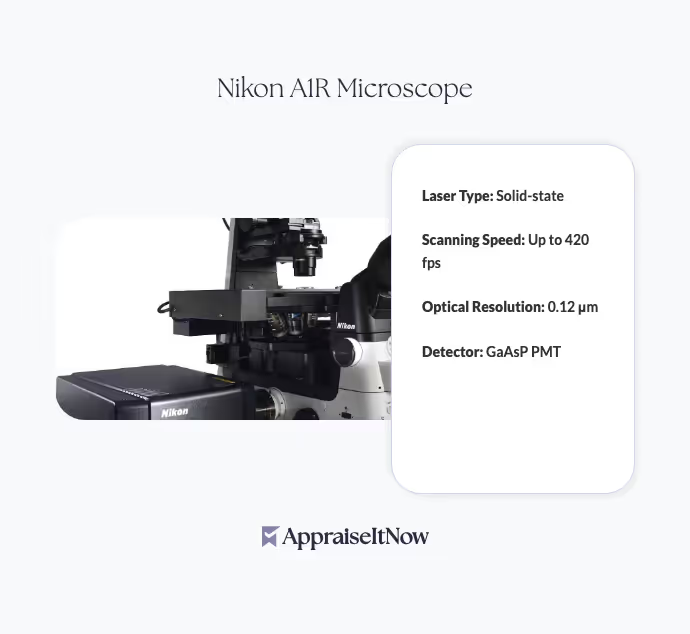
<p>Your A1R represents one of the most sophisticated optical systems available to researchers and scientists worldwide. Since its introduction in 2010, the A1R has become the standard for cutting-edge imaging work in cell biology, neuroscience, and materials science. The microscope's patented Resonant Scanner technology combined with proprietary GaAsP detectors creates imaging capabilities that justify its premium market position among comparable <a href="/types/equipment-and-machinery">equipment and machinery</a> assets.</p>
<p>The A1R's modular design means your specific system's value depends heavily on which components you've installed. A base unit with standard objectives will appraise significantly lower than a fully configured system with multiple laser lines, advanced detector arrays, and complementary software licenses. This component-specific valuation approach is crucial when determining your microscope's actual market worth.</p>
<div class="callout tip"><p><strong>Valuation Insight</strong></p>
<p>Complete systems with documentation of all installed components, software licenses, and maintenance records typically command 15-25% premiums over systems with unclear configurations.</p></div>
<h2>Component-Level Factors That Affect Your A1R's Value</h2>
<p>Understanding which specific parts influence your microscope's appraisal value helps you prepare comprehensive documentation before meeting with a professional appraiser. The A1R's architecture means several interchangeable and upgradeable elements directly impact resale value.</p>
<p><strong>Objectives and optical configurations</strong> form the foundation of value. The A1R accepts Nikon's full suite of objectives, ranging from 4x plan-apo to 100x oil-immersion lenses. Each objective represents significant capital investment, and their presence substantially increases your system's worth. A complete set of five to seven matched objectives can add $20,000-$40,000 to your appraisal.</p>
<p><strong>Laser systems</strong> represent another major value component. The A1R accommodates multiple laser lines (405nm, 488nm, 561nm, 635nm, and optional additional wavelengths), with each laser adding $5,000-$15,000 to system value depending on power and specifications. A fully equipped multi-laser system reaches the upper range of the $100,000-$150,000 valuation window.</p>
<p><strong>Detector configurations</strong> including standard photomultiplier tubes or the advanced GaAsP detector arrays significantly influence pricing. The proprietary GaAsP technology delivers enhanced sensitivity and faster imaging speeds, making systems equipped with these detectors worth 10-20% more than those with standard PMT configurations.</p>
<p>The motorized XY stage, z-focus mechanics, and integrated software licenses all contribute to comprehensive valuation. Your appraiser will examine whether the system includes NIS-Elements software, which alone carries licensing value of $10,000-$25,000 depending on module configurations and perpetual versus subscription arrangements.</p>
<h2>Gathering Essential Documentation for Your Appraisal</h2>
<p>Professional appraisers require specific documentation to establish accurate valuations for microscopy <a href="/blog/10-essential-tips-for-getting-an-accurate-lab-equipment-appraisal">equipment</a>. The more complete your records, the more confident your appraiser can be in the final valuation figure.</p>
<p>Start by locating your <strong>serial numbers</strong> for the main microscope body, stage, and all major component modules. These numbers allow appraisers to verify the system configuration against Nikon's production records and establish manufacturing dates. Serial number matching across components also confirms whether your system is original or has mixed components from different production runs—a distinction that affects value.</p>
<p><strong>Service and repair history</strong> documents tell the story of your A1R's maintenance and any major work performed. Records showing regular calibration, alignment procedures, or repairs by authorized Nikon service centers actually increase value by demonstrating proper care. Documentation of when alignment was last performed, for example, adds 5-10% to system value since proper optical alignment is critical for performance and requires specialized expertise.</p>
<p><strong>Purchase invoices and original quotes</strong> establish the system's original value and provide baseline documentation. If you have the original purchase order showing exactly which components and software were included, this accelerates the appraisal process considerably. Many organizations have these records archived in accounting or facilities departments.</p>
<p><strong>Software licenses and product keys</strong> represent substantial value that often gets overlooked. NIS-Elements software, AutoFocus modules, and other Nikon applications carry licensing restrictions and value. Appraisers need to understand whether licenses are perpetual, subscription-based, or tied to specific hardware. Software installation media or license documentation should be compiled during the appraisal preparation.</p>
<p><strong>Calibration certificates</strong> from authorized service providers validate that your system meets performance specifications. Current or recent calibration documents can add 10-15% to valuations by reducing buyer uncertainty about system performance. These certificates are particularly important if your A1R has been stored or idle, as they reassure potential buyers about optical and mechanical functionality.</p>
<div class="callout note"><p><strong>Documentation Priority</strong></p>
<p>Even partial documentation significantly improves appraisal accuracy. If you've lost certain records, an appraiser can often verify components through visual inspection and serial number analysis.</p></div>
<h2>Understanding Secondary Market Pricing</h2>
<p>The microscopy equipment secondary market operates differently from consumer goods markets. Recent sales data for used Nikon A1R systems shows considerable variation based on configuration completeness, age, and market segment.</p>
<p><strong>Research institutions and university departments</strong> form the primary buyer base for used A1R systems, creating relatively stable demand in the $80,000-$150,000 range depending on components. Corporate research divisions and pharmaceutical companies represent secondary buyers, often seeking systems for specific applications rather than comprehensive imaging suites.</p>
<p><strong>Scientific equipment dealers and specialty resellers</strong> typically purchase used A1R systems at 60-75% of your appraised value, meaning a system valued at $120,000 might sell through a dealer for $72,000-$90,000. However, direct sales to research institutions or individual scientists often realize prices closer to 75-85% of fair market value, particularly for well-configured and documented systems.</p>
<p><strong>Auction outcomes</strong> for microscopy equipment vary significantly. Specialized scientific equipment auctions (rather than general liquidation auctions) typically see A1R systems sell within 70-85% of professional appraisals, while general auctions may realize only 50-70% depending on buyer attendance and auction marketing. The venue where your system is sold directly impacts realized value.</p>
<p>Geographic location influences secondary market pricing. Coastal regions with concentrations of research institutions and biotech companies typically see higher realized prices than rural areas. Similarly, systems located near major research universities attract more qualified bidders and competitive pricing.</p>
<h2>Age, Maintenance, and Depreciation Dynamics</h2>
<p>The Nikon A1R's depreciation curve differs substantially from most equipment due to its specialized nature and limited secondary supply. Understanding these depreciation patterns helps you contextualize your system's current value within the broader $100,000-$150,000 market range.</p>
<p>Systems from 2010-2012 (original A1R generation) currently appraise at approximately <strong>$60,000-$90,000</strong>, reflecting 15+ years of age and potential obsolescence concerns around software compatibility with modern operating systems. However, these earlier models remain scientifically valuable for core imaging applications, maintaining stronger value retention than comparable general laboratory equipment.</p>
<p>A1R systems manufactured from 2013-2016 typically appraise in the <strong>$80,000-$120,000</strong> range, representing the sweet spot for secondary market demand. These systems benefit from improved software versions, enhanced detector options available during that period, and recent enough age that software support remains viable.</p>
<p><strong>Newer A1R systems from 2017 onward</strong> command the premium end of the valuation range, with fully configured examples reaching $130,000-$150,000+. These systems incorporate the latest software iterations, improved laser specifications, and optical refinements introduced during the later product lifecycle.</p>
<p>Maintenance history dramatically affects age-related depreciation. A well-maintained 2012 A1R with documented regular service, alignment, and cleaning schedules might appraise at $85,000, while a neglected 2012 system with unknown maintenance history could appraise at $65,000—a 23% difference attributable solely to demonstrable care.</p>
<p>Software upgrades and firmware updates represent another maintenance factor influencing value. Systems running current NIS-Elements software versions appraise 10-15% higher than those on obsolete software, even if the underlying optical system remains identical. This makes maintaining software licenses particularly important for value retention.</p>
<h2>Remote Versus In-Person Appraisal Considerations</h2>
<p>Whether you pursue remote photo-based appraisal or in-person inspection depends on your specific situation and the system's condition and complexity. Understanding the advantages and limitations of each approach helps you choose appropriately.</p>
<p><strong>Remote photo-based appraisals</strong> work well for systems in excellent condition with complete documentation and clear photographs. If you can provide high-resolution images showing serial numbers, component configurations, optical quality, and any visible wear or damage, experienced microscopy appraisers can provide accurate valuations within 5-10% of in-person assessments. Remote appraisals typically take 3-5 business days and cost significantly less than in-person evaluations.</p>
<p>Remote appraisals become problematic when your A1R shows significant age-related signs like dust inside optical pathways, stage movement quality issues, or unclear component status. Additionally, if major components are missing or if you're uncertain about the complete system configuration, remote assessment may miss critical details affecting value.</p>
<p><strong>In-person inspections</strong> provide comprehensive assessment but require significantly more time and cost. A qualified appraiser visiting your facility can thoroughly evaluate optical alignment quality, mechanical functionality of motorized stages, laser output characteristics, and software functionality—details impossible to assess remotely. In-person appraisals typically take 4-8 hours including detailed photography, testing, and report compilation.</p>
<p>For systems valued above $120,000, in-person appraisal generally becomes economically justified. The additional 2-5% accuracy improvement in valuation easily offsets the $1,000-$3,000 cost difference versus remote assessment. For systems in the $80,000-$100,000 range, remote appraisal with comprehensive photography often provides adequate accuracy.</p>
<div class="callout tip"><p><strong>Appraisal Strategy</strong></p>
<p>Start with remote appraisal if you have good documentation. If the initial assessment suggests significant value or if questions arise about components, schedule in-person inspection for definitive valuation.</p></div>
<h2>Timeline and Cost Expectations</h2>
<p>Professional appraisals of microscopy equipment like the Nikon A1R follow predictable timelines and fee structures, though costs vary based on complexity and assessment method.</p>
<p><strong>Remote appraisals</strong> typically take 3-7 business days from submission of photos and documentation to delivery of the final report. AppraiseItNow and similar services with specialized <a href="/blog/a-guide-to-understanding-the-value-of-laboratory-equipment">laboratory equipment expertise</a> can often provide preliminary assessments within 24-48 hours. Remote appraisal fees generally range from $300-$800 depending on the service provider and report complexity.</p>
<p><strong>In-person appraisals</strong> require scheduling coordination and travel time, extending timelines to 2-4 weeks from initial contact to final report. However, the actual inspection typically occurs within 5-10 business days once scheduled. In-person appraisal fees typically range from $1,200-$3,500 including travel, inspection, photography, and detailed documentation.</p>
<p>Both approaches generate formal appraisal reports suitable for insurance purposes, financial reporting, litigation, or donation documentation. USPAP-compliant reports from credentialed appraisers (AAA, ISA, ASA, CAGA, AMEA credentials) meet bank, insurance, and court standards for verification and evidence.</p>
<p>The investment in professional appraisal pays for itself through accurate insurance coverage, informed sale decisions, and credible documentation for any purpose. A $500-$2,000 appraisal protecting a $120,000 asset represents excellent value protection.</p>
<h2>Where to Sell Your A1R for Optimal Pricing</h2>
<p>Understanding which marketplace matches your system's characteristics helps maximize realized value. Different sales channels attract different buyer types, directly affecting final price realization.</p>
<p><strong>Direct sales to research institutions</strong> typically yield the highest prices—often 80-90% of appraised value—when researchers specifically need your system's configuration. Contacting department chairs or research administrators at universities and research hospitals near your location can identify interested buyers. These sales require more sales effort but generate stronger returns.</p>
<p><strong>Scientific equipment resellers and dealers</strong> provide faster sales with modest price reduction (typically 60-75% of appraised value). These professionals handle inspection, transport, and buyer matching, making the process simpler though less profitable. Dealers maintain buyer networks and can often close sales within 30-45 days.</p>
<p><strong>Specialized scientific equipment auctions</strong> (distinct from general liquidation auctions) attract serious buyer communities and typically realize 70-85% of appraised value. Online platforms and regional auction houses specializing in laboratory equipment often generate competitive bidding, particularly for complete systems with good documentation.</p>
<p><strong>Online consignment platforms</strong> for scientific equipment have emerged as middleground options, offering faster sales than direct private sales with better pricing than dealer purchases. These platforms typically charge 15-25% commission on final sale price while handling photography, listing, and logistics.</p>
<p><strong>General liquidation auctions</strong> should be your last choice for high-value systems unless urgency overrides financial optimization. General auctioneers typically realize only 50-70% of appraised value due to limited qualified buyer attendance and minimal equipment-specific marketing.</p>
<h2>Documentation for Insurance, Donation, or Litigation</h2>
<p>Your appraisal report serves multiple critical functions beyond simple valuation. Professional USPAP-compliant appraisals from credentialed experts provide documentation accepted by insurance companies, tax authorities, courts, and financial institutions.</p>
<p><strong>Insurance purposes</strong> require appraisals specifically stating replacement cost value—what it would cost to replace your exact system with a comparable new or used equivalent. These reports should document condition, serial numbers, and specific coverage recommendations including agreed-value policies that prevent disputes at claim time.</p>
<p><strong>Tax donation documentation</strong> for charitable contributions requires Fair Market Value appraisals meeting IRS requirements. These specialized reports quantify the deduction amount and provide the substantiation needed for tax filings exceeding $5,000.</p>
<p><strong>Litigation and asset division</strong> (divorce, bankruptcy, or business valuations) demands appraisals withstanding expert challenge. Credentialed appraisers provide defensible methodologies and comparable sales analysis that survive courtroom scrutiny.</p>
<p>Professional appraisals ensure you have authoritative documentation protecting your interests across these varied applications.</p>
<div class="callout note"><p><strong>Key Takeaway</strong></p>
<p>A USPAP-compliant appraisal of your Nikon A1R Microscope provides accurate valuation ($100,000-$150,000 range), comprehensive component documentation, and credible evidence for insurance, sale, donation, or legal purposes. Whether pursuing remote assessment or in-person inspection, professional appraisal transforms your system's worth from uncertain estimate into verified financial fact.</p></div>