









<h1>How to Get Your Nanalysis NMR 60Pro Appraised</h1>
<p>The Nanalysis NMR 60Pro represents a significant investment for research laboratories and analytical facilities. Whether you're evaluating this <strong>$75,000–$95,000</strong> benchtop NMR spectrometer for purchase, sale, insurance, or financial purposes, obtaining a professional appraisal ensures you have accurate, defensible documentation of its market value.</p>
<h2>Understanding the Nanalysis NMR 60Pro's Market Position</h2>
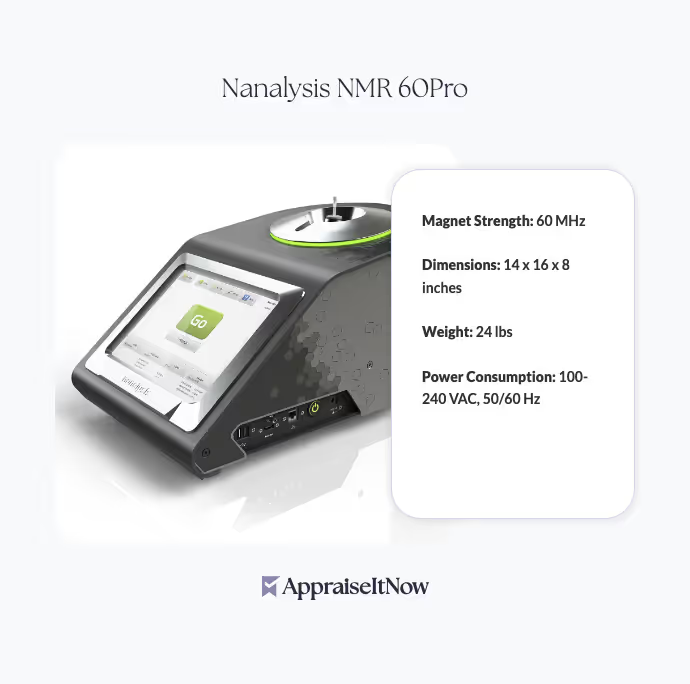
<p>Your NMR 60Pro occupies a unique position in the analytical instrumentation market. Launched in 2018, this compact benchtop system delivers performance previously available only in larger, more expensive systems. The 60 MHz permanent magnet provides exceptional resolution and sensitivity for analyzing organic molecules, polymers, and biological samples, making it an indispensable tool across academia, pharmaceuticals, chemical manufacturing, and contract research organizations.</p>
<div class="callout tip"><p><strong>Market Insight</strong></p>
<p>Benchtop NMRs like the 60Pro command stronger secondary market demand than ever before, as research budgets shift toward cost-effective instrumentation without sacrificing analytical capability.</p></div>
<p>The current market value range of <strong>$75,000–$95,000</strong> for the NMR 60Pro reflects its position as a mid-range analytical instrument—far more affordable than high-field systems (400, 600, or 800 MHz) that routinely cost $500,000 to $3 million, yet substantially more expensive than entry-level alternatives. This sweet spot in pricing makes accurate appraisal critical when making acquisition or divestment decisions.</p>
<h2>Key Specifications That Influence Your NMR's Appraisal Value</h2>
<p>When you seek a professional appraisal for your Nanalysis NMR 60Pro, several technical specifications and operational features directly impact valuation. The system's 60 MHz permanent magnet design—engineered through Nanalysis's patented magnet technology—provides superior stability and temperature regulation, which appraisers carefully document because these features affect both performance longevity and resale appeal.</p>
<p>Your NMR 60Pro's multi-nuclei capability (supporting ¹H, ¹³C, and ¹⁹F analysis) determines applicable research applications and market breadth. The automated shimming and tuning functionality represents significant technological advancement compared to older manual-adjustment instruments, directly translating to higher valuation for well-maintained units. The comprehensive software suite bundled with the system—including processing, analysis, and data management tools—adds tangible value that professional appraisers quantify when evaluating the complete package.</p>
<p>The aluminum alloy construction, implemented since the product's 2018 introduction, supports extended operational life while maintaining the instrument's compact benchtop footprint. Unlike earlier generations or competing systems using different materials, the NMR 60Pro's durable construction contributes to favorable depreciation rates and strong secondary market demand.</p>
<h2>Age, Condition, and Calibration History Matter</h2>
<p>When determining why NMR systems command such varied prices in the used market, three factors emerge as particularly influential: age, operational condition, and documented calibration history. A well-maintained NMR 60Pro from 2020 might fetch <strong>$85,000–$92,000</strong>, while an identical 2018 model in poor condition with incomplete service records could appraise at <strong>$65,000–$75,000</strong>—a significant differential.</p>
<p>Professional appraisers examine detailed service records documenting regular maintenance, calibration intervals, and any repairs or component replacements. The backing of the 5-year manufacturer warranty—if still active or recently expired—substantially affects value. Systems approaching or beyond warranty expiration typically see modest valuation reductions reflecting future maintenance costs that buyers must anticipate. Documentation of certified calibration against traceable standards represents particularly important evidence of operational reliability, especially for laboratory equipment destined for regulated industries (pharmaceuticals, contract research, quality control) where compliance documentation is mandatory.</p>
<p>The operational history matters significantly. An NMR 60Pro used intensively in a high-throughput core facility may show heavier wear than a research lab's intermittently-used system, directly influencing condition assessment. Appraisers investigate whether the magnet has been properly maintained in its field-locked state, whether the cryogenic system (if applicable) has been serviced regularly, and whether sample introduction mechanisms show signs of wear.</p>
<h2>How Accessories, Probes, and Software Enhance Value</h2>
<p>The completeness of your NMR 60Pro's accessory ecosystem significantly impacts appraisal value. Beyond the base instrument, professional appraisers quantify the worth of included components. A system bundled with multiple RF probes (perhaps including broadband, observe, or specialized nuclei probes) carries substantially higher value than a bare system. Each additional probe adds $3,000–$8,000 to the overall valuation, depending on specifications and condition.</p>
<p>Liquid sample handling accessories—including autosamplers, temperature control modules, or flow injection systems—expand the instrument's analytical range and command corresponding value premiums. Your NMR's software suite represents another critical asset. Full software licenses for advanced processing, 2D NMR experiments (COSY, HSQC, HMBC), quantitation modules, and structure elucidation tools add tangible value. Transferability of software licenses during sale requires careful documentation and vendor approval, factors that experienced appraisers address directly with Nanalysis representatives.</p>
<p>Service contracts or extended warranties, if transferable to new owners, enhance valuation. Many laboratories acquire systems near warranty expiration and value the assurance of continued manufacturer support. Documentation of included peripherals—computer systems, sample trays, calibration standards, documentation libraries—should accompany your appraisal request.</p>
<h2>Why Field Strength, Instrument Type, and Market Demand Matter</h2>
<p>The question of how field strength affects NMR valuation illuminates important market dynamics. Your 60 MHz NMR 60Pro occupies a distinct market segment from higher-field systems. Why are 400, 600, and 800 MHz instruments more expensive? These systems employ superconducting magnets cooled by liquid helium, representing fundamentally different technology than the NMR 60Pro's permanent magnet design. A 400 MHz superconducting NMR might cost $400,000–$600,000 new, while 800 MHz systems exceed $2 million.</p>
<p>However, the secondary market dynamics differ markedly. High-field NMRs depreciate rapidly initially due to operational complexity and the expense of maintaining helium cooling systems. Used 400 MHz instruments frequently trade for $150,000–$250,000, less than half their original cost. The NMR 60Pro's permanent magnet approach creates different economics—lower initial capital, simpler operation, and more resilient residual values.</p>
<p>This positions the benchtop NMR market as increasingly attractive to budget-conscious research institutions and startup contract laboratories. Demand in the secondary market for 60 MHz instruments significantly exceeds that for high-field systems, meaning your NMR 60Pro holds resale potential more reliably than costlier alternatives. Contemporary trends show laboratories consolidating to one high-field system for complex structure elucidation while acquiring multiple benchtop instruments for routine analysis—a shift that supports your NMR 60Pro's market positioning.</p>
<div class="callout note"><p><strong>Market Reality</strong></p>
<p>Benchtop NMRs like the 60Pro demonstrate depreciation rates of 10–15% annually for the first five years, substantially outperforming high-field instruments that lose 20–40% of value in the same period.</p></div>
<h2>Documentation Requirements for USPAP-Compliant Appraisals</h2>
<p>Professional appraisers preparing USPAP-compliant valuations for laboratory equipment like your NMR 60Pro follow rigorous documentation standards. You should compile several categories of supporting materials to facilitate thorough, defensible appraisals.</p>
<p><strong>Acquisition and Service Records</strong> form the foundation. Original purchase invoices establish acquisition price and date—critical baseline information. Complete service and maintenance logs documenting all maintenance, repairs, or component replacements demonstrate careful stewardship. Annual calibration certificates from qualified service providers (Nanalysis field engineers or authorized service centers) provide objective evidence of ongoing functionality and compliance with manufacturer specifications. Any instances of downtime, malfunction, or corrective action should be documented.</p>
<p><strong>Technical Documentation and Specifications</strong> include the original operator's manual, instrument specifications, software version information, and any factory updates or modifications. This documentation proves the system's configuration and capabilities, essential for valuation accuracy.</p>
<p><strong>Compliance and Regulatory Records</strong> matter particularly if your NMR operates in regulated environments. Quality assurance documentation, validation protocols, and records of 21 CFR Part 11 compliance (if applicable) add value for systems destined for pharmaceutical or clinical applications.</p>
<p><strong>Photographs and Physical Condition Documentation</strong> should capture the overall system, display screens, control interfaces, sample handling components, and any visible wear. Professional appraisers often request or conduct in-person inspections to verify condition against photographic documentation.</p>
<p>When seeking appraisal services for your NMR 60Pro, ensure your provider specializes in <a href="/types/lab-equipment">laboratory equipment</a> valuation and understands analytical instrumentation. This expertise ensures comprehensive assessment of technical specifications, market demand, and regulatory compliance factors that general appraisers might overlook.</p>
<h2>Why Reason for Appraisal Affects Report Content and Approach</h2>
<p>The purpose driving your appraisal request influences how professional appraisers structure their analysis and conclusions. When appraising for <strong>sale purposes</strong>, appraisers emphasize fair market value—the price at which an NMR 60Pro would change hands between a willing buyer and seller, neither under pressure. This approach typically yields valuations at the moderate end of the range, reflecting realistic secondary market pricing.</p>
<p><strong>Insurance appraisals</strong> often target replacement cost value—what you'd pay to acquire an equivalent functioning system today. This frequently produces higher valuations than fair market value, particularly if your original NMR is older or harder to locate. Insurance companies require USPAP compliance and supporting comparable sales data.</p>
<p><strong>Donation appraisals</strong> for charitable contributions require adherence to IRS standards, with appraisers determining fair market value while documenting the charitable organization's intended use. These appraisals must justify valuations through comparative analysis and may differ from commercial sale valuations.</p>
<p><strong>Litigation and estate planning appraisals</strong> demand meticulous documentation of valuation methodology, with appraisers prepared to defend conclusions in legal proceedings. These reports typically include extensive comparable sales analysis and sensitivity testing of key assumptions.</p>
<p><strong>Equipment financing and lease valuations</strong> require appraisers to estimate residual values at predetermined future dates, necessitating careful consideration of depreciation curves and market conditions. Lenders and lessors depend on accurate projections to structure financing appropriately.</p>
<p>Professional appraisers adjust their analysis framework based on your intended use, ensuring reports serve their specific purpose while maintaining USPAP standards. Understanding this distinction helps you communicate your needs clearly and receive appropriately targeted appraisal documentation.</p>
<h2>The Professional Appraisal Timeline and Investment</h2>
<p>Professional appraisal for your Nanalysis NMR 60Pro typically requires <strong>5–10 business days</strong> from submission through final report delivery. This timeline encompasses initial documentation review, condition assessment, market research, comparable sales analysis, and report preparation. Appraisers specializing in <a href="/types/equipment-and-machinery">equipment and machinery</a> valuations maintain databases of comparable sales and market transactions, enabling rapid market analysis without extending timelines.</p>
<p>The cost for a comprehensive NMR 60Pro appraisal typically ranges from <strong>$1,500–$3,500</strong>, depending on complexity and appraiser credentials. This represents a modest investment relative to the instrument's $75,000–$95,000 value, particularly when you consider the appraisal's utility for insurance, sale, financing, or dispute resolution. Appraisers certified by professional organizations (AAA, ISA, ASA, CAGA, AMEA) command consistent fees in this range, justified by their credentials, research capabilities, and defensible conclusions.</p>
<p>Secure online submission platforms used by specialized appraisal services like <strong>AppraiseItNow</strong> streamline the process. You photograph your NMR, describe its condition and configuration, upload supporting documentation, and receive expert analysis without requiring in-person visits for straightforward valuations. When physical inspection adds value—particularly for detailed condition assessment—appraisers coordinate facility visits with your research team.</p>
<div class="callout tip"><p><strong>Pro Tip</strong></p>
<p>Collect all maintenance records, calibration certificates, and original documentation before submitting your appraisal request. Complete documentation accelerates analysis and strengthens the credibility of final valuations.</p></div>
<h2>Connecting Your Appraisal to Broader Asset Management Strategies</h2>
<p>Your NMR 60Pro appraisal fits within broader asset management and capital planning strategies. Research institutions managing multiple instruments benefit from comprehensive equipment inventory appraisals for portfolio valuation, depreciation tracking, and strategic replacement planning. An accurate appraisal establishes baseline values useful for subsequent depreciation calculations or fair market value adjustments in subsequent years.</p>
<p>For organizations considering decommissioning aging instrumentation, accurate appraisals determine whether systems warrant sale into secondary markets or disposal. A 2018 NMR 60Pro with strong maintenance records might generate $60,000–$75,000 in secondary market proceeds, justifying the effort of arranged sales rather than disposal. Understanding your equipment's residual value informs these decisions strategically.</p>
<p>Appraisals also support capital equipment financing and lease arrangements. Lenders require professional valuations establishing collateral value before approving equipment financing. Similarly, lease residual value calculations depend on accurate appraisals predicting instrument value at lease conclusion. Professional documentation strengthens your institution's negotiations with financial providers.</p>
<p>For laboratories considering equipment swaps, upgrades, or relocation to new facilities, knowing your NMR 60Pro's precise market value informs decisions about retention, sale, or trade-in arrangements. The appraisal process, while sometimes viewed as a compliance necessity, actually provides strategic intelligence supporting sound capital decisions.</p>
<hr />
<div class="callout note"><p><strong>Key Takeaway</strong></p>
<p>A certified USPAP-compliant appraisal of your Nanalysis NMR 60Pro provides defensible documentation of its <strong>$75,000–$95,000</strong> market value, supported by comprehensive analysis of technical specifications, condition, market demand, and comparable instruments. Whether you're buying, selling, insuring, financing, or managing laboratory assets, professional appraisal expertise ensures accurate valuation and confidence in your equipment decisions.</p></div>