









<h1>How to Get Your Koike Laser Cutting Machine Appraised</h1>
<p>A Koike laser cutting machine represents a significant capital investment for your manufacturing or metalworking operation. Whether you're purchasing, selling, financing, or insuring this specialized equipment, understanding how to navigate the appraisal process ensures you get accurate valuations that reflect current market conditions and your specific machine's condition. With estimated values ranging from <strong>$250,000 to $320,000</strong>, getting the appraisal right matters substantially.</p>
<h2>Understanding Your Koike's Market Position</h2>
<p>The Koike laser cutting machine has established itself as a cornerstone asset in modern fabrication shops since its introduction in 1985. Over 10,000 units are now operating across factories worldwide, creating a stable secondary market while maintaining strong demand for well-maintained examples. Your machine's value depends on multiple interconnected factors beyond just age or basic specifications.</p>
<div class="callout tip"><p><strong>Market Insight</strong></p>
<p>Current market demand for used Koike machines remains strong, with recent sale prices clustering around $250,000–$320,000 for units in good working condition with proper documentation.</p></div>
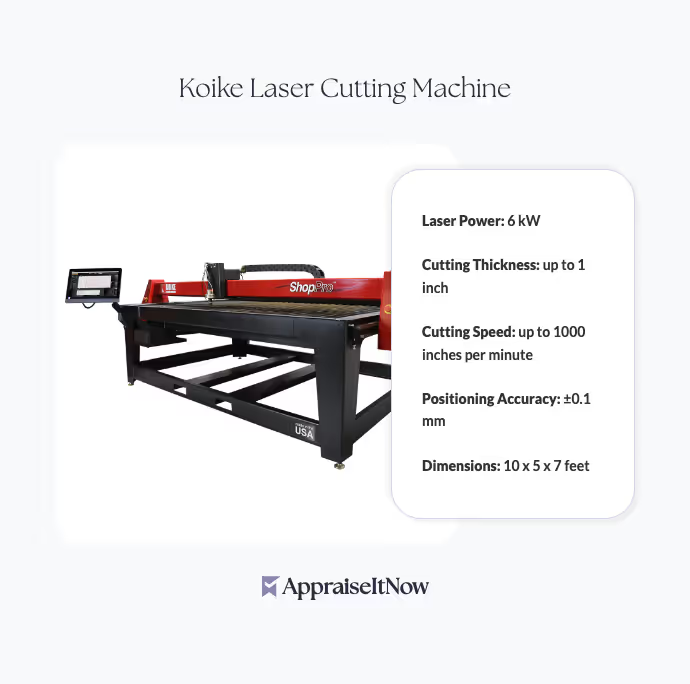
<p>The Koike's advanced CNC control system and high-grade stainless steel construction make it capable of handling complex cutting patterns across steel, aluminum, and stainless steel materials. This versatility appeals to diverse buyers, from small job shops to larger contract manufacturers. When evaluating your machine's market position, understanding which technical and condition factors most influence value becomes essential for securing an accurate appraisal.</p>
<h2>Key Technical Factors That Drive Valuation</h2>
<p>When appraising your Koike laser cutting machine, specialized evaluators examine specific technical characteristics that directly impact market value. The laser wattage and tube type form the foundation of operational capability—your machine's original specifications determine its speed and cutting capacity relative to comparable models. Higher-wattage systems command premium valuations, though this advantage diminishes if the laser tube has approached end-of-life without replacement.</p>
<p>Cutting hours represent perhaps the single most important condition indicator. A machine with 5,000 hours of documented operation sits in a different value category than one with 25,000 hours, even if both function identically. This mirrors how <a href="/types/equipment-and-machinery">equipment and machinery appraisal</a> considers usage intensity across all industrial assets. Professional appraisers request maintenance logs showing when the laser tube was replaced, how frequently alignment and calibration occurred, and what repair history exists.</p>
<table class='appraisal-table'>
<thead>
<tr>
<th>Key Technical Element</th>
<th>Value Impact</th>
<th>Appraisal Consideration</th>
</tr>
</thead>
<tbody>
<tr>
<td>Laser wattage and tube type</td>
<td>±20-30% variance</td>
<td>Cutting speed, material thickness capability</td>
</tr>
<tr>
<td>Cumulative cutting hours</td>
<td>±15-25% variance</td>
<td>Equipment wear, remaining operational life</td>
</tr>
<tr>
<td>CNC control system condition</td>
<td>±10-15% variance</td>
<td>Software updates, spare parts availability</td>
</tr>
<tr>
<td>Maintenance record completeness</td>
<td>±5-10% variance</td>
<td>Documented care, professional servicing</td>
</tr>
</tbody>
</table>
<p>The control system's sophistication and software currency also matter significantly. A Koike with updated drivers and accessible technical support documentation appraises higher than one with legacy systems lacking modern compatibility. Parts replacement history—particularly whether the laser tube, optics, and motion components were serviced by authorized Koike technicians—influences both value and buyer confidence.</p>
<div class="callout note"><p><strong>Appraisal Focus</strong></p>
<p>Comprehensive maintenance records documenting professional service intervals become critical documentation when supporting a high-value appraisal in the $250k–$320k range.</p></div>
<h2>Documentation That Supports Valuation</h2>
<p>Getting a credible appraisal requires presenting professional documentation that verifies your machine's condition and operational history. Service logs showing routine maintenance, calibration certificates proving optical alignment, and invoices for parts replacements all substantiate your machine's true market value. Without these records, appraisers must discount your valuation to account for unknown condition variables.</p>
<p>When seeking documentation to strengthen your appraisal, compile purchase invoices establishing original specifications and acquisition date. Calibration records demonstrate that your machine operates within manufacturer tolerances. Parts replacement receipts—particularly for the laser tube, which typically lasts 8,000–12,000 hours—show professional maintenance rather than neglect or amateur repairs. These records essentially tell the story of your machine's care and directly influence whether an appraiser supports the higher or lower end of the $250,000–$320,000 valuation range.</p>
<p>Service contracts and warranty documentation add credibility to your appraisal file. The Koike's 5-year manufacturer warranty, if transferred upon sale or documented as maintained during ownership, reduces buyer risk and supports higher valuations. For <a href="/types/metalworking-equipment">metalworking equipment</a> appraisals specifically, these institutional records carry significant weight in USPAP-compliant valuations.</p>
<h2>Industry Market Conditions and Demand Dynamics</h2>
<p>Your Koike's value fluctuates based on broader manufacturing market conditions and the competitive landscape for laser cutting capacity. During periods of strong industrial demand, when fabricators rush to add capacity, used machines trade at premium prices relative to baseline valuations. Conversely, economic uncertainty may depress secondary market values even for well-maintained equipment. Understanding these cyclical patterns helps you time sales strategically or negotiate purchases intelligently.</p>
<p>Local versus national buyer pools dramatically affect achievable prices. A Koike laser cutter in a region with concentrated metalworking activity may attract multiple qualified buyers willing to negotiate above minimum prices. The same machine in a region with limited manufacturing presence faces narrower buyer interest and potentially lower realized values. Professional appraisers factor in geographic demand when conducting <a href="/blog/the-benefits-of-professional-equipment-and-machinery-appraisal">machinery valuations</a>.</p>
<p>Competing brands create additional market pressure. While Koike machines command respect for reliability and precision, comparable systems from Trumpf, Bystronic, and Amada compete directly for the same buyer dollars. An appraiser familiar with recent auction records and secondary market listings for these alternative brands positions your Koike's value appropriately within the broader competitive context. Some buyers view Koike favorably for value and operating cost efficiency, while others prefer larger manufacturers with more established service networks.</p>
<div class="callout tip"><p><strong>Market Reality</strong></p>
<p>Your Koike's resale value strengthens in regions with active metalworking industries and concentrated potential buyer bases. Understanding local market demand helps explain whether your machine appraises toward the $250k or $320k range.</p></div>
<h2>Transport, Installation, and Logistical Considerations</h2>
<p>The physical reality of moving and installing a $250,000–$320,000 laser cutting machine significantly impacts its fair market value. Buyers factor substantial costs for transport, disassembly from your facility, reassembly at their location, and professional realignment into their purchase price negotiations. These soft costs—which you may have absorbed years ago when acquiring the machine—now represent real value deductions from the equipment's "as installed" price.</p>
<p>A buyer's perspective shifts when understanding that relocating your Koike requires specialized handling to prevent optical misalignment, potential damage to precision components, and extended downtime during installation. These realities mean buyers typically negotiate based on the machine's condition and portability rather than assuming they're simply purchasing a portable asset. Appraisers account for transportation difficulty and installation expertise requirements when valuing <a href="/types/heavy-machinery">heavy machinery</a> and specialized industrial equipment.</p>
<p>If your Koike is equipped for easy relocation—perhaps it was recently moved or documented as transportation-tested—this positively influences appraisal values. Conversely, machines bolted permanently into facility infrastructure or requiring specialized lifting equipment to move face valuation discounts reflecting their practical immobility.</p>
<h2>Professional Appraisal Turnaround and Investment</h2>
<p>Appraising equipment in the $250,000–$320,000 range typically requires 3–6 weeks from initial submission to final certified report. The process involves detailed physical inspection, documentation review, market research, and professional analysis that justifies this timeline. Appraisal fees for machines in this value range generally fall between $2,500–$5,000, depending on complexity, location, and required travel for on-site evaluation.</p>
<p>What drives these costs? Complex valuations require market research across multiple geographies, potentially contacting recent buyers and sellers for comparable transaction data. Detailed condition assessment demands expertise in laser systems, CNC controls, and industrial machinery. Professional written reports suitable for financing, insurance, or litigation purposes require documented analysis that stands up to third-party scrutiny. Traveling to your facility for physical inspection adds expense but dramatically increases appraisal credibility for high-value assets.</p>
<p>Several factors influence whether your appraisal lands at the lower or higher end of typical pricing. Equipment requiring on-site inspection costs more than appraisals based on detailed photography and documentation. Machines with complex or unusual configurations demand additional appraiser expertise. <a href="/blog/the-basics-of-equipment-and-machinery-appraisal">Equipment valuations</a> tied to financing often require lender-specific compliance documentation, increasing complexity.</p>
<h2>Appraisal Purposes and Report Types</h2>
<p>Your appraisal's intended purpose shapes the specific documentation and analysis required. If you're purchasing equipment, a financial assessment validates the seller's asking price and protects your capital investment. Sellers preparing machines for auction need market-value opinions that guide reserve pricing and marketing strategy. Equipment financing requires cost approaches demonstrating lender-secure asset values. Insurance purposes demand replacement-cost assessments ensuring adequate coverage for loss scenarios.</p>
<p>Estate and tax situations require different analytical frameworks than commercial transactions. Tax valuations for depreciation purposes follow specific guidelines differing from fair market value assessments used in sales contexts. Litigation-related appraisals demand exceptional documentation rigor since opposing counsel will scrutinize methodology and conclusions. Understanding which appraisal type matches your specific need ensures the professional you engage provides exactly the documentation required.</p>
<div class="callout note"><p><strong>Key Distinction</strong></p>
<p>Different appraisal purposes—sale, financing, insurance, estate, taxation—require distinct analytical approaches and documentation. Specifying your purpose when requesting an appraisal ensures the professional delivers precisely what you need.</p></div>
<h2>Comparable Analysis and Benchmark Data</h2>
<p>Determining your Koike's specific value within the $250,000–$320,000 range requires analyzing recent comparable sales and current market listings. Professional appraisers maintain databases of recent transactions for laser cutting equipment, including auction house sales, dealer listings, and private transactions. This data reveals whether machines similar to yours are commanding premium prices or facing buyer resistance.</p>
<p>Comparable benchmarking extends beyond just Koike models to include alternative brands with similar cutting capacity, speed, and precision capabilities. A Trumpf or Bystronic laser system with equivalent specifications provides context for your Koike's competitive positioning. Some buyers view Koike as offering superior value relative to larger European manufacturers, while others prefer brands with more extensive local service networks. These buyer preferences influence realized prices in your regional market.</p>
<p>Recent auction data provides particularly valuable insight into realistic pricing. When comparable equipment sells below estimates, it signals market softness or buyer concerns about specific machine characteristics. Conversely, auctions where machines exceed estimates suggest strong demand and potential upside to valuations. Professional appraisers track these trends systematically to position your specific machine accurately.</p>
<h2>Depreciation Methodology and Tax Considerations</h2>
<p>Your Koike's depreciation path differs significantly depending whether you're calculating tax deductions versus establishing fair market value for sale purposes. Tax depreciation typically follows MACRS (Modified Accelerated Cost Recovery System) guidelines, allowing accelerated write-downs relative to actual market value loss. A machine purchased for $400,000 five years ago might have book value of $150,000 for tax purposes while maintaining $280,000 fair market value in today's secondary market.</p>
<p>Understanding this distinction becomes critical when selling equipment, negotiating insurance coverage, or planning capital asset strategies. An appraiser familiar with both tax and market value methodologies helps you optimize these calculations across multiple reporting purposes. Commercial appraisal standards require clear distinction between cost approach valuations and market-based assessments, ensuring your documentation maintains integrity regardless of how the appraisal gets used.</p>
<h2>The Appraisal Report and Your Next Steps</h2>
<p>A professional USPAP-compliant appraisal report delivers comprehensive documentation of your machine's estimated value, the methodology supporting that estimate, condition observations, and market analysis justifying the conclusion. When engaging AppraiseItNow or similar specialized platforms, you submit detailed photos, operational history, and specifications online. Certified experts review this documentation, potentially conduct on-site inspection, and deliver professional reports accepted by lenders, insurers, and legal proceedings.</p>
<p>For <a href="/blog/what-types-of-equipment-and-machinery-can-be-appraised">machinery appraisals</a> involving specialized industrial equipment like laser cutting systems, working with appraisers who specifically understand metalworking technology ensures accurate assessment. Generic equipment appraisers may undervalue or misunderstand technical factors unique to precision laser systems.</p>
<div class="callout note"><p><strong>Key Takeaway</strong></p>
<p>A certified appraisal of your Koike laser cutting machine provides the documentation you need for confident buying, selling, financing, or insurance decisions. The investment in professional valuation pays dividends by ensuring you understand your equipment's true market position within the $250,000–$320,000 range and by providing defensible documentation for any third-party requirements.</p></div>