









<h1>How to Get Your Jouan Centrifuge CR412 Appraised</h1>
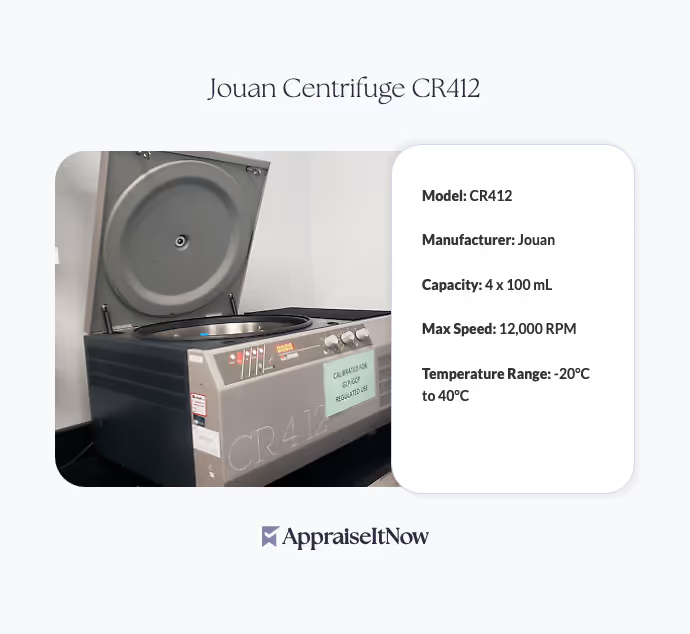
<p>The Jouan Centrifuge CR412 stands as a cornerstone piece of laboratory equipment, valued between <strong>$25,000 and $35,000</strong> in today's market. Whether you're acquiring one, liquidating lab assets, or establishing insurance coverage, understanding what drives the valuation of this robust benchtop centrifuge ensures you receive an accurate appraisal that reflects its true worth.</p>
<h2>What Makes the Jouan CR412 Valuable</h2>
<p>Since its introduction in 1995, the Jouan CR412 has earned a reputation as a highly sought-after workhorse in research and clinical laboratories worldwide. Its value stems from exceptional engineering that combines robust construction with precise speed and temperature controls—features that remain relevant even as newer models enter the market.</p>
<p>The CR412's versatility matters tremendously when assessing value. Its ability to handle everything from small-scale experiments to large-scale sample processing across diverse tube sizes and sample volumes makes it suitable for numerous applications. When evaluating <a href="/types/lab-equipment">lab equipment</a> like the CR412, appraisers recognize that this flexibility translates directly to market demand and residual value.</p>
<div class="callout tip"><p><strong>Market Insight</strong></p>
<p>The CR412's intuitive touchscreen interface and compact footprint distinguish it from comparable centrifuges of its era, supporting stronger retention of value compared to older models lacking these features.</p></div>
<h2>Key Factors That Influence Your CR412's Appraisal Value</h2>
<p>Understanding which specific elements appraisers scrutinize helps you prepare documentation and recognize what affects your equipment's worth.</p>
<p><strong>Age and operating hours</strong> remain primary valuation drivers. While the CR412's 1995 introduction date now places it nearly 30 years in service, many examples remain highly functional. Appraisers carefully evaluate cumulative runtime—a lightly used laboratory unit with 10,000 operating hours commands significantly higher value than a heavily utilized system with 50,000+ hours, even when both function properly.</p>
<p><strong>Service history documentation</strong> dramatically influences appraisals. Units with complete maintenance logs demonstrating regular calibration, filter changes, and professional servicing fetch premiums of 15-25% above comparable equipment lacking such records. If your CR412 includes original calibration certificates or third-party validation of specifications, these documents add substantial credibility to your appraisal.</p>
<p>The presence of <strong>original accessories</strong> matters considerably. CR412 units with their complete complement of rotors, adapters, and sample carriers typically appraise 10-20% higher than equipment sold without these complementary pieces. Matching serial numbers across major components further validates authenticity and proper assembly.</p>
<table class='appraisal-table'>
<thead>
<tr>
<th>Documentation Element</th>
<th>Impact on Appraisal</th>
<th>Importance</th>
</tr>
</thead>
<tbody>
<tr>
<td>Complete maintenance logs</td>
<td>+15-25%</td>
<td>Demonstrates proper care and reliability</td>
</tr>
<tr>
<td>Calibration certificates</td>
<td>+10-15%</td>
<td>Validates current specifications</td>
</tr>
<tr>
<td>Original rotor sets</td>
<td>+10-20%</td>
<td>Increases functional versatility</td>
</tr>
<tr>
<td>Service records by authorized technicians</td>
<td>+5-10%</td>
<td>Confirms expert-level maintenance</td>
</tr>
</tbody>
</table>
<h2>Remote Appraisal vs. On-Site Inspection</h2>
<p>When considering where to get your Jouan CR412 appraised, you'll encounter flexibility in how professional evaluations occur. <strong>USPAP-compliant appraisals can be completed remotely</strong> using high-quality photographs, detailed descriptions, and supporting documentation—particularly valuable when your equipment remains installed in an active laboratory or when transportation poses logistical challenges.</p>
<p>However, for items of significant value or those requiring mechanical validation, many appraisers recommend on-site inspection. During physical evaluation, specialists test core functions (spindle operation, temperature stability, display responsiveness) and assess wear patterns that photographs alone cannot fully convey. For <a href="/types/medical-equipment">medical equipment</a> and laboratory instruments like the CR412, this hands-on assessment often proves worth the additional coordination effort.</p>
<div class="callout note"><p><strong>Practical Consideration</strong></p>
<p>Remote appraisals work exceptionally well for CR412 units with comprehensive documentation and clear photographs. On-site inspection becomes more critical when equipment history is unclear or mechanical concerns exist.</p></div>
<h2>Documentation You Should Gather</h2>
<p>Preparing thorough documentation accelerates the appraisal process and supports accurate valuation. Your appraiser needs the <strong>serial number</strong> and any identifying model information clearly documented. Original purchase paperwork, if available, establishes acquisition date and initial specifications—context that helps appraisers understand your unit's vintage and expected performance envelope.</p>
<p>Photographs should capture the equipment from multiple angles: front display panel showing the touchscreen interface, side and rear views highlighting the compact design, and detail shots of any visible wear or damage. Include images of the rotor compartment, any attached accessories, and the condition of external surfaces. For <a href="/types/equipment-and-machinery">equipment and machinery</a> valuations, appraisers rely on visual documentation to assess cosmetic condition when remote evaluation occurs.</p>
<p>Beyond photographs, compile any available maintenance records, service receipts, or calibration documentation. If your laboratory maintains digital maintenance logs, provide copies of entries specific to the CR412. Contact information for any authorized service providers who've worked on the unit adds credibility to service history claims.</p>
<h2>Understanding Different Appraisal Types and Their Purpose</h2>
<p>The type of appraisal you need directly influences the approach and value conclusion your appraiser provides. <strong>Fair market value appraisals</strong> estimate what a willing buyer would pay to a willing seller in an arms-length transaction—appropriate for general asset management or sale purposes. This standard valuation typically ranges your CR412 within the <strong>$25,000-$35,000</strong> band based on current market conditions.</p>
<p><strong>Liquidation value appraisals</strong> assume forced or rapid sale scenarios, often resulting in 30-40% discounts from fair market value. These prove useful when laboratories must quickly liquidate equipment due to closure, consolidation, or emergency asset conversion. <strong>Insurance replacement value appraisals</strong> estimate the cost to replace your CR412 with comparable equipment of similar age and condition—useful for property coverage decisions.</p>
<p>For intended uses like financing, tax documentation, or donation valuation, different standards apply. Your appraiser must understand your specific purpose to deliver an appropriate report. Professional appraisers from credentialed organizations like <strong>ASA, ISA, AAA, CAGA, and AMEA</strong> provide specialized expertise in determining which valuation approach matches your needs.</p>
<div class="callout tip"><p><strong>Pro Tip</strong></p>
<p>Clearly communicate your intended use when requesting an appraisal. Different scenarios (sale vs. insurance vs. donation) may result in different value conclusions, all defensible under appropriate standards.</p></div>
<h2>Market Conditions Affecting CR412 Valuations</h2>
<p>Current demand for used laboratory equipment, particularly benchtop centrifuges, influences your CR412's market positioning. Vibrant markets for laboratory consolidation and facility upgrades support stronger valuations. Conversely, when institutions delay equipment replacement or restrict purchasing budgets, demand softens and liquidation values decline.</p>
<p>Geographic location affects pricing substantially. Laboratories in research-intensive regions with strong academic or pharmaceutical presence typically support higher equipment values due to concentrated buyer pools. Equipment marketed in industrial areas with fewer laboratory facilities may face longer sale periods and lower offers.</p>
<p>The availability of comparable equipment matters significantly. If multiple CR412 units recently sold in your regional market, comparable sales data anchors valuations. When few recent transactions exist, appraisers rely more heavily on specification-based analysis and broader centrifuge market trends. Understanding these dynamics helps you recognize whether your appraisal reflects current market realities or needs updating based on recent sales activity.</p>
<h2>Working With Credentialed Appraisers</h2>
<p>Professional expertise matters when valuing <a href="/types/chemical-equipment">chemical equipment</a> and laboratory instruments. Appraisers credentialed through established organizations bring specialized knowledge about equipment specifications, market demand, and technical factors influencing value. These specialists understand how features like the CR412's temperature stability and rotor compatibility affect laboratory utility and thus market price.</p>
<p>When selecting an appraiser, verify credentials with organizations like the <strong>American Society of Appraisers (ASA)</strong>, <strong>International Society of Appraisers (ISA)</strong>, <strong>American Academy of Appraisers (AAA)</strong>, <strong>Canadian Association of Personal Property Appraisers (CAGA)</strong>, or <strong>American Medical and Equipment Appraisers (AMEA)</strong>. These organizations maintain professional standards and continuing education requirements that support consistent, defensible valuations.</p>
<p>Request appraisers familiar with laboratory equipment specifically. General business property appraisers may lack the specialized knowledge needed to accurately assess technical specifications and market positioning of centrifuges. Your appraiser should understand rotating equipment, understand temperature and speed control systems, and have recent experience valuing similar <a href="/types/lab-equipment">lab equipment</a> for various purposes.</p>
<h2>Timeline and Cost Considerations</h2>
<p>Professional appraisals for equipment like the Jouan CR412 typically require 1-2 weeks from initial submission to final report delivery. Remote appraisals often complete faster since they don't require scheduling on-site visits. If your appraiser needs to inspect the equipment in person, factor in additional coordination time for appointment scheduling and travel logistics.</p>
<p>Appraisal costs for laboratory equipment generally range from <strong>$500 to $1,500</strong> depending on complexity, report type, and whether on-site inspection occurs. For valuable equipment like your CR412 within the $25,000-$35,000 range, this investment represents 1.5-6% of the asset's value—a reasonable expense when accurate documentation protects insurance coverage or supports significant transactions. Organizations like <strong>AppraiseItNow</strong> provide transparent pricing and expedited services, connecting you with credentialed specialists who understand the equipment's nuances and market positioning.</p>
<h2>Maximizing Your Appraisal Value</h2>
<p>Preparing your CR412 for appraisal involves practical steps that support higher valuations. Clean the equipment thoroughly before photography or inspection, removing dust and residue that might suggest neglect. Demonstrate that all functions operate properly—the display responds, temperature controls stabilize, and the rotor spins smoothly. Minor cosmetic issues matter far less than confirmed mechanical reliability.</p>
<p>Organize and clearly present all documentation you've gathered. Create a file containing purchase records, service history, calibration certificates, and maintenance logs in chronological order. For appraisers conducting remote evaluations, provide PDF copies of these materials alongside high-resolution photographs. This level of organization signals that you've maintained the equipment conscientiously, supporting higher value conclusions.</p>
<p>Consider the timing of your appraisal relative to potential sale or use. Equipment valuations typically remain valid for 6-12 months depending on market volatility. If you obtained an appraisal more than a year ago, updating it before significant transactions ensures your documentation reflects current market conditions. For insurance purposes, annual revaluations help maintain adequate coverage as market values fluctuate.</p>
<div class="callout note"><p><strong>Key Takeaway</strong></p>
<p>A certified appraisal for your Jouan Centrifuge CR412 provides essential documentation for accurate valuation, insurance protection, and transaction support. By preparing comprehensive documentation and working with credentialed specialists, you ensure your equipment's true market value receives professional recognition and defensible documentation that stands up to institutional and legal standards.</p></div>