









<h1>How to Get Your JEOL NMR 600 MHz Appraised</h1>
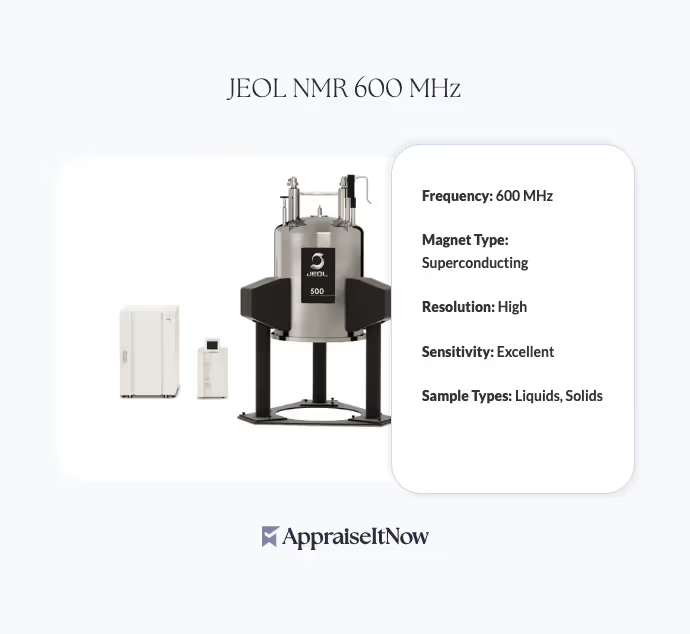
<p>If you're considering selling, insuring, or valuing a <strong>JEOL NMR 600 MHz</strong> spectrometer, understanding its current market worth and the appraisal process is essential. These sophisticated instruments represent significant capital investments in research and pharmaceutical laboratories, commanding market values between <strong>$450,000 and $520,000</strong> for well-maintained examples.</p>
<h2>Understanding the JEOL NMR 600 MHz's Market Position</h2>
<p>The JEOL NMR 600 MHz operates at the nexus of precision analytical chemistry and advanced materials science research. First introduced in 1990, this spectrometer established itself as a cornerstone instrument in leading research institutions worldwide. The 600 MHz frequency designation refers to the magnetic field strength—specifically <strong>14.1 Tesla</strong>—which provides exceptional resolution and sensitivity for characterizing complex molecular structures.</p>
<p>When collectors or researchers ask about NMR magnetic field strength, the 600 MHz designation tells you this instrument operates at roughly the middle range of commercial NMR systems. To answer a common comparison question: a 400 MHz NMR operates at approximately 9.4 Tesla, while the 600 MHz delivers 14.1 Tesla of magnetic field strength. Understanding these specifications helps you appreciate why the JEOL 600 MHz commands its particular valuation within the broader landscape of <a href="/types/lab-equipment">laboratory equipment</a>.</p>
<div class="callout tip"><p><strong>Appraiser Insight</strong></p>
<p>The 600 MHz frequency remains one of the most commercially popular NMR configurations, meaning parts availability and service support directly impact residual value.</p></div>
<h2>What Drives JEOL NMR 600 MHz Value</h2>
<p>Your spectrometer's appraisal value depends on multiple interconnected factors. The JEOL 600 MHz's robust design and advanced electronics represent decades of refinement in NMR technology. This instrument handles everything from simple liquid samples to complex solids and materials, making it invaluable across pharmaceutical research, chemical analysis, materials science, and academic institutions.</p>
<p>The initial purchase price for a new JEOL NMR 600 MHz typically reaches $600,000 to $800,000, which provides context for current secondary market valuations. As with most scientific <a href="/types/equipment-and-machinery">equipment and machinery</a>, depreciation follows a predictable curve—newer systems with minimal service hours retain proportionally higher value than older instruments approaching technological obsolescence.</p>
<p>Key performance attributes affecting your spectrometer's worth include its advanced data processing capabilities, sophisticated pulse sequence library, and specialized probe configurations. Whether your JEOL 600 MHz includes cryogenic probes, variable temperature modules, or additional detection capabilities directly influences its market positioning within the $450,000 to $520,000 range.</p>
<h2>Condition and Technical Specifications Matter</h2>
<p>When you prepare for appraisal, recognizing what evaluators examine ensures you understand your instrument's value proposition. The JEOL NMR 600 MHz's reputation for reliability and robustness means well-maintained examples retain considerable value even after 15-20 years of research service.</p>
<p>Professional appraisers assess several technical dimensions:</p>
<p>Your magnet's field homogeneity and shimming performance directly impact resolution capabilities. The software version and installed pulse sequence libraries determine experimental versatility. Service and maintenance records establish whether the instrument received proper care—critical for superconducting systems requiring careful cryogen management and regular system checks.</p>
<p>Matching original accessories, probes, and documentation substantially enhance appraisal value. A JEOL 600 MHz with factory-original probes, complete manuals, and documented calibration records typically commands 15-20% premiums over stripped examples. Like <a href="/types/antique-artwork">antique artwork</a> where provenance documentation increases value, scientific instruments benefit from clear service history and original components.</p>
<h2>Current Market Comparisons and Benchmarks</h2>
<p>The question of how much an 800 MHz NMR spectrometer costs provides useful perspective. These systems typically range from $800,000 to $1.2 million when new, but secondary market examples appear less frequently due to their specialized nature. The 600 MHz represents a sweet spot balancing performance, cost, and market demand—more affordable than 800 MHz systems yet substantially more capable than 400 MHz instruments.</p>
<p>Different NMR frequencies serve different research needs. When comparing 300 MHz versus 500 MHz NMR instruments, the differences are architectural—400 MHz systems provide good general-purpose capability, while 600 MHz systems offer superior resolution for complex structure elucidation. This explains why JEOL 600 MHz instruments command their particular market position and why they remain actively sought by research institutions upgrading from older 400 MHz systems.</p>
<p>The distinction between MRI strength (measured in Tesla) and NMR specifications sometimes confuses people. While MRI magnets typically operate at 1.5 to 3 Tesla for clinical imaging, laboratory NMR spectrometers like your JEOL require much stronger fields—14.1 Tesla for the 600 MHz system—to achieve the exceptional molecular-level resolution necessary for analytical chemistry work.</p>
<h2>Finding the Right Professional Appraiser</h2>
<p>Obtaining an accurate JEOL NMR 600 MHz appraisal requires specialists who understand both analytical instrumentation and current laboratory equipment markets. General appraisers lack the technical knowledge to properly evaluate spectrometer condition, functionality, and marketability.</p>
<p>You'll want to engage appraisers experienced with <a href="/blog/10-essential-tips-for-getting-an-accurate-lab-equipment-appraisal">scientific and laboratory equipment</a>. The best evaluators understand NMR technology specifics, can verify operational specifications, and maintain current knowledge of secondary market demand. Services like <strong>AppraiseItNow</strong> connect you with certified experts credentialed through organizations including ISA, ASA, and AAA who specialize in <a href="/types/equipment-and-machinery">equipment and machinery valuation</a>.</p>
<p>Professional appraisers will conduct in-depth examinations including magnet field verification, electronic system diagnostics, probe functionality testing, and operational software assessment. They'll also review maintenance records, service documentation, and any available calibration certificates. This thorough evaluation produces a defensible, USPAP-compliant appraisal report suitable for insurance purposes, sale transactions, or facility planning decisions.</p>
<div class="callout note"><p><strong>Key Consideration</strong></p>
<p>Insurance companies and institutional buyers require certified appraisals for JEOL NMR systems. Don't rely on manufacturers' list prices or generic online valuations—expert assessment protects your interests in both acquisition and disposition scenarios.</p></div>
<h2>Maximizing Your Appraisal Value</h2>
<p>Before requesting a professional appraisal, prepare documentation demonstrating your spectrometer's condition and maintenance history. Complete service records from qualified NMR technicians substantially strengthen valuation. Original manuals, software licenses, and probe documentation matter considerably—these elements can add $20,000 to $40,000 to your instrument's assessed value.</p>
<p>Ensure your JEOL 600 MHz receives professional servicing from qualified technicians. Unlike some <a href="/types/technology-equipment">technology equipment</a> where maintenance is optional, superconducting NMR systems require specialized care. Regular cryogen fills, shimming updates, and electronic system testing directly preserve instrument value and marketability.</p>
<p>Document any recent upgrades or component replacements. If your JEOL 600 MHz has received software updates, new probe installations, or refurbished electronics within the past few years, this information significantly impacts valuation. Conversely, instruments that have sat dormant or received minimal maintenance may face substantial value reductions reflecting greater uncertainty about performance reliability.</p>
<h2>When to Seek Appraisal Services</h2>
<p>You should obtain a professional appraisal in several circumstances. If you're liquidating laboratory assets or relocating research equipment, an accurate valuation protects your financial interests in sale transactions. Insurance companies increasingly require certified appraisals for high-value <a href="/blog/understanding-the-value-of-your-lab-equipment-an-appraisal-expert-s-guide">laboratory equipment</a> exceeding $250,000.</p>
<p>Estate planning and organizational asset management frequently necessitate current appraisals. Research institutions undergoing mergers, consolidations, or facility closures need documented values for financial reporting and transition planning. Professional appraisals also support grant administration, depreciation calculations, and equipment donation claims requiring independent verification of fair market value.</p>
<p>Academic researchers and corporate laboratories benefit from comprehensive <a href="/blog/the-basics-of-laboratory-equipment-appraisal">lab equipment appraisals</a> that establish baseline values for insurance, replacement planning, and capital equipment management. Updating your JEOL NMR 600 MHz's appraisal every 3-5 years ensures your insurance coverage reflects current market conditions and technological advances affecting residual value.</p>
<h2>Why Comprehensive Appraisals Matter</h2>
<p>A certified JEOL NMR 600 MHz appraisal provides more than a dollar figure—it documents your instrument's condition, capabilities, and position within current scientific equipment markets. This documentation protects you through insurance claims, supports institutional asset management, and strengthens negotiating positions in equipment sales.</p>
<p>The appraisal process itself educates you about your spectrometer's technical capabilities and market positioning. Professional evaluators can identify optimization opportunities, address service concerns, and position your JEOL 600 MHz advantageously whether you're retaining or divesting the instrument.</p>
<div class="callout note"><p><strong>Key Takeaway</strong></p>
<p>A certified appraisal of your JEOL NMR 600 MHz (valued between $450,000–$520,000) provides essential documentation for insurance, transaction, and planning purposes. Professional expertise ensures your sophisticated analytical instrument receives accurate valuation reflecting current market conditions and technical specifications.</p></div>