









<h1>How to Get Your HERMLE Centrifuge Z326K Appraised</h1>
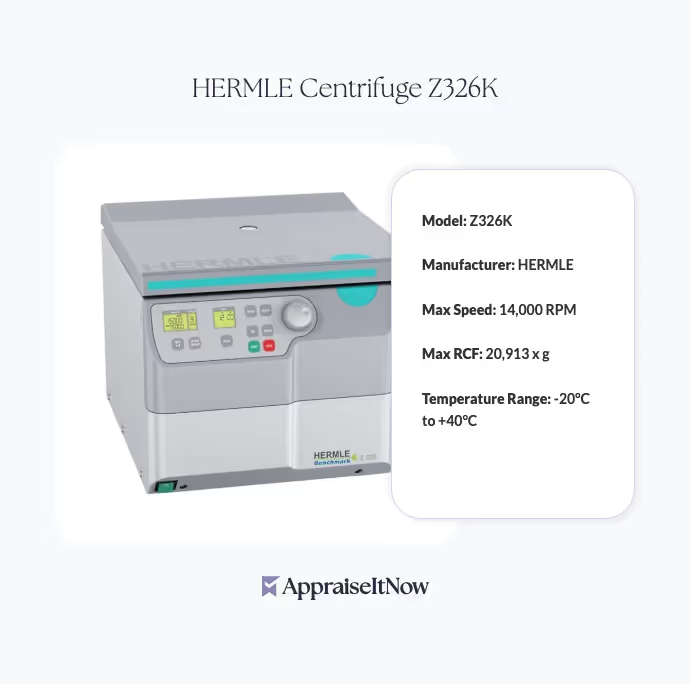
<p>If you're managing laboratory equipment assets, selling surplus instrumentation, or protecting your investment through proper insurance coverage, getting a professional appraisal for your HERMLE Centrifuge Z326K is essential. This high-performance laboratory centrifuge, valued between <strong>$15,000 and $20,000</strong>, represents a significant equipment asset that deserves expert evaluation.</p>
<h2>Understanding HERMLE Centrifuge Z326K Value Fundamentals</h2>
<p>The HERMLE Z326K has established itself as a reliable workhorse in research and clinical laboratories since its introduction in 2010. Its robust construction, advanced safety features, and exceptional speed capabilities make it a sought-after piece of used <a href="/types/lab-equipment">lab equipment</a> in today's market. When you're evaluating your centrifuge's worth, you're looking at an instrument designed specifically for high-volume sample processing, cell separation, and biomolecule purification—capabilities that maintain consistent demand across scientific institutions.</p>
<p>What makes the Z326K particularly valuable isn't just its original price tag, but rather its engineering durability. The brushless induction motor and programmable settings ensure consistent, reproducible results across multiple experiments. This reliability translates directly into stable resale value and strong insurance replacement cost estimates, making proper appraisal documentation critical whether you're buying, selling, or protecting your equipment investment.</p>
<div class="callout tip"><p><strong>Equipment Insight</strong></p>
<p>HERMLE centrifuges maintain their value better than many laboratory instruments due to their reputation for dependability and the company's strong support network across the U.S.</p></div>
<h2>Key Factors That Influence Your Z326K's Appraisal Value</h2>
<p>Understanding what drives your centrifuge's valuation helps you prepare documentation and set realistic expectations. Professional appraisers examine multiple dimensions when determining your equipment's worth, and knowing these factors positions you to present your Z326K in its best light.</p>
<p>The age of your instrument matters significantly, but not always in the way you'd expect. While your Z326K was first introduced in 2010, a well-maintained 2015 model may hold more value than a poorly kept 2018 unit. This is where <strong>run-hours</strong> become critically important—appraisers examine usage patterns to assess remaining equipment lifespan and remaining utility. An instrument with 5,000 operating hours presents differently than one with 50,000 hours, even if both are identical models.</p>
<p><strong>Maintenance history</strong> directly impacts your Z326K's value. Equipment serviced according to HERMLE specifications, with documented service records from qualified technicians, commands significantly higher appraisals than units with incomplete maintenance records. Professional appraisers want to see evidence that you've invested in proper care—this suggests the instrument will continue performing reliably for the next owner.</p>
<p><strong>Calibration currency</strong> is another critical factor. Appraisers verify that your centrifuge has current calibration certificates from accredited laboratories. This documentation proves your Z326K meets established performance standards and hasn't drifted outside acceptable tolerances. Units with recent calibration certificates may see value increases of 10-15% compared to uncalibrated equipment, as buyers face additional costs to bring equipment into compliance.</p>
<p><strong>Optional accessories</strong> expand your centrifuge's functionality and market appeal. Rotor configurations, specialized carriers, temperature monitoring upgrades, or sample holders specific to your laboratory applications increase the instrument's versatility. Appraisers evaluate which accessories came with your unit and whether they're included in the sale, as these can add $1,000-$3,000 to your final valuation depending on condition and compatibility.</p>
<h2>Documentation That Strengthens Your Appraisal</h2>
<p>Professional appraisers require specific documentation to establish accurate valuations. The more complete your records, the faster your appraisal process moves and the more defensible your valuation becomes for insurance or tax purposes.</p>
<p>Your <strong>serial number</strong> serves as your centrifuge's identification fingerprint. Appraisers verify that the serial number matches HERMLE's production records, confirming the equipment's authenticity and manufacturing date. The Z326K's serial number appears on the rear panel and should be clearly documented in your records.</p>
<p><strong>Service and repair records</strong> tell the story of your equipment's care history. Documentation showing routine maintenance, parts replacements, and professional servicing demonstrates responsible stewardship. If you've invested in major repairs—such as motor overhauls or electronic system upgrades—this documentation significantly strengthens your appraisal value by proving the equipment has been maintained to manufacturer specifications.</p>
<p><strong>Calibration certificates</strong> from accredited laboratories provide objective evidence that your Z326K performs within established tolerances. Recent certificates (within the last 12-24 months) are particularly valuable, as appraisers can confidently assess the instrument's current operational capability. Older calibration records still matter, but appraisers may factor in potential recalibration costs for the buyer.</p>
<p>Your original <strong>product manuals and technical documentation</strong> add credibility to your appraisal. These materials help appraisers understand your specific configuration and verify that all components are original or properly documented replacements. Instruction manuals also assist future owners, making your equipment more attractive and justifying premium pricing.</p>
<div class="callout note"><p><strong>Documentation Priority</strong></p>
<p>Gather everything you can find—even partial records are valuable. Appraisers work with incomplete documentation regularly and will note what exists versus what's missing.</p></div>
<h2>Different Appraisal Types and Their Application</h2>
<p>The purpose of your appraisal shapes how professionals evaluate your HERMLE Z326K and what value they ultimately assign. Understanding these distinctions helps you select the right appraisal type for your situation.</p>
<p><strong>Fair market value</strong> appraisals establish what your Z326K would sell for in an arm's-length transaction between willing buyer and seller in the current market. This is the standard appraisal type for general sale purposes and most common when buying or selling equipment. Fair market value reflects realistic market conditions—neither distressed liquidation pricing nor inflated collector pricing.</p>
<p><strong>Insurance replacement cost</strong> valuations estimate what you'd need to spend today to replace your Z326K with comparable equipment. This type often exceeds fair market value because new comparable instruments may cost more than your used equipment's market price. Insurance companies use replacement cost appraisals to determine coverage levels, and this approach protects you against underinsurance.</p>
<p><strong>Liquidation valuations</strong> establish discounted prices for rapid equipment sales, typically when organizations need to convert assets quickly. These appraisals produce values 30-50% lower than fair market value, reflecting the reality that rush sales demand price reductions. If you're facing equipment liquidation, understanding this valuation approach helps you set realistic timeline and pricing expectations.</p>
<p><strong>Tax and donation appraisals</strong> follow specific IRS guidelines and establish value for charitable contribution documentation. These appraisals must meet stringent requirements if you're claiming charitable deductions, and the appraiser's qualifications become especially important. When donating laboratory equipment to educational institutions or nonprofits, a properly documented tax appraisal provides substantiation that IRS auditors will accept.</p>
<h2>Market Demand and Availability Dynamics</h2>
<p>Your HERMLE Z326K's specific value within the <strong>$15,000-$20,000</strong> range depends significantly on current market conditions. Laboratory equipment markets aren't as transparent as used car markets, so understanding demand dynamics helps explain why identical instruments might appraise at different values in different regions or timeframes.</p>
<p><strong>Geographic location</strong> influences demand and therefore pricing. Research universities and pharmaceutical manufacturing centers in major metropolitan areas typically support higher equipment values because local competition for quality instruments drives pricing up. Rural areas with fewer research facilities may see lower values for the same equipment, simply because fewer potential buyers exist.</p>
<p><strong>Current scientific funding cycles</strong> affect laboratory equipment demand. When research budgets expand, institutions prioritize equipment purchases, and quality used instruments command premium prices as labs upgrade. Conversely, during funding contractions, used equipment values soften as institutions defer capital purchases.</p>
<p><strong>Specific application demand</strong> matters more than you might expect. If your Z326K's configuration perfectly matches applications that are currently trending in research (perhaps specific cell-type separations or new biomolecule analysis techniques), your equipment holds stronger market value. Appraisers track these application trends to assess market demand for your specific instrument model and condition.</p>
<h2>Timeline and Cost Expectations for Professional Appraisal</h2>
<p>When you decide to pursue professional appraisal, understanding the typical process timeline and associated costs helps you plan accordingly. Professional <a href="/blog/10-essential-tips-for-getting-an-accurate-lab-equipment-appraisal">lab equipment appraisals</a> vary based on complexity and location, but certain patterns hold across the industry.</p>
<p><strong>Timeline typically ranges from 5-15 business days</strong> from submission to completed report, though this varies based on appraiser workload and your equipment's accessibility. Initial documentation review and preliminary assessment take 2-3 days. If on-site inspection is required, scheduling and travel time add 1-2 weeks depending on appraiser location relative to your equipment. Remote appraisals based on photographs and documentation move faster, typically completing within 5-7 business days.</p>
<p><strong>Cost ranges generally fall between $300-$800</strong> for laboratory centrifuge appraisals, depending on whether the appraisal is conducted remotely or requires on-site inspection. Remote appraisals utilizing high-quality photographs and existing documentation typically cost $300-$500. On-site inspections with functional testing and detailed mechanical assessment run $500-$800, with potential travel fees if your location is more than 50 miles from the appraiser's office. These costs are generally tax-deductible if the appraisal supports a business purpose like equipment sale or insurance documentation.</p>
<h2>On-Site Testing Versus Remote Appraisal Capabilities</h2>
<p>One of the most practical questions equipment owners ask is whether accurate appraisals require physical inspection or can be conducted remotely. The answer depends on your specific situation and how the appraisal will be used.</p>
<p><strong>On-site functional testing</strong> provides the highest confidence in equipment valuation. Appraisers can verify that your Z326K powers on, accelerates smoothly, maintains programmed settings, and shows no unusual vibration or noise patterns. Functional testing reveals maintenance issues that photographs alone cannot capture—a slight bearing wear pattern, electronic display anomalies, or rotor condition concerns that impact value. If you're selling equipment to sophisticated buyers (research institutions, equipment dealers, medical facilities), on-site testing often becomes a requirement rather than optional. When seeking insurance replacement cost valuations that will stand up to claim assessment, insurers typically prefer appraisals supported by functional testing documentation.</p>
<p><strong>Remote appraisals utilizing detailed photography and documentation</strong> work effectively for general purpose valuations and when budget constraints exist. High-quality photographs of all sides of your Z326K, close-ups of the serial number and control panel, images showing interior rotor configuration, and documentation of any visible wear provide sufficient information for many appraisals. Remote appraisals work particularly well when you have comprehensive maintenance and calibration records—these documents provide the functional verification that physical testing would supply.</p>
<p>The practical answer: <strong>Remote appraisals often suffice for fair market value and initial valuation decisions</strong>, while <strong>on-site inspections become valuable when the appraisal outcome will influence major financial decisions</strong> like equipment sale negotiations or insurance coverage amounts. Many appraisers offer hybrid approaches—initial remote assessment followed by optional on-site verification if the preliminary valuation suggests substantial value is at stake.</p>
<div class="callout tip"><p><strong>Appraisal Strategy</strong></p>
<p>For insurance documentation or significant sale transactions, invest in on-site appraisal. For general information or preliminary valuations, remote appraisal provides excellent value at lower cost.</p></div>
<h2>Professional Credentials and Standards That Matter</h2>
<p>Not all appraisers are equally qualified to value laboratory equipment. When selecting a professional to appraise your HERMLE Z326K, understanding relevant credentials and standards ensures you're working with someone who brings appropriate expertise.</p>
<p><strong>USPAP (Uniform Standards of Professional Appraisal Practice)</strong> compliance is fundamental for any appraisal that will be used for insurance, legal, or financial purposes. USPAP-compliant appraisals follow established methodologies, contain specific documentation requirements, and meet ethical standards that courts and financial institutions recognize. When you need an appraisal that can withstand professional scrutiny, USPAP compliance becomes non-negotiable.</p>
<p><strong>AAA (American Association of Appraisers)</strong> credentials indicate specialized training in equipment valuation across multiple categories. AAA-certified appraisers maintain continuing education requirements and adhere to professional standards that ensure quality and consistency.</p>
<p><strong>ISA (International Society of Appraisers)</strong> certification demonstrates expertise in personal property valuation, including laboratory and scientific equipment. ISA appraisers maintain rigorous standards and professional conduct expectations.</p>
<p><strong>ASA (American Society of Appraisers)</strong> certification covers multiple appraisal disciplines, with specific emphasis on business valuation and equipment assessment. ASA members commit to ongoing education and ethical practice standards.</p>
<p><strong>AMEA (American Medical Equipment Association)</strong> credentials are particularly relevant for appraisers specializing in <a href="/types/medical-equipment">medical equipment</a> and related laboratory instrumentation. These appraisers understand specific standards and regulations affecting healthcare and research equipment.</p>
<p>When selecting an appraiser, look for credentials specific to <a href="/types/equipment-and-machinery">equipment and machinery</a> valuation. An appraiser with real estate expertise, while perfectly competent in their field, may lack the specialized knowledge necessary to accurately assess laboratory centrifuge condition and market value. AppraiseItNow connects you with appraisers holding relevant credentials and current <a href="/blog/the-basics-of-laboratory-equipment-appraisal">lab equipment appraisal</a> expertise.</p>
<h2>Market Depreciation Models for Laboratory Equipment</h2>
<p>Understanding how depreciation applies to your HERMLE Z326K provides context for its current value relative to original purchase price. Laboratory equipment depreciates differently than many other assets, and knowing these patterns helps you develop realistic expectations.</p>
<p><strong>Accelerated depreciation</strong> typically characterizes the first 3-5 years of laboratory equipment life. A new Z326K might depreciate 30-40% in the first two years as it transitions from new to used status. This rapid initial depreciation reflects the reality that used equipment commands discounts compared to new instruments, even if the used equipment functions identically.</p>
<p><strong>Stabilized depreciation</strong> follows the initial acceleration period, with values declining 8-12% annually for the next 5-10 years of the equipment's life. This more gradual depreciation reflects normal wear, technology advancement, and market demand patterns. Your Z326K, having been introduced in 2010, is now at a point where depreciation rates have stabilized, and maintenance quality increasingly matters relative to age.</p>
<p><strong>Residual value plateau</strong> emerges for well-maintained equipment 10+ years old. Once instruments reach 15-20 years in service life, depreciation often slows dramatically if they've been properly maintained. Some well-kept laboratory instruments actually increase in value during this phase if they become harder to find or if newer models prove less reliable. However, technology advancement and regulatory changes can accelerate depreciation if newer instruments offer significantly improved capabilities or if older models no longer meet updated laboratory standards.</p>
<p>For your Z326K currently in the market, you're likely evaluating equipment that has passed initial depreciation acceleration and entered the stabilized depreciation phase where maintenance quality becomes the primary value driver.</p>
<h2>Condition and Damage Factors That Reduce Value</h2>
<p>Certain conditions and damage patterns significantly reduce your Z326K's appraisal value. Understanding what appraisers specifically look for helps you assess your equipment candidly and prepare for realistic valuation outcomes.</p>
<p><strong>Corrosion affecting critical components</strong>—particularly the rotor housing or motor interior—can reduce value 20-40%. Laboratory environments sometimes expose equipment to humid or chemically corrosive conditions, and rust patterns suggest potential mechanical reliability concerns. Surface cosmetic corrosion matters less than structural or functional corrosion.</p>
<p><strong>Electronic control system malfunctions</strong> create substantial value reduction because replacement or repair represents significant expense. Display issues, programming failures, or sensor malfunctions that prevent proper operation may reduce value 25-50% depending on repair feasibility and cost.</p>
<p><strong>Rotor damage or imbalance</strong> is particularly problematic because rotors represent expensive replacement components. Visible rotor warping, bearing wear patterns, or previous impact damage significantly reduces value and may require appraisers to recommend professional rotor assessment before confidently valuing the equipment.</p>
<p><strong>Missing or damaged safety features</strong> create liability concerns for subsequent owners. If your Z326K's safety interlocks are non-functional, lid-securing mechanisms are damaged, or emergency stop systems show wear, appraisers factor in the cost to restore safety compliance—often $500-$2,000 depending on what requires attention.</p>
<p><strong>Cosmetic damage</strong> like dents, paint chips, or scratched plastic panels matters far less than functional damage but still affects value. Buyers generally accept cosmetic wear if mechanical systems perform properly, but severe cosmetic degradation may reduce appeal and lower value 5-10%.</p>
<div class="callout note"><p><strong>Damage Context</strong></p>
<p>Document your Z326K's specific condition honestly during appraisal. Appraisers expect minor wear on used equipment; transparency about damage builds appraiser confidence in the overall valuation process.</p></div>
<h2>How Appraisals Support Buyers, Sellers, and Risk Management</h2>
<p>Professional appraisals serve multiple purposes beyond simple price determination. Understanding these various applications helps you leverage your appraisal strategically whether you're buying, selling, or managing equipment assets.</p>
<p><strong>Seller advantage</strong>: When listing your HERMLE Z326K for sale, a certified appraisal provides objective justification for your asking price. Sellers equipped with professional appraisal documentation can confidently negotiate with potential buyers and respond to low-ball offers with third-party valuation support. Appraisals also help identify which equipment condition aspects justify premium pricing—perhaps your exceptional maintenance history deserves higher valuation than standard market comparables.</p>
<p><strong>Buyer protection</strong>: Purchasers benefit from independent appraisals that verify equipment condition, functionality, and fair market value. Before committing to a $15,000-$20,000 equipment purchase, obtaining your own appraisal protects against overpaying or discovering undisclosed damage after purchase. Appraisals also provide documentation supporting negotiation if discovered issues warrant price reduction.</p>
<p><strong>Insurance documentation</strong>: Insurers require detailed appraisal reports to establish replacement cost coverage for specialized equipment like centrifuges. Your appraisal creates the baseline documentation that ensures you maintain adequate coverage as equipment ages and potential replacement costs change. This documentation proves invaluable if equipment loss or damage requires insurance claims.</p>
<p><strong>Tax and donation support</strong>: When donating laboratory equipment to educational institutions, qualified appraisals provide IRS substantiation supporting charitable deductions. The appraisal report documents fair market value at donation date, protecting you if tax authorities question your deduction amount.</p>
<p><strong>Estate and legal purposes</strong>: Appraisals support equipment asset division in estate settlements, divorce proceedings, or business dissolutions. Professional documentation prevents disputes over equipment value and provides evidence all parties can rely upon during settlement negotiations.</p>
<hr />
<div class="callout note"><p><strong>Key Takeaway</strong></p>
<p>Getting your HERMLE Centrifuge Z326K professionally appraised provides clear documentation of its $15,000-$20,000 value, whether you're buying, selling, insuring, or managing equipment assets. Proper appraisal—supported by comprehensive documentation and qualified expertise—protects your investment and ensures confident decision-making around this valuable laboratory instrument.</p></div>