









<h1>How to Get Your Great Plains Disk Ripper 8550 Appraised</h1>
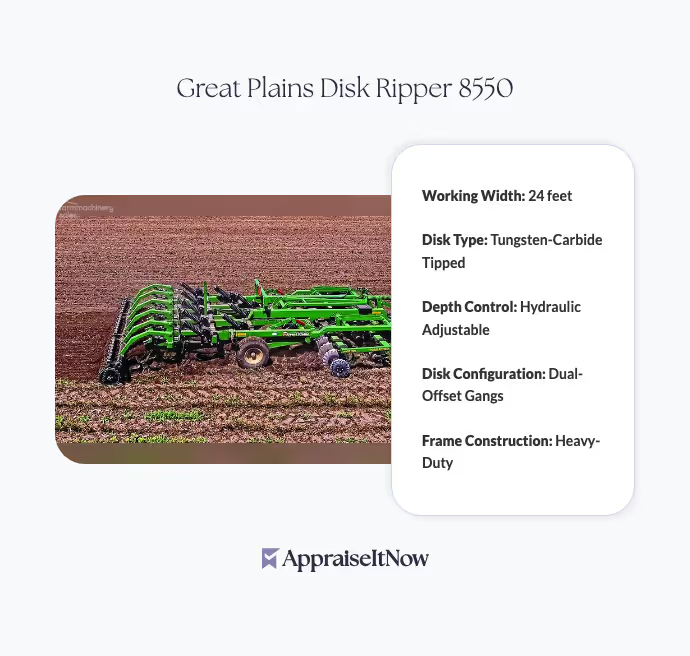
<p>The Great Plains Disk Ripper 8550 represents a significant agricultural asset for large-scale farming operations. Whether you're looking to sell, refinance, insure, or document the value of your equipment, understanding how to approach a professional appraisal ensures you receive an accurate, defensible valuation. If you own one of these robust 24-foot tillage implements, here's what you need to know about the appraisal process and the factors that determine value.</p>
<h2>Understanding Your Great Plains Disk Ripper 8550's Market Value</h2>
<p>The Great Plains Disk Ripper 8550 currently commands an estimated market value between <strong>$35,000 and $41,000</strong>, making it a substantial piece of equipment that warrants professional evaluation. This heavy-duty implement has earned its place in agricultural operations since its introduction in 1992, and its market position reflects both its durability and continued demand among farmers managing large acreage.</p>
<p>Your specific valuation depends on several interconnected factors. The 8550's tungsten-carbide tipped disks, 24-foot working width, and customizable hydraulic depth control make it valuable for operations tackling challenging soil conditions. However, individual machines vary significantly based on hours of operation, maintenance history, mechanical condition, and regional market demand. A certified appraiser specializing in <a href="/types/agricultural-equipment">agricultural equipment</a> valuations will assess these variables to determine where your specific machine falls within the market range.</p>
<h2>What Documentation You'll Need to Present</h2>
<p>When preparing for your appraisal, gather specific documentation that helps appraisers establish accurate values through comparison with similar recent sales. Your appraiser will need the serial number, which provides crucial information about your machine's manufacturing date and specifications. Without this baseline data, establishing proper market comparables becomes difficult.</p>
<p>Beyond the serial number, compile your maintenance and repair records, which demonstrate how well you've cared for the equipment. Documentation showing regular hydraulic service, disk replacement, or frame repairs tells the story of your machine's reliability and helps justify asking price. If you have operator manuals, original purchase invoices, or warranty documentation, these strengthen the appraisal by confirming the equipment's authenticity and specifications.</p>
<p>Operating hours represent another critical data point. Modern equipment often has hour meters—if yours does, accurate readings show whether your 8550 has been lightly used, moderately worked, or run through years of intensive operation. This single factor can shift valuation by thousands of dollars. Additionally, photograph the equipment from multiple angles to capture overall condition, paying special attention to the disk gangs, frame integrity, hitch points, and tire or boot condition.</p>
<div class="callout tip"><p><strong>Documentation Advantage</strong></p>
<p>Sellers who organize comprehensive maintenance records typically receive higher appraisals because documentation proves conscientious ownership and reduces buyer uncertainty.</p></div>
<h2>How Appraisers Determine Your Equipment's Value</h2>
<p>Professional appraisers approach <a href="/types/equipment-and-machinery">equipment and machinery</a> valuations using a structured methodology that combines market research, condition assessment, and depreciation analysis. For your Great Plains Disk Ripper 8550, they'll examine three primary approaches: comparable sales analysis, the cost approach, and the income approach if applicable.</p>
<p>The comparable sales method forms the foundation of most equipment appraisals. Your appraiser will research recent sales of similar disk rippers through agricultural equipment auctions, dealer inventory records, and private transactions. They'll identify sales of 8550 models or comparable implements sold within the past 12-24 months, documenting prices, condition grades, hours of operation, and geographic location. This data establishes the baseline range—your $35,000-$41,000 estimate comes from this comparable analysis.</p>
<p>Market conditions shift based on regional demand. In grain-producing regions with consistent large-scale operations, demand for quality tillage equipment remains steady, supporting stronger pricing. Conversely, areas experiencing drought, crop transitions, or economic stress may see softer demand. Your appraiser understands these geographic variables and adjusts valuations accordingly.</p>
<p>The cost approach estimates what it would cost to replace your used 8550 with a new equivalent model, then deducts depreciation. A new Great Plains disk ripper might cost $65,000-$75,000 depending on specifications. Your 1992-era machine depreciates based on age, hours, and market acceptance of the model. This approach helps appraisers verify that comparable sales align with logical depreciation patterns rather than market anomalies.</p>
<div class="callout note"><p><strong>Valuation Insight</strong></p>
<p>Appraisers distinguish between depreciation (predictable decline based on age and use) and obsolescence (whether the market still values the design and capabilities).</p></div>
<h2>Condition Grading and Its Impact on Value</h2>
<p>Your Great Plains Disk Ripper 8550's condition grade directly translates to pricing. Professional appraisers use a standardized grading system to ensure consistency and defensibility. Understanding these grades helps you anticipate where your machine falls within the $35,000-$41,000 range.</p>
<p><strong>Excellent condition</strong> ($39,000-$41,000) describes machines with minimal wear, fully functional hydraulic systems, intact disk gangs with sharp or recently replaced carbide tips, strong frame integrity, and good tire/boot condition. These machines show obvious care and have current maintenance. <strong>Good condition</strong> ($36,000-$39,000) encompasses well-maintained equipment with normal operational wear, functional systems, and recent maintenance records. Minor cosmetic issues or slightly worn components don't prevent top performance. <strong>Fair condition</strong> ($32,000-$36,000) includes machines with visible wear, possible minor repairs needed, hydraulic issues requiring attention, or aging tire condition. <strong>Poor condition</strong> ($25,000-$32,000) applies to equipment needing significant repairs, experiencing hydraulic failures, or showing frame damage.</p>
<p>Your specific grade depends on factors appraisers examine during inspection. Hydraulic issues significantly impact grading because repairing or replacing hydraulic systems on large tillage equipment costs thousands of dollars. A machine with known hydraulic leaks or sluggish pressure response moves down one or two grades immediately. Similarly, disk condition matters—if your tungsten-carbide tipped disks show minimal penetration in sample tests or appear severely dulled, replacement costs factor into valuation.</p>
<h2>Finding and Consulting with Qualified Appraisers</h2>
<p>Selecting the right appraiser for your Great Plains Disk Ripper 8550 proves essential. Look for professionals holding credentials from recognized organizations like <strong>ISA (International Society of Appraisers)</strong>, <strong>ASA (American Society of Appraisers)</strong>, <strong>AMEA (American Machinery Equipment Appraisers)</strong>, or <strong>AAA (American Appraisers Association)</strong>. These credentials indicate the appraiser has demonstrated expertise, maintained education requirements, and agreed to ethical standards.</p>
<p>Appraisers specializing in agricultural equipment bring critical advantages over generalists. They understand vintage farming implements, recognize regional demand patterns, and maintain databases of comparable sales specific to your machinery class. When interviewing potential appraisers, ask about their experience with <a href="/types/farm-equipment">farm equipment</a> valuations, whether they've appraised Great Plains implements specifically, and which sales databases they access for comparables research.</p>
<p>Remote appraisals using photographs and documentation have become increasingly viable, though in-person inspections provide superior reliability for high-value equipment. If your appraiser cannot visit your location, expect them to request comprehensive, well-lit photographs from multiple angles, internal photos showing hydraulic condition, and potentially a video walkthrough you can provide. For equipment exceeding $35,000, USPAP (Uniform Standards of Professional Appraisal Practice) compliance typically requires on-site inspection, though partial remote assessment combined with local follow-up inspections can work when circumstances require it.</p>
<div class="callout tip"><p><strong>Credential Check</strong></p>
<p>Certified appraisers carry insurance and maintain continuing education, providing accountability and expertise that justifies their fees—typically $400-$800 for comprehensive agricultural equipment appraisals.</p></div>
<h2>Turnaround Times and Fee Expectations</h2>
<p>Understanding typical appraisal timelines helps you plan accordingly. Most USPAP-compliant appraisals require 10-15 business days from inspection to final report delivery. This timeline allows the appraiser to research comparable sales, compile photographs, write the detailed report, and review findings for accuracy and completeness.</p>
<p>Fees for agricultural equipment appraisals generally range from <strong>$400 to $800</strong> depending on equipment complexity, location, and whether the appraisal involves travel. Your Great Plains Disk Ripper 8550, being a single large implement with straightforward valuation requirements, typically falls in the lower-to-middle range. Rush appraisals cost more—requesting delivery within 3-5 days typically adds 25-50% to standard fees.</p>
<p>The appraisal cost represents a small fraction of your equipment's value. For a $37,500 piece of equipment, a $600 appraisal costs 1.6% of asset value—an excellent investment when you're financing, insuring, or selling significant machinery. Lenders often require formal appraisals before approving equipment loans, making professional valuation non-negotiable anyway.</p>
<h2>Preparing Your Equipment for Inspection</h2>
<p>How you prepare your Great Plains Disk Ripper 8550 for appraisal can influence the appraiser's assessment and your confidence in the results. Before the inspection, clean the equipment thoroughly so the appraiser can examine all components without obstruction. Remove accumulated soil, crop residue, and rust where safely possible. Clean machines don't lie about condition—cosmetic dirt sometimes hides minor damage, but thorough cleaning ensures the appraiser evaluates actual mechanical state rather than guessing under grime.</p>
<p>Check that your equipment operates properly before the inspection. Have it functional so the appraiser can assess hydraulic responsiveness, disk gang movement, and overall mechanical operation. If you know of repairs needed, don't hide them. Honest disclosure about known issues actually strengthens valuations—appraisers adjust expectations appropriately and appreciate transparency. Attempting to disguise problems often backfires when the appraiser discovers issues during inspection and questions overall accuracy of your representations.</p>
<p>Document any recent repairs, new tires, disk replacements, or hydraulic service. These investments show up in your equipment's condition and support fair market valuation. If you've recently replaced the tungsten-carbide tipped disks or invested in hydraulic repair, have receipts ready—these capital improvements justify higher valuations.</p>
<h2>Using Your Appraisal for Financing, Insurance, and Sales</h2>
<p>Once you have your formal appraisal, it serves multiple purposes beyond mere curiosity about your Great Plains Disk Ripper 8550's worth. When seeking equipment financing through agricultural lenders, presenting a certified appraisal accelerates approval and may secure better terms. Lenders appreciate independent valuations that confirm equipment value supports their loan amount.</p>
<p>Insurance purposes represent another critical application. Your casualty insurance carrier needs accurate replacement cost valuations to ensure you carry adequate coverage. An outdated or informal valuation might leave you underinsured if your 8550 suffers loss. Professional appraisals documenting current market value give you confidence that your insurance will cover replacement or repair costs. Similarly, explore resources on <a href="/blog/the-basics-of-equipment-and-machinery-appraisal">equipment and machinery appraisal</a> to understand how different appraisal types serve different purposes.</p>
<p>If you're planning to sell your equipment, a professional appraisal helps you price competitively. Knowing you're within the $35,000-$41,000 range means you can justify your asking price if challenged by buyers. For estate or partnership dissolution scenarios where equipment value affects distribution decisions, appraisals provide documented fairness that prevents disputes.</p>
<div class="callout note"><p><strong>Key Takeaway</strong></p>
<p>A USPAP-compliant appraisal of your Great Plains Disk Ripper 8550 provides documented, defensible valuation that protects your interests whether you're financing, insuring, selling, or managing agricultural assets. Professional expertise ensures your equipment receives accurate market assessment rather than guesswork, giving you confidence and credibility in all transaction and coverage decisions.</p></div>