









<h1>How to Get Your Great Plains Drill 3S-4000HD Appraised</h1>
<p>The Great Plains Drill 3S-4000HD represents a significant investment in agricultural infrastructure, commanding prices between <strong>$45,000 and $60,000</strong> in today's market. Whether you're buying, selling, refinancing, or managing estate assets, obtaining a professional appraisal ensures you have accurate documentation grounded in current market conditions and equipment-specific factors. Understanding how appraisers value this heavy-duty seeding drill helps you navigate the valuation process with confidence.</p>
<h2>Understanding Your Great Plains Drill 3S-4000HD's Market Value</h2>
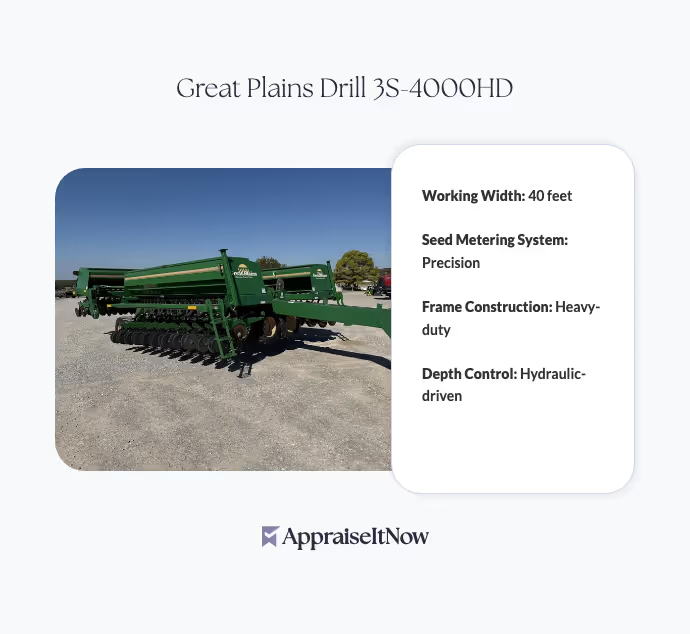
<p>The 3S-4000HD is a workhorse among large-scale farming operations. Introduced in <strong>2015</strong>, this drill features a robust <strong>40-foot working width</strong> capable of covering extensive acreage efficiently, making it ideal for farmers managing thousands of acres. Its precision seed metering system ensures accurate seed placement, directly impacting crop yields and operational productivity. The combination of reinforced heavy-duty construction, hydraulic depth control, and proven performance in challenging soil conditions makes this model consistently sought after in the <a href="/types/agricultural-equipment">agricultural equipment</a> market.</p>
<p>Your 3S-4000HD's value within the $45,000-$60,000 range depends on multiple factors that professional appraisers assess systematically. Equipment age, operating hours, maintenance history, current condition, and regional demand all contribute to determining fair market value. For farmers and agricultural businesses evaluating <a href="/types/farm-equipment">farm equipment</a> assets, this valuation becomes critical for financial planning, equipment financing, insurance coverage, and tax documentation.</p>
<h2>Key Factors That Influence 3S-4000HD Valuation</h2>
<p>When appraisers evaluate your Great Plains drill, they examine specific criteria that directly impact its market position. Understanding these factors helps you prepare for the appraisal process and anticipate how your equipment will be assessed.</p>
<p><strong>Equipment age and usage hours</strong> form the foundation of any appraisal. A 2015 model with 500 operating hours will command significantly different value than an identical unit with 3,000 hours. Appraisers source historical price data and depreciation schedules specific to the 3S-4000HD to establish baseline values, then adjust based on actual usage patterns documented in maintenance records. Operational hours directly correlate with component wear, bearing fatigue, and remaining service life—all factors determining your equipment's market desirability.</p>
<p><strong>Maintenance and repair history</strong> reveals how carefully previous owners operated and maintained the drill. Complete documentation of routine service, seasonal maintenance, and any repairs demonstrates responsible stewardship that preserves value. Conversely, deferred maintenance, improvised repairs, or undocumented work can reduce value significantly. Appraisers request detailed records showing hydraulic fluid changes, seal replacements, opener maintenance, and any structural repairs. Equipment that received professional servicing at certified dealers typically garners higher valuations than units serviced only during emergencies.</p>
<p><strong>Current mechanical and operational condition</strong> requires comprehensive assessment. Professional appraisers physically inspect your 3S-4000HD's critical systems: the hydraulic depth control mechanism, precision seed metering components, opener condition, frame integrity, and hitch attachment points. They verify that all hydraulic functions operate smoothly, seed tubes deliver consistently, and structural welds show no signs of cracking or stress. This hands-on evaluation parallels the thoroughness required in <a href="/types/heavy-machinery">heavy machinery</a> appraisals, where operational functionality directly determines value.</p>
<div class="callout tip"><p><strong>Preparation Insight</strong></p>
<p>Before appraisal, clean your drill thoroughly and ensure all hydraulic systems operate smoothly. This showcases your commitment to maintenance and facilitates the inspector's work.</p></div>
<p><strong>Regional market variations and seasonal demand</strong> significantly affect 3S-4000HD pricing. Agricultural equipment values fluctuate seasonally, with spring and early summer typically commanding premium prices when farmers actively purchase for the planting season. Geographic factors matter too—regions with larger-scale farming operations and greater acreage utilization create stronger demand for 40-foot drills. Southern and Midwest agricultural markets often support higher valuations than areas where smaller-scale farming dominates. Understanding your local market context helps establish realistic expectations for your equipment's value.</p>
<h2>Documentation and Evidence You'll Need</h2>
<p>Professional appraisers require specific documentation to produce credible, defensible valuations suitable for financing, insurance, tax, estate, or litigation purposes. Gathering these materials before scheduling your appraisal streamlines the process and often improves valuation outcomes.</p>
<p>Compile <strong>original purchase documentation</strong> including the dealer invoice, warranty information, and any manufacturer's certificates. These establish the equipment's authentic model year and original specifications. Maintain <strong>complete maintenance records</strong> showing every service performed, including dates, hours recorded, work performed, and service provider information. Documentation from authorized Great Plains dealers carries particular weight in professional appraisals. Keep <strong>repair records</strong> for any modifications, component replacements, or damage repairs, ideally with receipts and contractor details.</p>
<p><strong>High-quality photographs</strong> from multiple angles should capture overall condition, specific components in good detail, the hydraulic system, seed metering mechanisms, frame condition, and any visible wear or repairs. Professional appraisers often request photographs showing the serial number plate, which authenticates your unit and links it to production records. Detailed close-ups of wear areas, modified components, or repairs provide essential context for valuation adjustments.</p>
<p>For equipment approaching the $50,000+ valuation range, many appraisers recommend <strong>on-site inspection</strong> rather than desktop valuations alone. While online evaluations provide preliminary estimates when you submit photos and descriptions, hands-on assessment allows appraisers to detect mechanical issues, verify hydraulic system performance, and assess structural integrity that photographs cannot fully reveal. This distinction matters significantly when securing equipment financing or establishing insurance replacement values—lenders and insurers typically require comprehensive on-site appraisals for assets of this magnitude.</p>
<div class="callout note"><p><strong>Documentation Priority</strong></p>
<p>Missing maintenance records don't disqualify appraisals, but they may result in more conservative valuations as appraisers must assume average maintenance rather than documented excellent care.</p></div>
<h2>Selecting the Right Appraiser for Agricultural Equipment</h2>
<p>Your appraisal's accuracy and credibility depend substantially on choosing qualified professionals. Seek appraisers holding credentials from recognized industry organizations: the <strong>American Society of Appraisers (ASA)</strong>, <strong>International Society of Appraisers (ISA)</strong>, <strong>American Society of Farm Managers and Rural Appraisers (ASMRAA)</strong>, or other specialized agricultural certification bodies. These credentials indicate formal training in valuation methodology, market analysis, and USPAP (Uniform Standards of Professional Appraisal Practice) compliance.</p>
<p>Experience with <a href="/types/tractor">tractor</a> and <a href="/types/equipment-and-machinery">equipment and machinery</a> valuations matters—specialists familiar with Great Plains drills understand model-specific depreciation patterns, regional market variations, and technical specifications that generalist appraisers may miss. Request references and ask about their experience specifically with 3S-4000HD units or comparable 40-foot seeding drills. Professional agricultural equipment appraisers maintain databases of recent comparable sales and auction results, enabling them to position your equipment accurately within current market dynamics.</p>
<p>AppraiseItNow connects you with credentialed agricultural equipment specialists who understand the complexities of valuing heavy-duty implements like the 3S-4000HD. Our network includes appraisers qualified to produce USPAP-compliant reports accepted by financial institutions, insurance companies, tax authorities, and courts. Whether your appraisal supports equipment financing, refinancing, insurance documentation, tax valuation, or estate distribution, our experts provide defensible valuations grounded in comparable sales analysis and current market conditions.</p>
<h2>How Appraisers Source Comparable Sales and Market Data</h2>
<p>Professional valuation of your Great Plains Drill 3S-4000HD relies on systematic comparison with recent sales of similar equipment. Appraisers access multiple data sources to establish fair market value: auction results from organizations like <strong>Farm Equipment Auctions</strong>, <strong>Iron Planet</strong>, and regional agricultural equipment auction houses document actual selling prices for comparable units. These public sales provide transparent benchmarks showing how 3S-4000HD models priced against market expectations.</p>
<p>Dealer inventory listings and private sale inquiries supplement auction data, revealing asking prices even when actual sales remain undisclosed. Trade publications and equipment valuation databases like <strong>NADA Guides</strong> for agricultural machinery provide historical depreciation schedules, helping appraisers adjust base prices for equipment age and hours. Direct communication with dealers and equipment brokers familiar with your regional market adds local market intelligence that national databases cannot capture.</p>
<p>Appraisers also consider manufacturer announcements, production changes, and technological improvements that affect model desirability. When Great Plains introduces advanced features in newer drill models, this typically reduces demand for earlier versions, creating downward valuation pressure. Conversely, discontinued models sometimes appreciate when supply becomes scarce, particularly if performance remains competitive with current offerings. This nuanced market analysis, combined with adjustment for your specific equipment's condition and hours, produces valuations that accurately reflect your 3S-4000HD's true market position.</p>
<h2>Valuation Adjustments for Condition, Repairs, and Modifications</h2>
<p>Starting from a baseline market value for comparable 3S-4000HD units, professional appraisers apply systematic adjustments reflecting your equipment's specific characteristics. Well-maintained equipment in excellent condition typically commands premiums of 10-20% above baseline values, while units showing significant wear or deferred maintenance may be adjusted downward by 15-35% depending on repair requirements.</p>
<p><strong>Damage and repairs</strong> require careful documentation. Minor cosmetic wear has minimal impact, but structural damage, cracked welds, bent frames, or failed hydraulic components trigger substantial adjustments. Conversely, recent professional repairs with documented warranties often receive favorable treatment—a newly replaced hydraulic system or professionally welded structural component demonstrates that major maintenance has been addressed. Appraisers distinguish between professional repairs that restore full functionality and jury-rigged fixes that suggest ongoing concerns.</p>
<p><strong>Aftermarket modifications</strong> create valuation complexity. If you've added precision GPS guidance systems, advanced seed monitoring technology, or improved hydraulic configurations, these often increase functional value but may reduce appeal to buyers preferring original equipment. Appraisers adjust based on whether modifications improve productivity or appeal, or conversely, whether they suggest the original equipment proved inadequate in certain conditions. Proprietary modifications that complicate future maintenance or repair generally receive unfavorable treatment.</p>
<h2>Understanding Appraisal Costs and Turnaround Times</h2>
<p>Expect professional USPAP-compliant agricultural equipment appraisals to cost between <strong>$400 and $800</strong> depending on equipment complexity and accessibility. On-site inspections command premium fees compared to desktop valuations, but they provide superior accuracy for equipment valued around $50,000+. Your appraisal investment typically represents 0.7-1.5% of the equipment's value—a modest expense given the financial importance of accurate valuation for financing, insurance, and tax purposes.</p>
<p>Turnaround times typically range from <strong>5-15 business days</strong> after the physical appraisal occurs, assuming straightforward valuations. Complex cases involving disputed condition assessments, unusual modifications, or extensive repair histories may require additional research and analysis. Appraisers prioritize work based on deadline urgency, so communicate specific timing needs when scheduling your Great Plains Drill 3S-4000HD appraisal. Rush service options exist for time-sensitive situations, though they typically involve premium fees.</p>
<h2>Using Your Appraisal Across Multiple Purposes</h2>
<p>A professional USPAP-compliant appraisal provides essential documentation serving multiple critical functions. For <strong>equipment financing</strong> or refinancing, lenders require certified valuations to establish loan-to-value ratios and ensure adequate collateral coverage. Your appraisal demonstrates that the 3S-4000HD's fair market value supports the requested loan amount, improving financing terms and approval likelihood.</p>
<p><strong>Insurance coverage</strong> demands accurate equipment valuation. Your appraisal establishes replacement cost basis, ensuring your equipment is properly insured against theft, damage, or loss. Underinsured agricultural equipment leaves you exposed to significant financial loss, while overinsurance wastes premium dollars. Professional appraisals optimize your coverage at appropriate levels reflecting true market value.</p>
<p>For <strong>tax purposes</strong>, documented equipment valuations support depreciation calculations, cost segregation studies, and asset basis determinations. Farmers and agricultural businesses can utilize professional appraisals to establish accurate depreciation schedules for federal and state tax compliance. <strong>Estate planning and distribution</strong> similarly rely on professional valuations ensuring fair asset division among heirs and accurate estate tax calculations.</p>
<p><strong>Litigation and dispute resolution</strong> situations frequently require independent professional appraisals. Whether addressing equipment damage claims, partnership dissolution disputes, or contract disagreements involving your 3S-4000HD, certified appraisals provide neutral, expert assessment that courts and arbitrators recognize and rely upon. The professional credentials and USPAP compliance standards embedded in certified appraisals make them admissible in legal proceedings.</p>
<div class="callout tip"><p><strong>Multi-Purpose Value</strong></p>
<p>A single comprehensive appraisal often serves multiple purposes—finance approval, insurance documentation, tax valuation, and estate planning. This efficiency maximizes your appraisal investment value.</p></div>
<h2>Regional and Seasonal Market Considerations</h2>
<p>Great Plains Drill 3S-4000HD values fluctuate based on geography and seasonal timing. <strong>Midwest agricultural regions</strong> with extensive row crop production and larger-scale farming operations consistently support strong demand for 40-foot drills, maintaining valuations near the upper end of the $45,000-$60,000 range. Southern regions with similar farming scales show comparable values, while areas dominated by smaller operations or specialty crops may see lower demand and corresponding price reductions.</p>
<p><strong>Seasonal variations</strong> significantly impact equipment values and appraisal timing. Spring and early summer—peak planting season—create maximum demand for operational seeding drills, supporting premium valuations. Post-harvest periods show diminished demand as farmers complete planting and prioritize other operations. Savvy equipment buyers time purchases strategically, and professional appraisers understand these seasonal dynamics when positioning your equipment's value. Scheduling your appraisal during peak demand periods may yield higher valuations, while off-season appraisals may reflect reduced buyer interest.</p>
<p>Weather and crop conditions also influence regional markets. Years with delayed spring weather extend planting seasons and increase equipment demand, while severe drought or flooding may reduce commodity prices, dampening farmer equipment purchasing power. Professional appraisers factor these macroeconomic agricultural conditions into their valuations, ensuring your 3S-4000HD's assessment reflects current market realities rather than outdated benchmarks.</p>
<h2>Getting Started with Your Appraisal</h2>
<p>Professional valuation of your Great Plains Drill 3S-4000HD requires choosing qualified appraisers and gathering comprehensive documentation beforehand. Our guides on <a href="/blog/appraising-agricultural-equipment-assessing-machinery-and-equipment">appraising agricultural equipment</a> and <a href="/blog/checklist-for-preparing-your-agricultural-equipment-for-appraisal">preparing equipment for appraisal</a> provide detailed preparation strategies. Consider reviewing resources on <a href="/blog/common-mistakes-to-avoid-during-a-farm-equipment-appraisal">common appraisal mistakes</a> to ensure your equipment presents optimally during inspection.</p>
<p>The appraisal process itself benefits from understanding <a href="/blog/what-to-expect-during-an-agricultural-equipment-appraisal">what to expect during agricultural equipment appraisal</a> and the <a href="/blog/10-essential-questions-to-ask-your-farm-equipment-appraiser">questions you should ask appraisers</a>. These resources prepare you for productive conversations with appraisers and help you evaluate whether professional specialists meet your needs for credible, defensible valuations.</p>
<hr />
<div class="callout note"><p><strong>Key Takeaway</strong></p>
<p>Your Great Plains Drill 3S-4000HD represents a significant agricultural asset worth $45,000-$60,000, and professional USPAP-compliant appraisal provides essential documentation for financing, insurance, tax compliance, and estate planning. By understanding the valuation factors, gathering comprehensive documentation, and selecting qualified agricultural equipment specialists, you ensure accurate assessment that protects your interests across multiple critical applications.</p></div>