









<h1>How to Get Your Esaote MyLab Ultrasound Appraised</h1>
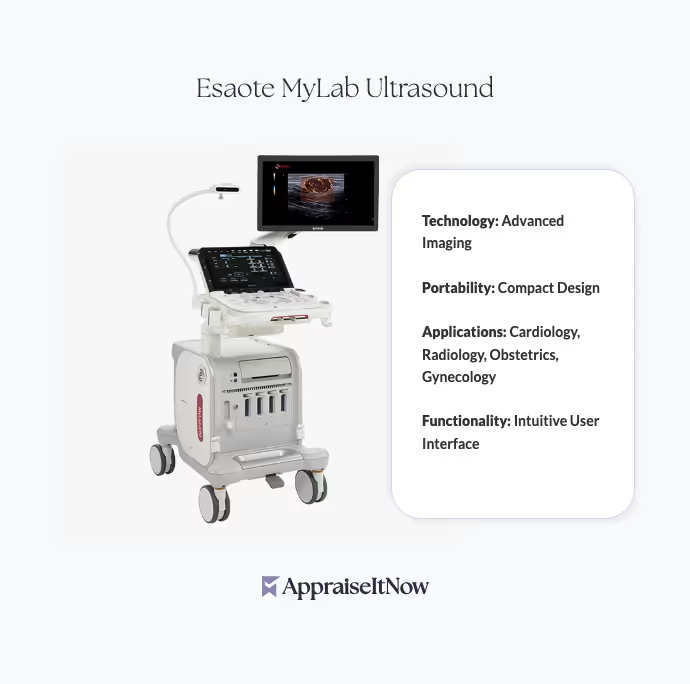
<p>The Esaote MyLab Ultrasound represents a substantial investment in diagnostic imaging capability, and understanding its current market value is critical whether you're buying, selling, or protecting your asset through proper insurance coverage. With estimated values ranging from <strong>$18,000 to $26,000</strong> depending on model variant, condition, and configuration, a professional appraisal provides the documentation you need to make informed decisions about this sophisticated medical imaging system.</p>
<h2>Understanding Esaote MyLab Ultrasound Market Value</h2>
<p>The Esaote MyLab Ultrasound has earned trust from healthcare professionals worldwide since its introduction in 2005, establishing it as a sought-after solution for medical facilities seeking reliable diagnostic capabilities. Your MyLab system's value in today's market depends on multiple interconnected factors that extend far beyond the simple question of what model you own.</p>
<p>When evaluating medical equipment appraisals, understanding what drives these values helps you interpret your appraisal results accurately. The MyLab's proven track record across diverse clinical applications—from cardiology and radiology to obstetrics and gynecology—means your system potentially appeals to a broad range of buyers and healthcare facilities seeking versatile imaging solutions. This versatility directly supports the substantial valuation range your equipment commands compared to single-purpose ultrasound systems.</p>
<div class="callout tip"><p><strong>Valuation Insight</strong></p>
<p>The Esaote MyLab's exceptional image quality and intuitive user interface command premium valuations within the portable ultrasound market segment.</p></div>
<h2>Key Factors That Determine Your MyLab's Appraisal Value</h2>
<p>Professional appraisers evaluating your Esaote MyLab Ultrasound examine specific technical and operational characteristics that significantly influence final valuation. Understanding these assessment criteria helps you prepare documentation and articulate your system's condition and capabilities to potential buyers or insurance providers.</p>
<p><strong>Model variant and generation</strong> represents your first critical value determinant. The MyLab family includes multiple iterations with varying capabilities, from the original 2005 release through current-generation systems. Newer models with advanced image processing, expanded probe compatibility, and enhanced software features typically command higher valuations within the $18,000 to $26,000 range. Conversely, older generation systems may fall toward the lower end unless they feature extensive maintenance records or valuable probe collection.</p>
<p><strong>Age and operating hours</strong> directly correlate with both remaining useful life and maintenance requirements. A system five years old with documented preventive service every 500 hours presents differently than a ten-year-old unit with unknown operational history. Professional appraisers assess the realistic remaining service life for your MyLab, as <a href="/types/medical-equipment">medical equipment</a> often maintains clinical utility well beyond manufacturer recommendations with proper maintenance.</p>
<p><strong>Available probes and transducers</strong> substantially enhance your appraisal value. The MyLab platform's strength lies in its transducer flexibility—your system might support cardiac, abdominal, linear, and specialty probes. Each compatible transducer adds value, with premium probe configurations potentially justifying valuations at the higher end of your range. Documented probe compatibility lists and included accessories directly factor into appraiser calculations.</p>
<p><strong>Software version and update history</strong> affects both current capability and future utility. Current-generation software with active vendor support commands premium valuation compared to legacy versions where manufacturer support has ended. Systems demonstrating complete update documentation indicate responsible ownership and reduce appraiser concerns about obsolescence or compatibility issues.</p>
<h2>Condition, Maintenance, and Technical Readiness</h2>
<p>Beyond age and features, the physical and operational condition of your Esaote MyLab determines where your appraisal lands within the valuation range. Professional appraisers conduct thorough assessments examining factors that directly impact clinical utility and remaining service life.</p>
<p><strong>Maintenance and service history</strong> serves as perhaps your strongest value determinant. Medical facilities and sellers who maintain detailed service records—including routine calibration, preventive maintenance schedules, and documented repairs—demonstrate responsible equipment stewardship. When appraisers review these records, they gain confidence in your system's reliability and remaining operational life, often supporting higher valuations. Conversely, systems lacking maintenance documentation raise questions about potential hidden issues or deferred repairs.</p>
<p><strong>Calibration status and compliance documentation</strong> represents a critical compliance factor. Your MyLab requires periodic calibration to meet diagnostic accuracy standards and regulatory requirements. Recent calibration certificates from qualified service providers add substantial credibility to your appraisal and support higher valuations. Systems showing calibration compliance demonstrate the owner understood their maintenance obligations and likely performed other care appropriately.</p>
<p><strong>Physical condition assessment</strong> evaluates cosmetic appearance alongside functional integrity. Professional appraisers examine the display screen, control panel, chassis, and wheel base for signs of wear, damage, or repair. While cosmetic wear typically has minimal impact on a diagnostic ultrasound's function, significant physical damage or evidence of repair can raise concerns about internal component integrity, potentially reducing valuation by 10-20% from excellent-condition benchmarks.</p>
<h2>Documentation Requirements for USPAP-Compliant Appraisals</h2>
<p>Obtaining a professional appraisal following <strong>USPAP (Uniform Standards of Professional Appraisal Practice)</strong> ensures your documentation meets standards accepted by insurance companies, courts, and financial institutions. Understanding what documentation supports credible appraisals helps you prepare materials that strengthen your valuation.</p>
<p>Professional appraisers require specific records to establish market value and condition. Your equipment's <strong>original purchase documentation</strong>—including invoices, warranties, and equipment specifications—provides baseline information about your MyLab's configuration. <strong>Service and maintenance records</strong> documenting routine care, calibration dates, and any repairs performed become essential evidence of responsible ownership and equipment reliability.</p>
<p><strong>Regulatory and compliance documentation</strong> matters significantly for medical equipment. Your appraisal should reflect FDA clearance status, IEC safety testing compliance, and any recalls or advisory notices affecting your model. Systems with complete compliance documentation and no outstanding safety concerns naturally support higher valuations than those with unclear regulatory histories.</p>
<p><strong>Probe inventory and accessory documentation</strong> including original purchase receipts, compatibility lists, and current working condition assessments helps appraisers accurately value your complete system. A MyLab bundled with multiple premium transducers and accessory equipment justifies valuations substantially above a base unit lacking probes. When seeking appraisal, compile photographic evidence of all included components with serial number verification when possible.</p>
<div class="callout note"><p><strong>Documentation Tip</strong></p>
<p>Organization matters—compile all documentation chronologically with clear labels identifying maintenance records, calibration certificates, and regulatory compliance materials.</p></div>
<h2>Accessory and Component Value Multipliers</h2>
<p>Your Esaote MyLab's total appraisal value extends beyond the base imaging system itself. Included accessories, optional transducers, support equipment, and software licenses can collectively add <strong>$2,000 to $6,000</strong> to your valuation depending on what accompanies your system.</p>
<p><strong>Transducers and specialized probes</strong> represent the most valuable accessories. Premium linear, phased array, curved, and specialty probes for cardiac or vascular imaging each add significant value. A complete probe collection—potentially including five or more compatible transducers—can justify valuations at the upper end of your range, sometimes pushing combined system value beyond $26,000.</p>
<p><strong>Cart systems and mounting equipment</strong> including wheeled or mobile stand configurations, power distribution systems, and cable management solutions add practical value. While less significant than probe quality, professional-grade carts demonstrate the system was deployed in clinical settings rather than research environments, supporting baseline equipment valuation.</p>
<p><strong>Software licenses and PACS connectivity</strong> capabilities increasingly matter in modern healthcare environments. Systems configured for Picture Archiving and Communication Systems (PACS) integration, electronic health record (EHR) compatibility, or with active software service agreements command premium valuations. Conversely, systems with expired licenses or incompatible configurations may see modest valuation reductions.</p>
<p><strong>Printers and documentation equipment</strong> including thermal printers for ultrasound image hardcopy occasionally accompany MyLab systems. While modest in individual value, these peripherals demonstrate comprehensive clinical deployment and rarely reduce valuation.</p>
<h2>Market-Specific Value Variations and Regional Factors</h2>
<p>Your Esaote MyLab Ultrasound's appraisal value can fluctuate based on geographic market dynamics, regulatory environments, and local demand patterns. Understanding these regional variations helps you contextualize your appraiser's findings and appreciate why identical systems might command different prices in different markets.</p>
<p>Certain U.S. regions with concentrated healthcare infrastructure—particularly major metropolitan areas with large hospital systems and diagnostic centers—often support stronger demand for used ultrasound equipment. Rural markets or regions with limited facilities may see reduced demand and modestly lower valuations. International markets present distinct opportunities; some European and Asian facilities value U.S.-sourced equipment highly, potentially supporting premium pricing for export-focused transactions.</p>
<p><strong>Regulatory environment differences</strong> affect equipment viability across markets. Systems requiring FDA recertification for certain applications may see reduced demand in restrictive regulatory environments, while markets with streamlined compliance potentially support higher valuations. Your appraiser considers these regional dynamics when establishing fair market value for your specific location and intended market.</p>
<p><strong>Competitive equipment availability</strong> influences pricing. Regions with abundant used ultrasound inventory often see more competitive pricing than areas where quality refurbished systems remain scarce. Professional appraisers monitor local supply dynamics and comparable sales to establish realistic market-based valuations reflecting current supply and demand conditions.</p>
<div class="callout tip"><p><strong>Market Insight</strong></p>
<p>Medical equipment demand fluctuates seasonally, with healthcare facilities often evaluating capital purchases during specific fiscal periods, potentially affecting your system's resale timing.</p></div>
<h2>Depreciation Patterns and Useful Life Considerations</h2>
<p>Understanding typical depreciation rates for ultrasound systems like the MyLab helps contextualize your appraisal value and plan for equipment replacement or upgrade cycles. Medical imaging equipment generally deprecates more slowly than consumer electronics due to durability, regulatory restrictions, and lengthy clinical deployment timelines.</p>
<p>The Esaote MyLab typically experiences approximately <strong>15-20% annual depreciation</strong> during the first three years of ownership, reflecting initial technology absorption and competitive product releases. This rate moderates to <strong>8-12% annually</strong> in years four through seven as the system establishes reliable performance records and establishes market position. Beyond seven years, depreciation slows further to approximately <strong>5-7% annually</strong>, with well-maintained systems sometimes stabilizing in value if they achieve "classic" status within collector or specialty market segments.</p>
<p>Your MyLab's useful life expectancy for clinical deployment typically ranges from <strong>10-15 years</strong> with proper maintenance, though individual systems sometimes remain viable beyond this window. This realistic lifecycle helps appraisers project remaining useful value and supports their valuation conclusions. A five-year-old system with excellent maintenance records may depreciate less dramatically than projected due to demonstrated reliability and remaining service life.</p>
<h2>Resale Channel Impact on Achievable Value</h2>
<p>Your Esaote MyLab Ultrasound can be liquidated through multiple channels, each offering distinct value realization and timeline characteristics. Understanding these options helps you contextualize your appraisal value and make informed decisions about optimal disposition strategy.</p>
<p><strong>Medical equipment dealerships and refurbishers</strong> typically purchase equipment at approximately 70-85% of appraised fair market value, accounting for their inventory costs, refurbishment requirements, and resale overhead. These channels offer quick liquidation timelines, typically closing transactions within 2-4 weeks. While not maximizing value, dealer channels provide certainty and convenience for sellers prioritizing speed.</p>
<p><strong>Direct sale to medical facilities, clinics, or diagnostic centers</strong> often achieves valuations closest to your professional appraisal. Healthcare providers evaluating used equipment frequently target specific capabilities and willingly pay fair market prices for systems meeting their needs. However, direct sales require marketing effort, facility vetting, and potentially extended sales cycles spanning 6-12 weeks or longer.</p>
<p><strong>Hospital surplus and healthcare liquidation auctions</strong> offer middle-ground value realization, typically achieving 75-90% of fair market value depending on competitive bidding activity. These channels provide broader reach and established buyer networks but introduce valuation uncertainty and potentially extended marketing timelines.</p>
<p><strong>International export markets</strong> sometimes offer premium pricing for quality U.S.-sourced medical equipment, particularly in developing healthcare markets. However, export transactions involve regulatory compliance complexity, international shipping logistics, and extended timelines. Professional appraisers increasingly consider export market potential when valuing equipment with international market appeal.</p>
<h2>Why Professional Appraisal Matters for Your Esaote MyLab</h2>
<p>Obtaining a certified professional appraisal from credentialed experts creates documentation far more valuable than simple market research or internal estimates. When you work with AppraiseItNow's network of experienced medical equipment appraisers, you gain access to specialists who understand the nuanced factors affecting ultrasound system valuations and maintain current market knowledge that individual sellers cannot replicate.</p>
<p>Professional appraisers apply rigorous assessment methodologies aligned with USPAP standards, examining your specific system's condition, capabilities, and market positioning to generate defensible valuations. This documentation becomes essential when insurance companies require replacement cost validation, courts need independent asset valuations for estate or litigation purposes, or buyers demand credible pricing justification for significant capital investments. Your certified appraisal report provides detailed analysis of factors supporting the valuation, creating transparent documentation that builds confidence in your asking price or insurance coverage levels.</p>
<p>Beyond valuation itself, professional appraisals often identify optimization opportunities—missing documentation, accessories that enhance value, maintenance improvements, or software updates that could strengthen your system's market position before disposition. Some sellers discover their equipment is worth more than initially assumed, while others gain realistic perspective on market positioning, informing whether to pursue sales or retain equipment for continued clinical service.</p>
<div class="callout note"><p><strong>Key Takeaway</strong></p>
<p>A certified appraisal of your Esaote MyLab Ultrasound from qualified medical equipment specialists provides credible, defensible documentation essential for insurance purposes, capital transactions, or confident value optimization. Whether buying, selling, or protecting your investment, professional appraisal expertise transforms uncertainty into actionable market intelligence grounded in current comparable data and expert analysis.</p></div>