









<h1>How to Get Your Bruker NMR 400 MHz Appraised</h1>
<p>The Bruker NMR 400 MHz spectrometer represents a significant investment in laboratory infrastructure, whether you're evaluating it for purchase, sale, insurance, or financial reporting purposes. With an estimated market value between <strong>$280,000 and $290,000</strong>, understanding how professional appraisers determine value for this sophisticated instrument helps you make informed decisions about your <a href="/types/lab-equipment">lab equipment</a>.</p>
<h2>Understanding the Bruker NMR 400 MHz and Its Value Drivers</h2>
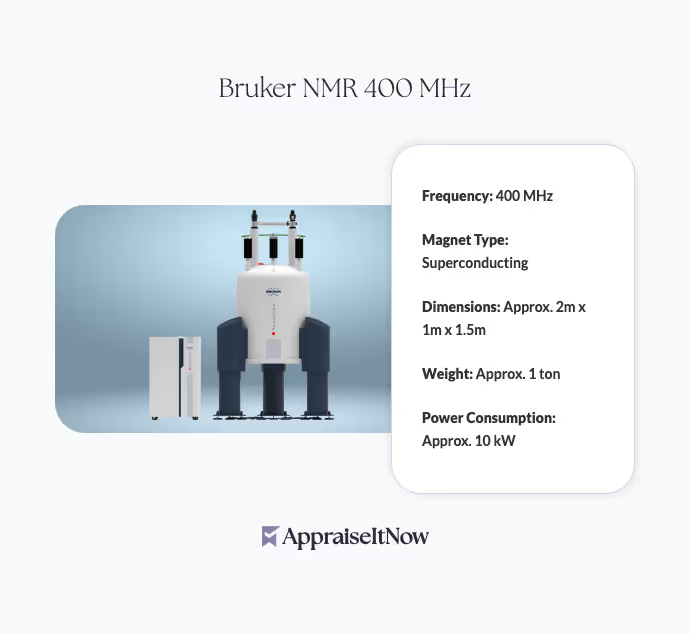
<p>The Bruker NMR 400 MHz is one of the most respected nuclear magnetic resonance instruments in research environments worldwide. First introduced in the 1990s, this spectrometer operates at a 400 MHz frequency, providing the resolution and sensitivity required for advanced structural analysis in organic chemistry, biochemistry, and materials science applications.</p>
<p>What makes your Bruker NMR 400 MHz valuable? The instrument combines cutting-edge superconducting magnet technology with sophisticated digital signal processing capabilities, enabling researchers to perform both routine and complex 2D and 3D NMR experiments. This versatility, paired with the brand's reputation for reliability, creates consistent demand in the secondary market among academic institutions, research laboratories, and industrial facilities seeking cost-effective analytical solutions.</p>
<div class="callout tip"><p><strong>Market Insight</strong></p>
<p>Bruker-manufactured NMR systems generally hold their value better than competing brands due to superior build quality and robust aftermarket support, affecting long-term investment returns.</p></div>
<h2>Magnetic Field Strength and Frequency Classifications</h2>
<p>A common question from potential buyers involves understanding what "400 MHz" actually means in practical terms. The 400 MHz designation refers to the operating frequency of the proton resonance, which directly corresponds to the strength of the superconducting magnet. For reference, a 400 MHz NMR operates at approximately <strong>9.4 Tesla</strong>—a substantial magnetic field that enables precise molecular structure determination.</p>
<p>How does this compare to other Bruker NMR specifications? The Bruker NMR product range spans from entry-level 300 MHz systems up to ultra-high-field 1.2 GHz instruments. Understanding where your 400 MHz fits within this spectrum matters significantly for appraisal purposes. The 400 MHz sits in the mid-to-high performance category, offering superior analytical capability compared to 300 MHz systems while commanding substantially lower purchase and maintenance costs than 600 MHz or 800 MHz alternatives.</p>
<p>The differences between 300 MHz and 500 MHz systems highlight why the 400 MHz occupies such a popular market position. While 300 MHz systems sacrifice some resolution for lower cost, and 500 MHz instruments demand significantly higher investment, the 400 MHz provides an optimal balance of performance and cost-effectiveness that appeals broadly across research institutions. Similarly, when comparing 400 MHz to 600 MHz capabilities, the jump in sensitivity and resolution for the 600 MHz system often doesn't justify the 40-50% higher acquisition and operating costs for many laboratory applications.</p>
<h2>Specialized Equipment Considerations for Valuation</h2>
<p>Your Bruker NMR 400 MHz isn't simply a standalone instrument—its value encompasses an integrated system requiring specialized infrastructure and supporting <a href="/types/chemical-equipment">chemical equipment</a>. Professional appraisers evaluating these systems examine multiple components affecting worth:</p>
<p>The superconducting magnet represents the single largest value component, typically accounting for 35-40% of total system value. However, appraisers must assess magnet condition including helium charge status, cryogenic cooling system functionality, and any history of magnet quenches or cryogenic failures. An aging cooling system or compromised magnet can reduce valuation by 20-30% depending on repair costs.</p>
<p>Digital electronics and software interfaces constitute another significant valuation factor. Current-generation Bruker console systems and pulse sequence software maintain higher values than legacy systems, particularly when considering end-user support and software compatibility with modern research protocols. Your specific system configuration—whether equipped with modern multinuclear capabilities, advanced gradient systems, or legacy probe sets—directly impacts market assessment.</p>
<div class="callout note"><p><strong>Appraiser Focus</strong></p>
<p>The cryogenic cooling system represents critical infrastructure. Systems requiring imminent liquid helium refills or showing compressor degradation see significant value reduction compared to well-maintained alternatives.</p></div>
<h2>Market Demand and Institutional Purchasing Patterns</h2>
<p>Understanding who purchases used Bruker NMR 400 MHz systems helps explain appraisal methodologies. Academic chemistry departments frequently upgrade to higher-field systems or specialized configurations, creating a steady supply of quality 400 MHz instruments entering the secondary market. These institutional buyers—looking to replace aging equipment without capital expenditure—drive consistent demand that supports your equipment's resale value.</p>
<p>Research institutions and pharmaceutical companies similarly seek well-maintained 400 MHz systems for routine screening applications, structure verification, and quality control work where the 400 MHz sensitivity proves adequate. This dual-use market dynamic creates more stable pricing compared to highly specialized analytical equipment facing narrow demand.</p>
<p>When seeking professional valuations, appraisers like those at <strong>AppraiseItNow</strong> leverage extensive databases of recent comparable sales, current market listings, and transaction history specific to <a href="/types/equipment-and-machinery">equipment and machinery</a>. This comparative market approach establishes your Bruker NMR 400 MHz's position within the <strong>$280,000-$290,000</strong> range, with specific valuations reflecting condition, age, maintenance history, and configuration details.</p>
<h2>Operational Status and Maintenance History Impact</h2>
<p>The distinction between functional and non-functional systems dramatically affects appraisals. A fully operational Bruker NMR 400 MHz with current shimming procedures, routine maintenance documentation, and verified performance specifications commands premium valuation. Conversely, systems requiring cryogenic recharge, recalibration, or probe replacement see proportional value reductions reflecting remediation costs.</p>
<p>Professional appraisers conduct performance assessments examining linewidth specifications, sensitivity measurements, and signal-to-noise ratios against Bruker's published standards. Systems demonstrating performance within normal parameters typically sustain full estimated valuations, while underperforming instruments see adjustments reflecting needed repairs or the discounted "as-is" market value.</p>
<p>Your maintenance documentation significantly influences appraisal outcomes. Institutions maintaining detailed service records, regular helium refills, and scheduled preventive maintenance typically retain 70-80% of their original instrument value over five-year ownership periods. Conversely, systems with unknown maintenance histories or deferred service see valuations reduced by 15-25% reflecting appraiser skepticism about undisclosed issues.</p>
<h2>Why Professional Appraisal Matters for NMR Systems</h2>
<p>Whether you're planning to sell your Bruker NMR 400 MHz, require insurance coverage, support a donation for tax purposes, or need documented valuations for financial reporting, professional appraisal services provide credible, defensible documentation. A certified appraiser's USPAP-compliant report carries weight with insurance carriers, tax authorities, and prospective buyers in ways informal pricing estimates cannot.</p>
<p>For organizations exploring <a href="/blog/how-to-determine-the-fair-market-value-for-lab-equipment">equipment and machinery valuations</a>, professional appraisals document current replacement value, fair market value, and depreciated value—each serving different purposes depending on your specific need. Insurance carriers increasingly demand appraisals for equipment exceeding $250,000 thresholds, making professional documentation essential for comprehensive coverage.</p>
<p>The complexity of NMR system valuations—encompassing technical performance assessment, market analysis, and specialized equipment knowledge—makes working with experienced appraisers critical. Appraisers specializing in <a href="/blog/understanding-the-value-of-your-lab-equipment-an-appraisal-expert-s-guide">lab equipment</a> understand the nuanced factors affecting Bruker NMR valuations that generalist appraisers often overlook.</p>
<h2>Comparing NMR Systems: Cost and Value Perspective</h2>
<p>Understanding cost differentials across NMR technologies contextualizes your 400 MHz system's value position. An 800 MHz NMR spectrometer typically costs <strong>$800,000-$1,200,000</strong> for new equipment, reflecting significantly enhanced sensitivity and resolution capabilities. However, used 800 MHz systems appreciate slowly if at all due to rapid technological advancement, sometimes seeing faster depreciation than mid-field systems like your 400 MHz.</p>
<p>This paradox explains why the 400 MHz maintains stronger resale value relative to original cost—institutional demand remains strong, technological advancement has plateaued for this performance tier, and operating costs remain reasonable compared to ultra-high-field alternatives. For institutions conducting routine structure determination without requiring cutting-edge sensitivity, a well-maintained 400 MHz system at <strong>$280,000-$290,000</strong> represents exceptional value compared to purchasing new equipment or upgrading to higher-field systems.</p>
<h2>Specialized Considerations for Different Applications</h2>
<p>Your Bruker NMR 400 MHz serves multiple analytical purposes, each affecting valuation depending on probe configurations and installed capabilities. Systems equipped for advanced multinuclear analysis, carbon-13 spectroscopy, and proton-based structural determination command higher values than systems limited to basic proton NMR applications. Custom probe sets optimized for solid-state NMR or specialized polymer analysis similarly enhance valuation for specific buyer populations.</p>
<p>Appraisers assess whether your system includes modern gradient capabilities enabling sophisticated two-dimensional experiments, which significantly enhance market appeal and value compared to older systems lacking this functionality. The presence of automated sample changers, temperature control systems, and modern lock-in procedures also affect valuation by expanding practical applications and reducing operational complexity for end-users.</p>
<div class="callout tip"><p><strong>Valuation Detail</strong></p>
<p>Systems with recently calibrated probes and modern pulse sequence libraries typically command 5-10% premiums over comparable equipment requiring immediate probe refurbishment or software updates.</p></div>
<h2>Documentation and Record Keeping for Appraisal Purposes</h2>
<p>To maximize your Bruker NMR 400 MHz's appraisal value and facilitate the evaluation process, gather comprehensive documentation including:</p>
<p>Service records demonstrating regular maintenance and any major repairs, original purchase documentation establishing acquisition date and initial configuration, system specifications confirming installed modules and capabilities, and performance verification records showing current operational status. High-quality photographs of the instrument, console, and data displays provide visual documentation supporting professional appraisals.</p>
<p>This documentation streamlines the appraisal process while establishing credibility for your valuation estimates. When seeking certified appraisal services, professional evaluators can incorporate this documentation directly into their reports, providing comprehensive justification for valuations that satisfy insurance companies, financial institutions, and tax authorities.</p>
<h2>Connecting With Specialized Appraisal Services</h2>
<p>AppraiseItNow connects you with credentialed appraisers experienced in <a href="/blog/the-basics-of-laboratory-equipment-appraisal">laboratory equipment valuation</a>, including sophisticated analytical instruments like your Bruker NMR 400 MHz. Our network includes appraisers holding relevant credentials from organizations like AAA, ISA, ASA, CAGA, and AMEA who understand both the technical specifications and market dynamics affecting your equipment's value.</p>
<p>The appraisal process begins with detailed equipment inspection, photographic documentation, and technical performance assessment. Professional appraisers then conduct comprehensive market research, identifying recent comparable sales and evaluating your system's position within current market conditions. The resulting USPAP-compliant report provides detailed valuation justification suitable for insurance coverage, financial reporting, or transactional purposes.</p>
<div class="callout note"><p><strong>Key Takeaway</strong></p>
<p>Your Bruker NMR 400 MHz represents a substantial analytical asset worth $280,000-$290,000 requiring professional valuation for insurance, sale, or institutional documentation purposes. Certified appraisals provide defensible, accurate valuations grounded in technical assessment and comprehensive market analysis, ensuring your equipment is properly valued in today's secondary market.</p></div>