









<h1>How to Get Your Sportfish Cabo 44 Hardtop Appraised</h1>
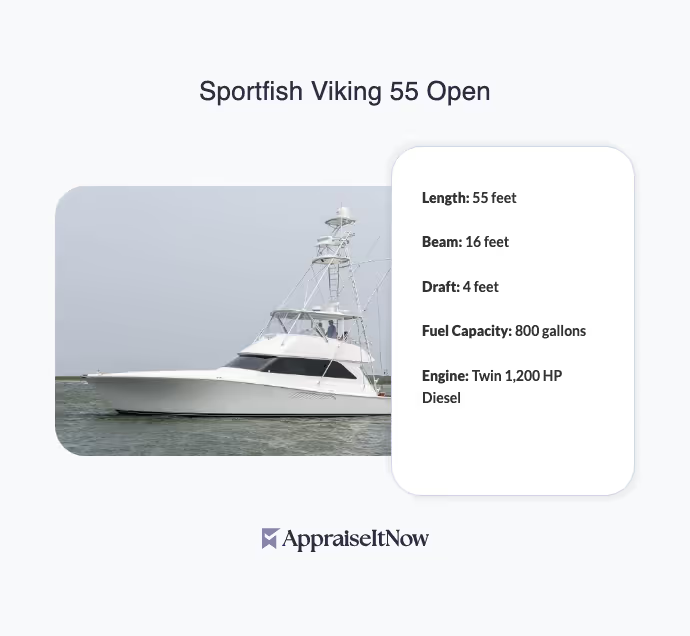
<p>The Sportfish Cabo 44 Hardtop commands strong interest in today's luxury marine market, with quality examples valued between <strong>$75,000 and $95,000</strong> depending on condition, age, and specifications. Whether you're buying, selling, insuring, or settling an estate, understanding what drives the appraisal process ensures you receive an accurate, defensible valuation that reflects your vessel's true market position.</p>
<h2>Understanding the Sportfish Cabo 44's Market Position</h2>
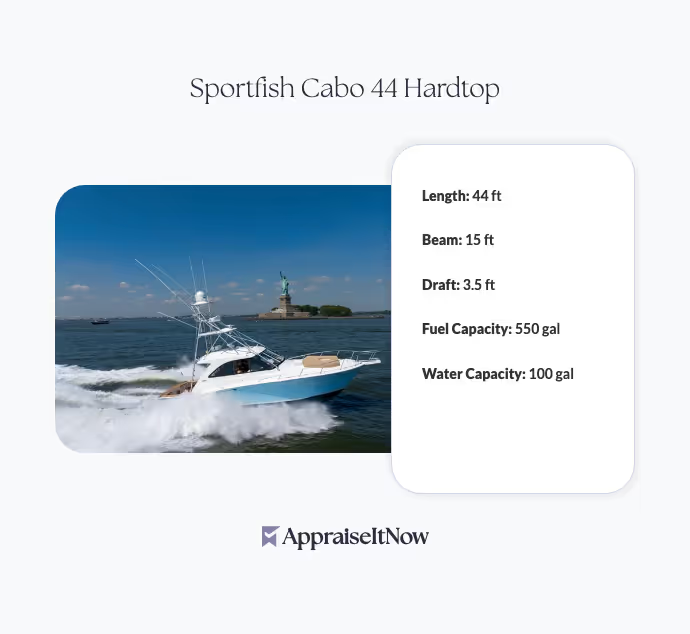
<p>Introduced in 2005, the Cabo 44 Hardtop has established itself as a highly sought-after platform among serious anglers and coastal cruisers. The combination of its sleek aerodynamic design, high-performance twin diesel engines, and well-appointed interior creates a vessel that successfully bridges luxury living with practical offshore capability. Unlike entry-level fishing boats that prioritize budget, the Cabo 44 demands appreciation for refined engineering and craftsmanship—qualities that professional appraisers must understand when establishing fair market value.</p>
<p>The teak-lined cockpit and flybridge, paired with state-of-the-art navigation electronics, position the Cabo 44 at the upper end of the sportfishing market. This places your vessel squarely in the category of <a href="/types/boat">yacht and marine asset appraisals</a>, where specialized expertise becomes essential for accurate valuation.</p>
<div class="callout tip"><p><strong>Market Insight</strong></p>
<p>Cabo 44 models with original engines under 1,500 hours and documented service records typically command valuations at the higher end of the range.</p></div>
<h2>Primary Value Drivers for Your Cabo 44</h2>
<p>When appraisers evaluate your Sportfish Cabo 44 Hardtop, they examine multiple interconnected factors that collectively establish market value. Rather than relying on guesswork, professional valuers apply systematic analysis to ensure defensibility.</p>
<p><strong>Age and hull condition</strong> form the foundation of any marine appraisal. A 2010 model in excellent condition will appraise differently than a 2005 model requiring structural work. Appraisers inspect the gel coat for cracks, check the hull for osmotic blistering, and assess overall structural integrity through methods that parallel <a href="/types/personal-property">personal property</a> and <a href="/types/equipment-and-machinery">equipment valuations</a>.</p>
<p><strong>Engine hours and maintenance history</strong> significantly impact value. Your twin diesel engines represent 30-40% of the Cabo's total worth, making documented service records crucial. Appraisers request engine logs showing regular oil changes, filter replacements, and any overhauls or major repairs. Engines under 1,000 hours command premium valuations; those exceeding 2,500 hours require depreciation adjustments that can reduce total value by 15-25%.</p>
<p><strong>Electronics and navigation systems</strong> have a pronounced effect on appraisal outcomes. State-of-the-art equipment like modern GPS chartplotters, fish finders, and autopilot systems can add $5,000-$15,000 to value, while outdated or non-functional systems create corresponding deductions. When you've invested in upgrading electronics or fishing gear, professional appraisers document these improvements and assess their market-accepted contribution to overall vessel worth.</p>
<div class="callout note"><p><strong>Documentation Advantage</strong></p>
<p>Receipts for electronics upgrades, custom modifications, and major repairs become your strongest allies during appraisal. Organize these chronologically with photos showing before/after conditions.</p></div>
<h2>Differentiating Market Value, Retail Value, and Replacement Cost</h2>
<p>Understanding these three distinct valuation approaches prevents confusion when reviewing your appraisal report. Professional appraisers distinguish between them clearly, and the purpose of your appraisal determines which approach applies.</p>
<p><strong>Market value</strong> represents what your Cabo 44 would sell for in the current open market between a willing buyer and seller, neither under pressure and both reasonably informed. This typically ranges $75,000-$95,000 and forms the basis for most insurance and estate valuations. When seeking financing through marine lenders, you'll encounter market value estimates.</p>
<p><strong>Retail value</strong> assumes the seller is a marine dealership with overhead costs factored into pricing—generally 10-20% higher than private-party market value. This matters less for individual sellers but remains important when dealers handle brokerage sales or trade-ins.</p>
<p><strong>Replacement cost</strong> calculates the expense to replace your exact vessel new or through similar used acquisition plus delivery, setup, and operational readiness. This figure typically exceeds market value by 25-40% and matters primarily for insurance underwriting where insurers determine premium adequacy. Understanding these distinctions parallels how professionals value other asset categories—whether <a href="/types/recreational-vehicle">recreational vehicles</a>, <a href="/types/artwork">artwork</a>, or <a href="/types/business-assets">business assets</a>—each category employs multiple valuation methodologies depending on purpose.</p>
<h2>Documentation Requirements for Thorough Valuation</h2>
<p>Your appraisal's quality depends directly on the documentation you provide. Professional appraisers, particularly those credentialed through organizations like <strong>ASA, ISA, AAA, or AMEA</strong>, follow standardized protocols requiring specific evidence to support valuations.</p>
<p>You'll want to compile your <strong>title and registration documents</strong> establishing clear ownership. For vessels operating in navigable U.S. waters, USCG documentation provides authoritative proof of ownership and construction details. Appraisers use these documents to verify the hull ID number, confirm specifications, and check for liens or salvage history that would dramatically reduce value.</p>
<p><strong>Maintenance records</strong> become your documentation's centerpiece. Rather than expecting appraisers to accept your word about engine condition or recent repairs, provide:</p>
<ul>
<li>Engine service logs and receipts for maintenance</li>
<li>Haul-outs and bottom painting records</li>
<li>Electrical system upgrades or repairs</li>
<li>Structural remediation or repainting work</li>
<li>Receipts for significant component replacements</li>
</ul>
<p><strong>Surveys</strong> function as independent third-party verification of vessel condition. A professional marine survey, though different from a USPAP-compliant appraisal, provides detailed condition assessment that appraisers incorporate into their analysis. Both documents serve different purposes—surveys typically support purchase decisions while appraisals establish value for legal, financial, or insurance purposes. If you've had your Cabo 44 surveyed within the past 24 months, provide that report; appraisers will reference it while conducting their independent evaluation.</p>
<p><strong>Receipts for upgrades and modifications</strong> deserve particular attention. If you've invested in custom electronics, a fighting chair tower, engine overhauls, or interior refinishing, these receipts substantiate claimed improvements. Without documentation, appraisers must conservatively estimate improvements' market acceptance—meaning you receive less credit than justified.</p>
<div class="callout tip"><p><strong>Professional Recommendation</strong></p>
<p>Create a vessel portfolio including high-resolution photos of the cabin, cockpit, engine room, and hull condition. Take new photos annually and maintain them with corresponding service records to streamline future appraisals.</p></div>
<h2>How Upgrades and Modifications Affect Appraised Value</h2>
<p>Not every upgrade contributes dollar-for-dollar to your Cabo 44's appraised value, and sophisticated appraisers understand market realities that differ from your acquisition cost.</p>
<p><strong>Custom electronics and navigation systems</strong> generally contribute 60-80% of their installed cost to appraised value. A $20,000 integrated navigation suite might add $12,000-$16,000 to your Cabo's worth, assuming the equipment remains current and compatible with the vessel. Dated or orphaned electronics systems—like superseded fish finder models or discontinued chartplotter software—contribute less due to replacement costs buyers would face.</p>
<p><strong>Fighting chair towers, outriggers, and specialized fishing gear</strong> command market acceptance ranging from 40-70% of acquisition cost. These additions appeal primarily to serious anglers, which limits the buyer pool compared to general coastal cruising upgrades. A custom fighting chair tower purchased for $8,000 might add $3,200-$5,600 in appraised value, depending on condition, quality, and market demand among your geographic buyer pool.</p>
<p><strong>Engine overhauls represent a different category altogether.</strong> Rather than improving value, they maintain it. An engine overhaul or replacement doesn't increase your Cabo's worth above what fresh engines would contribute anyway—but <em>lacking</em> such maintenance depresses value substantially. Think of engine work as maintaining position rather than gaining ground.</p>
<p><strong>Interior refurbishment and cabin updates</strong> contribute 50-75% of costs to appraised value. Upgraded upholstery, refreshed cabinetry, and modernized galley systems appeal broadly to potential buyers but don't command premium pricing equivalent to their acquisition cost. This differs from residential real estate where kitchen and bathroom updates often approach higher return percentages.</p>
<p>Understanding these dynamics prevents disappointment when appraisers assign lower values than your upgrade spending suggests deserved. Markets establish value; costs merely represent investment.</p>
<h2>Regional and Seasonal Market Variations</h2>
<p>Marine markets exhibit pronounced geographic and temporal variations that affect your Cabo 44's appraised value. The waters where your vessel has been used, the region where you're selling, and market seasonality all influence comparable sales data that appraisers rely upon.</p>
<p>Boats positioned in established fishing markets—the Florida Keys, Southern California, and the Gulf of Mexico—typically command higher values than identical vessels in less activity-concentrated regions. Active sportfishing communities support more comparables sales, creating efficient markets with established pricing. This mirrors how <a href="/types/real-estate">real estate appraisals</a> recognize geographic premium for properties in desirable locations.</p>
<p><strong>Seasonality impacts pricing substantially.</strong> If you're selling a Cabo 44 in November in a northern climate, appraisers recognize seasonal softness in boating demand—most buyers are planning rather than purchasing. The same vessel marketed in May commands higher prices as boating season peaks. Professional appraisers adjust for these cyclical patterns using seasonal adjustment factors derived from historical sales data, though savvy sellers use this knowledge strategically when timing sales.</p>
<p>Recent comparable sales provide appraisers' most reliable valuation foundation. Rather than relying on list prices (which often exceed actual sales prices), professional appraisers track closed transactions—what comparable Cabo 44s actually sold for over the past 6-12 months. Geographic proximity matters; a Cabo 44 that sold in Florida carries more weight than one that sold in Maine when appraising a Florida vessel, though good appraisers develop multi-regional databases to ensure market-informed valuations.</p>
<h2>The Sea Trial and Inspection Protocol</h2>
<p>While distinct from a pre-purchase survey, professional appraisals increasingly incorporate functional testing and detailed inspection to validate condition claims and establish defensible values. Understanding what appraisers examine ensures you understand their methodology and can address any concerns they identify.</p>
<p><strong>Sea trials</strong> test engine performance, propulsion responsiveness, and operational systems. Appraisers confirm engines start reliably, maintain stable idle, and accelerate smoothly without unusual vibration or smoke. They check steering responsiveness, verify transmission engagement, and assess overall handling characteristics. Engines that stumble, smoke excessively, or demonstrate rough idle immediately trigger red flags requiring investigation—either through mechanical documentation or corresponding value deductions.</p>
<p><strong>Engine compression tests</strong> provide objective data about engine condition. Rather than guessing about internal wear, compression testing reveals whether cylinders maintain proper pressure, suggesting good internal condition or identifying problems requiring expensive repairs. Appraisers may recommend compression testing for high-hour engines or when purchase inspections reveal concerns.</p>
<p><strong>Hull inspection</strong> includes above-water examination and, ideally, observations during haul-out. Appraisers look for osmotic blistering, stress cracks in gel coat, delamination, and evidence of previous damage repair. The engine room receives detailed attention—corrosion, bent fuel lines, deteriorated hoses, and improper installations all factor into condition grading and value adjustments.</p>
<p><strong>Electrical and plumbing systems</strong> are tested for functional operation. Appraisers confirm fresh water systems produce potable water, waste systems operate properly, and electrical systems provide power to all outlets and fixtures. Corroded through-hull fittings, leaking seacocks, and non-functional systems create deductions or repair recommendations.</p>
<div class="callout tip"><p><strong>Inspection Advantage</strong></p>
<p>Schedule your appraisal when the vessel is accessible and systems can be tested. Appraisers working with non-functional systems must estimate repair costs conservatively, potentially reducing appraised value more than necessary.</p></div>
<h2>Understanding Professional Appraiser Credentials and Qualifications</h2>
<p>Not all marine appraisers possess equivalent expertise or credentialing, which directly impacts appraisal quality and defensibility. When seeking services through AppraiseItNow, you'll access appraisers holding credentials from organizations recognized throughout the marine industry.</p>
<p><strong>American Society of Appraisers (ASA)</strong> members undergo rigorous education and demonstrate practical experience specific to marine vessel appraisal. ASA-credentialed appraisers maintain continuing education requirements and adhere to ethical standards that ensure independence and objectivity. ASA designations like <strong>AAM (Accredited Appraiser of Machinery)</strong> and <strong>AM (Appraiser Member)</strong> identify appraisers with specialized equipment and marine expertise.</p>
<p><strong>International Society of Appraisers (ISA)</strong> offers similar credentialing with emphasis on personal property valuation expertise. ISA members follow established standards and ethics codes, providing appraisals suitable for legal proceedings, estate settlements, and insurance purposes.</p>
<p><strong>American Society of Yacht Appraisers (ASYA)</strong> focuses specifically on maritime vessel valuations, combining marine knowledge with appraisal methodology. ASYA-affiliated appraisers understand unique marine valuation factors like osmotic blistering, through-hull deterioration, and offshore capability assessment.</p>
<p><strong>AAA and AMEA</strong> credentials, while less common than ASA/ISA, represent additional professional designations in specialized maritime and equipment appraisal fields. The key distinction: look for <strong>USPAP compliance</strong>. USPAP (Uniform Standards of Professional Appraisal Practice) ensures appraisals meet standards accepted by lenders, insurers, and courts. Professional AppraiseItNow appraisers maintain USPAP compliance, ensuring your report carries maximum defensibility and acceptance.</p>
<h2>Appraisal Costs and Timeline for a Cabo 44</h2>
<p>Understanding appraisal economics prevents sticker shock when you receive a proposal. Professional marine appraisals for vessels the size of a Cabo 44 typically range from <strong>$1,200 to $2,500</strong> depending on vessel accessibility, extent of inspection, and local market conditions. This investment seems substantial until you recognize it protects much larger assets—a $75,000-$95,000 vessel warrants professional valuation.</p>
<p><strong>Timeline typically spans 2-4 weeks</strong> from engagement through final report delivery. This includes scheduling (coordinating appraiser availability), conducting the appraisal inspection (typically 4-8 hours for a Cabo 44), research and analysis (comparing comparable sales, evaluating market data), and report preparation (detailed documentation formatted for your specific use). Expedited appraisals within 3-5 days cost premium fees reflecting appraiser schedule compression.</p>
<p>The investment becomes minuscule when you calculate potential errors. An appraisal error of just 5% represents $3,750-$4,750 on a typical Cabo 44 valuation—immediately invalidating any savings from using inexperienced or uncreditialed appraisers. Whether you're <a href="/blog/a-step-by-step-guide-to-boat-appraisals">financing a boat purchase</a>, <a href="/blog/using-boat-appraisals-to-insure-your-boat">adjusting insurance coverage</a>, or <a href="/blog/boat-appraisals-and-estate-planning-what-you-need-to-know">settling estate distribution</a>, professional appraisals represent insurance against costly valuation mistakes.</p>
<h2>Using Appraisals for Financing, Insurance, and Beyond</h2>
<p>Your Sportfish Cabo 44 appraisal serves multiple purposes, each with distinct requirements. Understanding these applications ensures you request the right appraisal type and documentation.</p>
<p><strong>Lender appraisals</strong> establish collateral value for marine financing. Banks and specialized marine lenders require USPAP-compliant appraisals meeting their loan-to-value requirements—typically 75-80%. Your appraisal report directly influences loan approval and interest rates. Appraisers know lender requirements and format reports accordingly, including standardized approaches to condition assessment and comparable sales analysis.</p>
<p><strong>Insurance appraisals</strong> establish replacement cost or agreed-value policy limits. Insurers need documented evidence supporting coverage amounts, particularly for specialty vessels like the Cabo 44 where standard formulas fail. An agreed-value policy based on professional appraisal ensures you receive full replacement value if loss occurs, rather than fighting insurers over post-loss valuations. Read more about <a href="/blog/using-boat-appraisals-to-insure-your-boat">appraisals for insurance purposes</a> to understand how appraisals affect your coverage.</p>
<p><strong>Estate and probate applications</strong> require appraisals meeting specific legal standards. When settling an estate, courts often mandate professional valuations to ensure fair distribution among heirs. Appraisers understand probate requirements and structure reports for legal defensibility, knowing they may be questioned during settlement proceedings.</p>
<p><strong>Divorce and property settlement</strong> appraisals face similar scrutiny. Each party's legal representatives will examine valuations carefully, making independent, professionally-supported conclusions essential. USPAP-compliant appraisals withstand cross-examination better than casual estimates.</p>
<p><strong>Sale negotiations</strong> benefit from professional appraisals establishing objective benchmarks. Rather than anchoring on listing prices or uninformed speculation, both buyer and seller reference the appraised value as a neutral starting point. This accelerates transaction closure and increases likelihood of successful closing compared to transactions based on inflated or deflated starting positions.</p>
<h2>Title, Liens, Salvage History, and Marketability</h2>
<p>Your Cabo 44's title status fundamentally affects appraised value and marketability. Appraisers verify clean title through official documentation; complications create value deductions or render vessels unmarketable regardless of condition.</p>
<p><strong>Outstanding liens</strong> on vessel titles create legal complications preventing transfer. A $10,000 lien on an $85,000 vessel doesn't simply reduce value by $10,000—it renders the vessel unmarketable until the lien is satisfied. Appraisers must note any title encumbrances, which creates substantial value reduction or negative appraisals if resolution remains uncertain.</p>
<p><strong>Salvage history</strong> indicates past total loss declarations by insurance companies. Rebuilt salvage-title vessels carry permanent value reduction of 30-50% regardless of repair quality, as buyers and lenders view them as higher-risk acquisitions. When evaluating whether to purchase a salvage-title Cabo 44, understand that financing becomes difficult and insurance premiums skyrocket. Professional appraisers clearly document salvage history and apply appropriate value adjustments.</p>
<p><strong>Undisclosed damage</strong> discovered during appraisal inspection requires thorough documentation. If evidence suggests previous structural damage, collision repair, or major water intrusion that wasn't disclosed, appraisers note these factors and estimate remediation costs, applying corresponding value reductions. This protects both buyers and insurers by identifying risks and establishing reserve amounts for necessary repairs.</p>
<div class="callout note"><p><strong>Title Priority</strong></p>
<p>Before engaging an appraiser, verify your vessel's title status through official USCG documentation (for federally-documented vessels) or your state's vessel registration system. Surprises during appraisal delay transactions and complicate financing.</p></div>
<h2>Summary: Securing Your Cabo 44's Professional Valuation</h2>
<p>Your Sportfish Cabo 44 Hardtop represents a significant asset deserving professional valuation expertise. Whether you're buying, selling, refinancing, or managing insurance coverage, obtaining a USPAP-compliant appraisal from credentialed professionals ensures accuracy, defensibility, and documentation that stands up to any subsequent scrutiny. The investment in professional appraisal services protects your financial interests far more effectively than guesswork or informal estimates. By understanding the factors appraisers evaluate—from engine hours and maintenance history to upgrade value and market comparables—you position yourself to make informed decisions and maximize outcomes across purchase, sale, financing, insurance, and estate planning scenarios.</p>
<div class="callout note"><p><strong>Key Takeaway</strong></p>
<p>A professional appraisal of your Sportfish Cabo 44 Hardtop provides objective, defensible valuation documentation essential for lenders, insurers, and legal proceedings. Detailed inspection, market research, and credentialed expertise ensure your $75,000-$95,000 asset receives accurate assessment that protects your financial interests and facilitates confident transaction closure.</p></div>