









<h1>How to Get Your Philippe Dufour Simplicity Appraised</h1>
<p>The Philippe Dufour Simplicity stands as one of the most revered mechanical watches in the world, commanding valuations between <strong>$100,000 and $150,000</strong> depending on condition, provenance, and market timing. Whether you're considering selling, seeking insurance coverage, or simply verifying ownership of this horological masterpiece, understanding the appraisal process ensures you receive accurate documentation from credentialed experts.</p>
<h2>Why Your Philippe Dufour Simplicity Requires Professional Appraisal</h2>
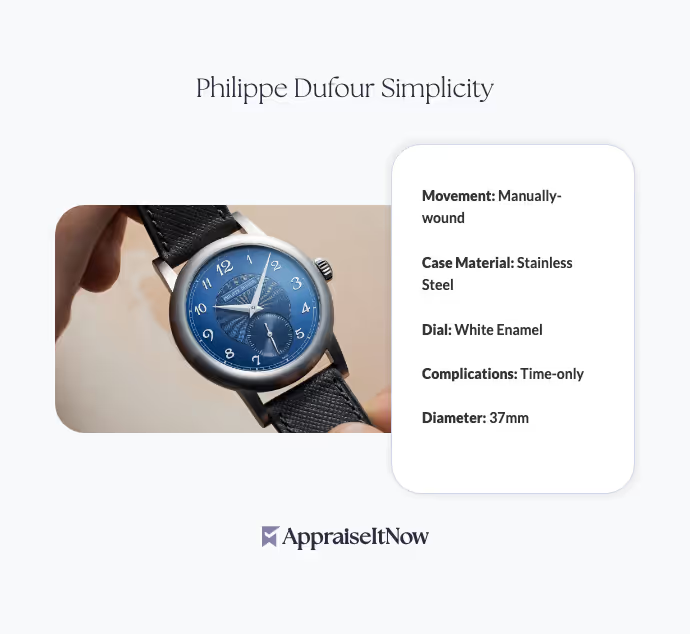
<p>The Simplicity represents far more than a functional timepiece—it embodies the pinnacle of traditional Swiss watchmaking craftsmanship. Designed and hand-built by legendary independent watchmaker <strong>Philippe Dufour</strong>, only <strong>200 pieces worldwide</strong> were produced beginning in 1998, making each example exceptionally rare and valuable. Unlike mass-produced watches, your Simplicity's true worth depends on multiple specialized factors that require expertise in haute horology to properly evaluate.</p>
<p>Professional appraisal becomes essential when you're navigating the <a href="/blog/appraising-luxury-watches-determining-the-value-of-timepiece-investments">luxury watch market</a>, where differences of a few thousand dollars separate comparable sales. The watch's minimalist yet elegant design with its meticulously finished hand-assembled movement deserves documentation from appraisers who understand independent watchmaking's unique position within the <a href="/types/memorabilia-and-collectibles">collectibles market</a>.</p>
<div class="callout tip"><p><strong>Critical Insight</strong></p>
<p>A certified appraisal from a specialist in haute horology is often the difference between receiving fair market value and being significantly undervalued in private sales or auctions.</p></div>
<h2>Key Factors That Impact Your Simplicity's Appraisal Value</h2>
<p>When appraisers evaluate your Philippe Dufour Simplicity, they examine specific elements that directly influence its market position within the $100,000–$150,000 range. Understanding these factors helps you appreciate why professional specialists are necessary and what documentation strengthens your appraisal.</p>
<p><strong>Production year</strong> carries substantial weight in valuation. Earlier examples from the initial 1998 production runs often command premiums over later pieces, as they establish clearer provenance within the limited 200-unit production window. <strong>Condition of the dial</strong> significantly affects desirability—pristine examples with original finish and no signs of refinishing maintain maximum value, while watches with dial work or previous repairs may see 10-20% reductions.</p>
<p>The <strong>movement's finishing quality</strong> and evidence of original hand-assembly directly correlate to pricing. Each Simplicity's unique movement architecture represents Dufour's distinctive design philosophy; appraisers examine the finishing details, hand-engraving, and mechanical innovation to confirm authenticity. <strong>Case materials and condition</strong> matter considerably—original cases with minimal polishing, correct proportions, and proper patina demonstrate superior preservation compared to heavily refinished examples.</p>
<p>Establishing <strong>provenance and ownership history</strong> provides crucial context for valuation. Watches with documented sales records, original invoices, or notable previous owners within the collecting community typically achieve higher valuations than those with unclear backgrounds. The presence of <strong>original box, papers, and warranty cards</strong> can add 15-25% to comparable valuations, as these elements prove authenticity and enhance collectibility.</p>
<p><strong>Service history</strong> presents nuanced considerations. Regular maintenance by qualified watchmakers demonstrates proper stewardship, yet extensive modifications or non-original replacements may concern appraisers. A complete service record actually enhances value by documenting careful ownership, whereas unknown service history raises authentication questions that specialists must resolve during inspection.</p>
<div class="callout note"><p><strong>Valuation Truth</strong></p>
<p>Two Simplicity watches at seemingly identical condition can differ by $10,000-$20,000 based solely on provenance clarity, dial originality, and documentation completeness.</p></div>
<h2>Authenticating Your Philippe Dufour Simplicity</h2>
<p>Verification begins with movement inspection by someone trained in Philippe Dufour's distinctive construction methods. The Simplicity's innovative movement architecture, featuring Dufour's signature finishing techniques and unique complications, cannot be replicated by other manufacturers. Specialists examine the hand-finishing details, examine proportions against known examples, and verify serial number consistency across all components.</p>
<p><strong>Serial number verification</strong> serves as your first authentication checkpoint. The Simplicity carries serial numbers that appraisers cross-reference against known production records and documentation from Dufour's archives. Unlike mass-produced watches where numbers are easily replicated, the limited 200-piece production creates manageable verification through expert networks and established reference materials.</p>
<p>Consulting <strong>maker records and expert databases</strong> strengthens authentication significantly. Specialists in independent watchmaking maintain detailed knowledge of Simplicity variants, dial configurations, and case variations. Your appraiser should have access to resources within the haute horology community—networks of collectors, dealers, and Dufour specialists who maintain institutional knowledge impossible to gather from published sources alone.</p>
<p><strong>Expert comparison with known examples</strong> provides critical verification context. Appraisers examining your Simplicity compare proportions, finishing details, dial characteristics, and movement construction against reference collections and documented sales. This comparative analysis identifies inconsistencies that might indicate later modifications, refinishing, or potentially problematic examples requiring closer scrutiny.</p>
<h2>Documentation You Should Provide for Accurate Appraisal</h2>
<p>Streamline the appraisal process by preparing comprehensive documentation before your consultation. Start with <strong>high-resolution photography</strong> capturing the dial, case, lugs, caseback, movement, and all identifying marks from multiple angles. Clear, well-lit images allow preliminary assessment and help specialists prepare for in-person inspection by identifying potential areas requiring detailed examination.</p>
<p>Original <strong>purchase documentation</strong> significantly strengthens your appraisal. Invoices from authorized dealers, warranty cards, and original boxes provide dated evidence of acquisition that establishes provenance chains. If original papers are unavailable, any sales receipts from subsequent private transactions create valuable ownership trails that appraisers can leverage when establishing market position.</p>
<p><strong>Service and maintenance records</strong> deserve careful documentation. Gather receipts from qualified watchmakers detailing work performed, dates of service, and any components replaced. Complete service records demonstrate proper stewardship and allow appraisers to assess mechanical reliability without concerns about undisclosed modifications. Conversely, absence of service records may warrant more cautious valuations pending movement inspection.</p>
<p><strong>Ownership history documentation</strong> including previous sales or inheritance records helps appraisers establish clear provenance. If you acquired the watch through estate settlement, auction, or private sale, gather any associated documentation that creates an unbroken ownership chain. For watches with notable previous owners within the collecting community, this connection often carries measurable value premium.</p>
<p>Prepare <strong>measurement specifications</strong> of case diameter, thickness, lug width, and any distinguishing features. While specialists will verify these details during inspection, preliminary measurements help identify variants and confirm you're presenting the correct model configuration to appraisers familiar with Simplicity specifications.</p>
<div class="callout tip"><p><strong>Preparation Advantage</strong></p>
<p>Organized documentation accelerates the appraisal timeline and reduces follow-up requests, sometimes completing professional valuations 30-40% faster than poorly documented submissions.</p></div>
<h2>Understanding Valuation Approaches for Haute Horology</h2>
<p>Professional appraisers use multiple valuation methodologies to establish your Simplicity's fair market value, particularly when market sales are infrequent. <strong>Comparable sales analysis</strong> represents the primary approach—specialists research recent private sales, auction results, and market transactions involving Simplicity examples or similar independent watchmaker pieces. Given the limited production run, finding exact comparables requires expertise in recognizing similar production periods, conditions, and provenances that create relevant benchmarks.</p>
<p><strong>Income approach</strong> holds limited relevance for personal timepieces, though some appraisers consider potential collector demand and long-term appreciation trends. For watches as investments, specialists may reference market appreciation curves within haute horology to contextualize your Simplicity's value within broader collectible watch trends. This proves particularly useful when <a href="/blog/what-you-need-to-know-about-getting-an-appraisal-for-investment-purposes">evaluating watches for investment purposes</a>.</p>
<p><strong>Cost approach</strong> serves as a floor valuation, considering manufacturing costs, materials, and skilled labor required to produce equivalent timepieces today. Given Philippe Dufour's advanced age and limited continued production, replacement cost through commission with alternative master watchmakers might exceed $150,000, which sometimes influences upper valuations for exceptional examples.</p>
<p>Specialists reconcile these approaches into a <strong>single defensible value opinion</strong> supported by detailed analysis. Your appraisal report should transparently explain which methodology dominated the conclusion and why specific comparable sales or market factors influenced the final valuation, creating documentation acceptable to insurance companies, auction houses, and financial institutions.</p>
<h2>Different Valuation Purposes and Their Implications</h2>
<p><strong>Insurance replacement value</strong> represents the cost to replace your Simplicity with an equivalent watch in the current market. This valuation reflects retail market conditions and typically ranges at the higher end of your $100,000–$150,000 estimate, as insurance providers require coverage sufficient to actually purchase a comparable example if loss occurs. When obtaining insurance appraisals, specialists ensure values reflect current market reality rather than historical acquisition costs.</p>
<p><strong>Fair market value</strong> reflects what a knowledgeable buyer and seller would agree upon in an arm's-length transaction. This standard valuation methodology serves estate planning, divorce settlements, and tax purposes, typically positioning between 85-95% of insurance replacement values. Appraisers establishing fair market value research actual market transactions rather than asking prices, providing realistic positioning for your Simplicity.</p>
<p><strong>Forced sale value</strong> contemplates rapid liquidation scenarios where time constraints prevent optimal market positioning. This valuation typically ranges 70-85% of fair market value, acknowledging that rushed sales through auction houses or dealers command discounts compared to patient private treaty negotiations. Forced sale valuations matter primarily in bankruptcy, forced liquidation, or time-pressured scenarios.</p>
<p>Understanding which valuation purpose applies to your situation prevents mismatches between appraisal expectations and actual market outcomes. Insurance purposes require replacement values, while estate planning often utilizes fair market value standards. Consulting with your appraiser about the intended use ensures the report methodology serves your specific needs.</p>
<h2>Selecting Qualified Appraisers for Your Simplicity</h2>
<p>Look for appraisers holding credentials from established organizations including <strong>AAA, ISA, ASA, CAGA, and AMEA</strong>—professional bodies requiring demonstrated expertise in <a href="/blog/understanding-the-role-of-appraisals-in-wealth-management-strategies">appraisal standards and ethics</a>. Credentials signal compliance with <strong>USPAP standards</strong> (Uniform Standards of Professional Appraisal Practice), ensuring your report meets legal and insurance industry requirements.</p>
<p><strong>Haute horology specialization</strong> distinguishes qualified watch appraisers from general jewelry specialists. Someone competent in diamond rings or gold chains may lack the technical knowledge to properly assess independent watchmaker construction, movement finishing details, and market dynamics unique to fine mechanical watches. Request explicit experience with Philippe Dufour timepieces or similar limited-production independent watchmaker examples during your initial consultation.</p>
<p>Verify <strong>active membership in professional networks</strong> serving the collectible watch community. Qualified appraisers maintain relationships with dealers, auction houses, and other specialists who provide market intelligence about recent sales, collector demand trends, and emerging valuations. These professional connections create access to transaction data impossible to gather through public sources alone.</p>
<p>Ask potential appraisers about their <strong>access to reference collections and historical records</strong>. Given the Simplicity's limited production, specialists should maintain or have access to databases documenting known examples, their provenance, and sales history. This institutional knowledge differentiates competent haute horology appraisers from generalists attempting to value rare mechanical watches.</p>
<div class="callout note"><p><strong>Credential Insight</strong></p>
<p>While all qualified appraisers should hold professional credentials, don't assume general jewelry appraisal credentials indicate haute horology expertise—always verify specific watch specialization experience.</p></div>
<h2>Market Trends Affecting Philippe Dufour Simplicity Values</h2>
<p>Independent watchmaking has experienced remarkable appreciation over the past two decades, with collector demand for master craftsmen pieces outpacing traditional luxury watch brands. Philippe Dufour's legendary status within horology circles, combined with his advanced age and limited continued production, has created scarcity premium dynamics that favor existing Simplicity examples. As fewer pieces trade annually compared to mainstream luxury watches, pricing becomes less transparent—creating situations where private treaty negotiations substantially exceed public auction results.</p>
<p><strong>Finishing quality and dial originality</strong> emerge as increasingly important value drivers within contemporary haute horology collecting. Contemporary collectors demonstrate heightened appreciation for pristine original dials, proper hand-finishing details, and evidence of minimal restoration compared to earlier market preferences that favored heavily polished examples. This trend particularly benefits well-preserved Simplicity watches that showcase original patina and unrefined finishing details.</p>
<p><strong>Generational wealth transfer</strong> influences demand patterns, as younger collectors entering the fine watch market demonstrate stronger interest in independent watchmakers and limited production pieces compared to traditional luxury brand portfolios. This demographic shift supports continued appreciation for Simplicity examples, potentially driving future valuations beyond current $100,000–$150,000 ranges as collecting preferences evolve.</p>
<p>The question of which specific finishing characteristics attract premium value requires specialist knowledge of contemporary collector preferences within the haute horology community. Your appraiser should discuss current market trends affecting your particular Simplicity configuration, helping you understand where your example positions within contemporary valuation frameworks.</p>
<h2>Preparing Your Simplicity for Sale After Appraisal</h2>
<p>Once you've obtained professional valuation, decisions about selling or consigning require strategic positioning in appropriate market channels. <strong>Private treaty negotiations</strong> often yield superior results compared to public auctions, as select buyers familiar with independent watchmaking understand nuanced value differentials and execute transactions at fair market valuations. Your appraiser can recommend trusted dealers or collectors within their professional network who maintain active interest in Simplicity examples.</p>
<p>Auction considerations require careful evaluation of handling fees, buyer's premiums, and market timing. Established auction houses specializing in fine watches understand the <a href="/blog/appraisals-for-estate-auctions-setting-reserves-and-attracting-bidders">collector base</a> and can position your Simplicity effectively, though their fees typically run 15-25% of realized price. Conservative reserve setting (typically 70-80% of appraised value) protects against underselling while maintaining competitive perceived value.</p>
<p><strong>Documentation presentation</strong> becomes critical when marketing your Simplicity for sale. The appraiser's detailed report, high-quality photography, and organized provenance documentation significantly enhance buyer confidence and perceived value. Professional presentation distinguishes your offering from undocumented watches, often justifying premium pricing that exceeds the appraisal cost within weeks of professional marketing.</p>
<div class="callout tip"><p><strong>Sales Success</strong></p>
<p>Using your professional appraisal as marketing foundation—including condition assessment details and comparable sales analysis—typically accelerates sales timelines by 50-60% compared to listings lacking expert documentation.</p></div>
<h2>The Role of Professional Appraisal in Your Collecting Strategy</h2>
<p>Beyond immediate transaction purposes, professional appraisals create essential documentation for collection management and estate planning. Your appraiser's detailed description of condition, finishing details, and distinguishing characteristics establishes baseline reference documentation that protects against future disputes or claims involving your Simplicity's specifications and authenticity. This archival value alone justifies professional appraisal costs over time.</p>
<p><strong>Insurance coverage</strong> depends fundamentally on accurate, credible appraisals from professionals recognized by carriers. Submitting amateur valuations or asking prices as documentation creates vulnerability—insurers may challenge high claims or deny coverage based on undocumented valuations. Professional appraisals shift this burden to established credentialed professionals, providing the documentation insurers expect when evaluating claims.</p>
<p>For collectors building significant fine watch portfolios, periodic reappraisals every three to five years maintain current market positioning and catch appreciation that should influence collection strategy or insurance adjustments. Market conditions shift—particularly in specialized collecting categories like independent watchmaking—making regular professional assessment prudent stewardship of valuable assets.</p>
<p>Your appraiser relationship extends beyond a single transaction, potentially providing ongoing market intelligence about your Simplicity's category, collecting trends, and value trajectory. Establishing professional relationships with qualified specialists creates valuable advisory resources as your collecting interests evolve or your circumstances change.</p>
<div class="callout note"><p><strong>Key Takeaway</strong></p>
<p>A certified appraisal of your Philippe Dufour Simplicity from a specialist in haute horology provides accurate valuation documentation, authentication confidence, and professional positioning whether you're buying, selling, insuring, or stewarding this exceptional mechanical timepiece. The investment in professional expertise yields returns far exceeding appraisal costs through proper insurance coverage, transaction confidence, and collection management clarity.</p></div>