









<h1>How to Get Your Mustang Boss 429 Appraised</h1>
<p>The Mustang Boss 429 stands as one of the most iconic American muscle cars ever produced, commanding strong collector interest and significant market value. If you own one of these rare performance legends or are considering purchasing one, understanding the appraisal process ensures you make informed financial decisions whether for insurance, sale, or investment verification purposes.</p>
<h2>Understanding Boss 429 Market Value</h2>
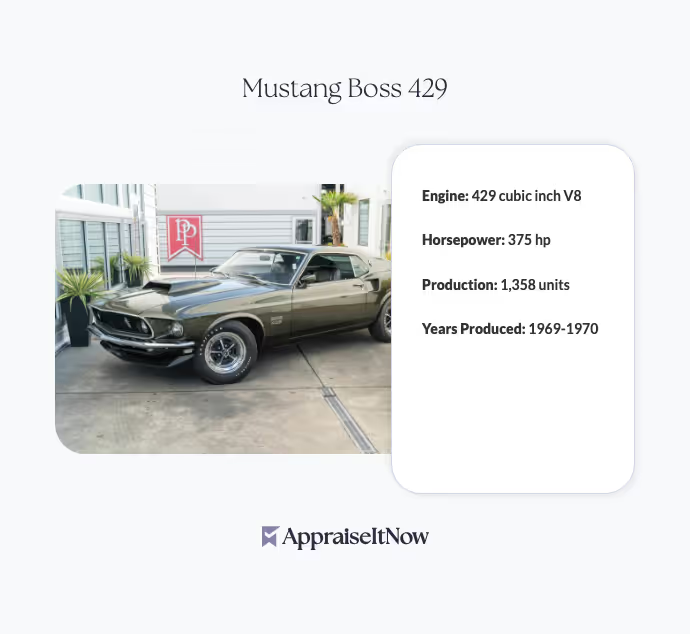
<p>The Mustang Boss 429 represents a unique convergence of American automotive engineering and collector demand. With only <strong>1,358 units produced</strong> between 1969 and 1970, these cars occupy an exclusive category in the classic car market. Current market estimates place a well-preserved Boss 429 between <strong>$80,000 and $100,000</strong>, though exceptional examples with documented racing history or museum-quality restorations can exceed six figures.</p>
<p>Why is the Boss 429 so expensive? The answer lies in its combination of factors. The <strong>429 cubic inch V8 engine</strong> producing <strong>375 horsepower</strong> made it one of the most powerful production automobiles of its era. Add to this the car's limited production run, distinctive Mustang styling, and the factory-installed competition parts that came standard, and you understand why collectors actively seek these vehicles. The Boss 429 was never intended as a mass-market car—it was designed specifically for serious performance enthusiasts who demanded the best American muscle car technology available.</p>
<div class="callout tip"><p><strong>Market Insight</strong></p>
<p>Boss 429 Mustangs first introduced in 1969 represent a pivotal moment in muscle car history, when manufacturers pushed engineering boundaries before emissions regulations began limiting performance capabilities.</p></div>
<h2>Rarity and Historical Significance</h2>
<p>How rare is a Mustang Boss 429? With only 1,358 examples built, your Boss 429 belongs to an exclusive club of collectors and enthusiasts. This scarcity directly impacts valuation—fewer vehicles on the market naturally command higher prices as demand remains consistent or increases. Unlike mass-produced vehicles where condition variations create wide price spreads, Boss 429s maintain relatively stable valuations due to their desirability.</p>
<p>The question of how many Boss 429 Mustangs exist today raises interesting considerations. Over fifty years, some examples have been lost to accidents, neglect, or modifications that destroy originality. This means the actual number of well-preserved, original-specification Boss 429s available for purchase is substantially lower than the original production figure. When evaluating your own Boss 429 appraisal, this scarcity becomes a powerful value driver.</p>
<p>The Boss 429 represents the final evolution of true muscle car engineering before the automotive industry underwent fundamental transformation. Manufactured in Detroit, Michigan, these cars embody an era when American automakers competed fiercely on performance metrics and engineering innovation. This historical positioning as one of the last truly uncompromised muscle cars adds significant collector appeal beyond mere transportation functionality.</p>
<h2>Key Factors Affecting Your Boss 429 Appraisal</h2>
<p>Professional appraisers evaluate Boss 429 Mustangs using a comprehensive assessment framework that examines far more than basic condition. Understanding these factors helps you appreciate what makes your vehicle valuable and how professional <a href="/types/automobile">automobile appraisals</a> determine accurate market pricing.</p>
<h3>Original Specifications and Matching Numbers</h3>
<p>The most valuable Boss 429s retain original factory specifications throughout. Matching numbers—where the engine, transmission, and chassis numbers correspond to original factory records—significantly enhance value. Many Boss 429 owners over the decades modified their cars for increased performance or personal preference, but these modifications typically reduce market value substantially. Collectors specifically seeking investment-grade examples prioritize originality above customization.</p>
<p>Your Boss 429's engine block, cylinder heads, intake manifold, and carburetor should all correspond to 1969 or 1970 production specifications depending on model year. Factory documentation verifying original paint color, interior trim, and optional equipment combinations supports higher valuations during professional appraisal processes.</p>
<h3>Condition and Restoration Quality</h3>
<p>Condition assessment directly determines where your Boss 429 falls within the $80,000-$100,000 range. A well-preserved original with minimal restoration commands premium pricing, while examples requiring significant work may appraise at the lower end of the spectrum. The restoration question deserves careful consideration—sympathetic, historically accurate restoration using period-correct materials and techniques can maintain or enhance value, while modern reinterpretations or non-original approaches typically reduce it.</p>
<p>Interior condition, mechanical functionality, chrome condition, glass clarity, and undercarriage preservation all factor into comprehensive evaluations. Unlike some <a href="/types/recreational-vehicle">recreational vehicles</a> where restoration represents standard practice, muscle car collectors often prefer original patina and honest wear patterns that document authentic history over cosmetic perfection.</p>
<div class="callout note"><p><strong>Appraisal Consideration</strong></p>
<p>Documentation of any restoration work, including photographs and receipts for materials and labor, significantly supports valuation claims during professional assessment.</p></div>
<h3>Provenance and Ownership History</h3>
<p>Does your Boss 429 have documented ownership history? Clear title and known previous ownership enhance appraisal value, particularly if previous owners achieved recognition within collecting communities. Conversely, gap years or unknown ownership periods raise questions requiring investigation. Registry documentation with organizations like the Mustang Club of America or Muscle Car Club of America provides valuable supporting evidence of authenticity and condition history.</p>
<p>The question of celebrity ownership or documented display in prestigious collections can positively influence valuation. Ownership pedigree matters significantly in premium collectible markets, and while no Boss 429 commands the astronomical prices of ultra-rare Ferraris, documented history enhances desirability.</p>
<h2>Professional Appraisal Process for Your Boss 429</h2>
<h3>What Professional Appraisers Examine</h3>
<p>When you engage professional <a href="/types/automobile">automobile appraisal</a> services like AppraiseItNow, the process extends far beyond visual inspection. Certified appraisers examining your Boss 429 will conduct detailed mechanical evaluation, verify matching numbers against factory documentation, assess restoration quality and originality, review service history and maintenance records, examine the undercarriage and frame condition, document paint thickness and originality, and compare your specific example against recent comparable sales.</p>
<p>The appraisal process typically requires 2-4 hours of hands-on evaluation, depending on vehicle condition and availability of documentation. You'll need to provide the vehicle for in-person inspection, access to any original paperwork, and ideally any maintenance or restoration records accumulated during your ownership.</p>
<h3>Documentation and Market Comparables</h3>
<p>Professional appraisers reference recent market sales of comparable Boss 429 Mustangs to establish fair market value. This comparative analysis examines auction results, private treaty sales, and dealer listings to understand current demand patterns. Market data from auction houses specializing in classic cars, automotive publications tracking sales, and collector databases all inform the valuation analysis.</p>
<p>Your appraiser will document condition using standardized photography and written descriptions suitable for insurance companies, legal proceedings, or transaction purposes. The resulting report provides USPAP-compliant documentation accepted by financial institutions and insurance carriers, protecting both your interests and those of any future buyers or lenders evaluating your Boss 429.</p>
<h2>Insurance and Investment Considerations</h2>
<p>Is the Boss 429 a good investment? The answer depends on your perspective and time horizon. Historically, muscle cars have appreciated significantly, with Boss 429s maintaining stable or increasing values over the past decade. The limited production run ensures scarcity, the strong collector demand maintains interest, and the cultural significance of the Boss 429 in American automotive history provides emotional appeal beyond pure financial calculation.</p>
<p>Proper insurance coverage requires an accurate appraisal establishing replacement cost value. Standard auto insurance policies typically undervalue classic cars, leaving owners underprotected. When you obtain a professional appraisal from credentialed experts with automotive specialization, you create documented proof of value for insurance purposes. This protects your investment and ensures that any loss settlement reflects your vehicle's actual worth rather than outdated book values.</p>
<p>For comprehensive insights into protecting your investment, our guide on <a href="/blog/the-importance-of-automobile-appraisals">the importance of automobile appraisals</a> explains how documented valuations serve multiple purposes beyond transaction support.</p>
<h2>Comparing Boss 429 Models and Variants</h2>
<p>The Boss 429 came in limited configurations, with production concentrated in 1969 and 1970. The 1969 model year represented the initial introduction, making these first examples particularly desirable among collectors seeking early production vehicles. Fewer 1970 examples were built, creating an interesting dynamic where model-year rarity affects valuation differently than total production numbers would suggest.</p>
<p>Engine variants within the Boss 429 designation remained consistent—all featured the <strong>429 cubic inch V8</strong> producing the same horsepower specifications. However, subtle differences in available options, color choices, and equipment combinations create collecting niches where particular configurations command premium pricing among specialized enthusiast groups.</p>
<div class="callout tip"><p><strong>Collector Insight</strong></p>
<p>1969 Boss 429s typically command 10-15% premiums over 1970 models among serious collectors, reflecting preference for initial production examples and early muscle car significance.</p></div>
<h2>Getting Your Boss 429 Appraised</h2>
<p>When you're ready to obtain professional appraisal services, selecting qualified appraisers specializing in classic <a href="/types/automobile">automobiles</a> ensures accurate, defensible valuations. Look for credentials including American Society of Appraisers (ASA) membership, American Association of Appraisers (AAA) certification, or International Society of Appraisers (ISA) standing. These professional organizations maintain ethical standards and continuing education requirements ensuring appraiser competency.</p>
<p>The appraisal cost typically ranges from $400-$800 depending on vehicle complexity and appraiser expertise. While this represents an investment, the resulting documentation pays dividends through insurance protection, transaction support, estate planning accuracy, and investment verification. Our resource on <a href="/blog/how-to-decide-between-independent-automobile-appraisal-companies">choosing the right automobile appraisal company</a> provides guidance on evaluating appraisal service providers.</p>
<h3>Preparation Before Your Appraisal</h3>
<p>Gather all available documentation before your appraisal appointment. Original factory window stickers or build sheets, service records, restoration documentation, maintenance receipts, and ownership history all support accurate valuation. Clean your Boss 429 thoroughly but avoid recent detailing that might mask underlying condition issues—appraisers need to assess authentic condition, not cosmetically enhanced appearance.</p>
<p>Ensure the vehicle operates mechanically during appraisal, allowing the appraiser to verify engine condition and drivetrain functionality. Having any known mechanical issues or necessary repairs disclosed upfront allows the appraiser to factor these into value calculations rather than discovering them during evaluation.</p>
<h2>Summary and Next Steps</h2>
<p>Your Mustang Boss 429 represents a significant asset deserving accurate, professional valuation. Whether you're insuring your vehicle, planning to sell, verifying estate value, or simply documenting your collection, a certified appraisal provides the documentation and expertise that instills confidence in any transaction or claim. The Boss 429's $80,000-$100,000 market value reflects its status as one of American automotive history's most significant muscle cars, a position earned through rare production, remarkable performance capabilities, and enduring collector appreciation.</p>
<p>Professional appraisers bring specialized knowledge of Boss 429 specifications, authentic market values, and comparable sales data that casual valuations simply cannot provide. This expertise protects your investment and ensures you understand both the historical significance and monetary value of your iconic muscle car.</p>
<div class="callout note"><p><strong>Key Takeaway</strong></p>
<p>A certified appraisal of your Mustang Boss 429 provides essential documentation for insurance protection, transaction support, and investment verification, ensuring you fully understand and can properly protect this legendary American muscle car.</p></div>