









<h1>How to Get Your Garland Oven G24 Appraised</h1>
<p>The Garland Oven G24 represents a significant asset in any professional kitchen, commanding <strong>$7,500 to $9,500</strong> in today's commercial equipment market. Whether you're selling restaurant assets, seeking insurance coverage, or evaluating equipment for loan collateral, obtaining a professional appraisal ensures you understand this workhorse's true value.</p>
<h2>Understanding the Garland Oven G24's Market Position</h2>
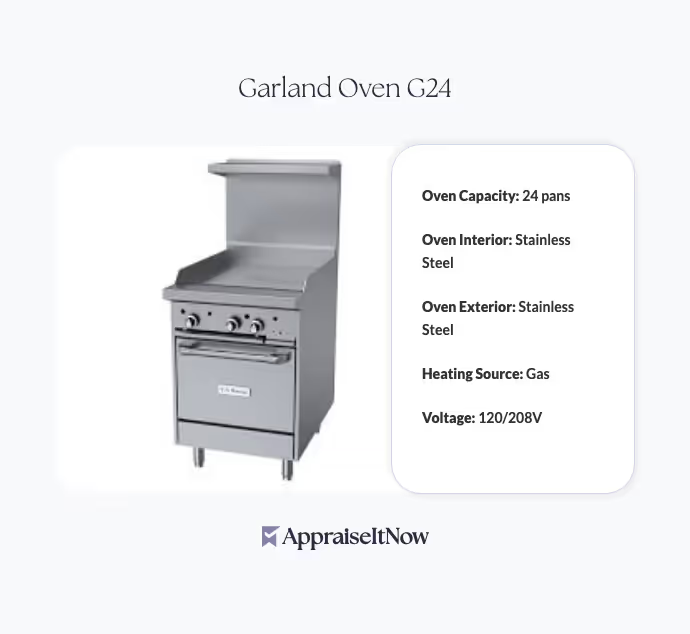
<p>Since its introduction in 1980, the Garland G24 has earned its reputation as the backbone of commercial kitchens worldwide. Your equipment's value reflects decades of proven reliability—this isn't a trendy appliance, but rather an industry standard trusted by renowned chefs and restaurants globally. The G24's heavy-duty construction, precise temperature control up to 550°F, and exceptional 24-pan capacity make it versatile for everything from artisanal bread baking to roasting large cuts of meat.</p>
<p>The oven's stainless steel interior and exterior combined with energy-efficient convection heating mean that even well-used units retain substantial value. Unlike some <a href="/types/restaurant-equipment">commercial kitchen equipment</a> that depreciates rapidly, the G24's reputation for durability and longevity makes it consistently sought after in the used equipment market. When evaluating your specific unit's position within the $7,500–$9,500 range, condition and operational hours become the primary determinants.</p>
<div class="callout tip"><p><strong>Market Insight</strong></p>
<p>G24 ovens with documented maintenance records and lower operational hours typically command valuations in the upper range, while units requiring repairs may fall toward the lower end of estimates.</p></div>
<h2>Key Factors That Influence Your G24's Appraisal Value</h2>
<h3>Age, Condition, and Operational Hours</h3>
<p>An appraiser examining your Garland G24 will assess multiple technical and operational factors. While the model's introduction in 1980 gives it decades of proven history, your specific unit's age and usage patterns directly affect valuation. Commercial ovens with documented maintenance showing regular professional servicing hold value better than units with unknown service histories.</p>
<p>The hours meter reading becomes critical during appraisal—a G24 with 10,000 operational hours presents differently than one with 50,000 hours. Heavy daily use in high-volume operations accelerates wear on heating elements, door seals, and internal components, though the G24's robust construction means even well-used examples typically function reliably. Visible deterioration like rust spots, dented panels, or seal degradation will reduce your appraisal value compared to cosmetically clean units.</p>
<h3>Replacement Parts Availability and Serviceability</h3>
<p>One advantage that strengthens the G24's market position is the ready availability of replacement parts and qualified service technicians. This accessibility directly impacts appraisal value because potential buyers recognize lower long-term ownership costs. When appraisers evaluate used <a href="/blog/appraisals-for-restaurant-and-food-service-businesses-evaluating-culinary-investments">restaurant and food service equipment</a>, they consider how easily an owner can maintain and repair the asset—and the G24's established supply chain works in your favor.</p>
<p>Contrast this with more recent or proprietary equipment designs where parts scarcity can reduce resale value by 15-25%. Your Garland's proven serviceability makes it attractive to restaurateurs, caterers, and institutional foodservice operations planning for long-term use.</p>
<h2>Documentation That Maximizes Appraisal Accuracy</h2>
<p>Professional appraisers require specific documentation to provide accurate valuations for <a href="/types/equipment-and-machinery">equipment and machinery</a>. Before scheduling your appraisal, compile the following materials to strengthen your unit's documented value.</p>
<p><strong>Essential Documentation Includes:</strong>
Your model and serial numbers serve as the foundation—these verify authenticity and help appraisers access historical manufacturing data. Maintenance records documenting regular service, repairs, and component replacements demonstrate responsible stewardship and extend estimated remaining useful life. Original purchase invoices or equipment history reports establish the initial investment and help calculate depreciation using standard appraisal methodologies. Hours meter readings, if accessible, provide concrete usage data rather than estimates.</p>
<p>Photographic records from multiple angles showing overall condition, internal heating elements, door seals, and any visible wear patterns give appraisers crucial visual assessment data. If you've had recent repairs or part replacements, those receipts and work orders document investment in maintaining the unit's functionality and lifespan.</p>
<div class="callout note"><p><strong>Documentation Tip</strong></p>
<p>Organized, complete documentation typically results in higher appraisal values because it reduces uncertainty and demonstrates professional equipment management.</p></div>
<h2>Appraisal Methods and Depreciation Approaches</h2>
<p>When you commission a professional appraisal through AppraiseItNow's network of credentialed experts, they employ industry-standard valuation approaches appropriate for commercial cooking equipment. Understanding these methods helps you recognize the quality of the appraisal you receive.</p>
<p>Appraisers typically use the <strong>cost approach</strong>, which calculates replacement cost new minus accumulated depreciation. For a Garland G24, this means determining current new equipment pricing (typically $12,000–$15,000 for modern equivalents) and applying depreciation based on the unit's age and condition. The <strong>market approach</strong> compares your unit against recent sales of comparable G24 ovens in the commercial equipment resale market. Online marketplaces, auction house results, and dealer inventory provide comparable sales data that professional appraisers actively monitor.</p>
<p>The <strong>income approach</strong>, while more commonly used for revenue-generating assets, sometimes applies when evaluating equipment in operating businesses. This method considers how the oven contributes to kitchen productivity and revenue generation.</p>
<div class="callout tip"><p><strong>Appraisal Method</strong></p>
<p>USPAP-compliant appraisals typically employ multiple approaches and reconcile the findings to support a final value conclusion, providing more defensible documentation than single-method estimates.</p></div>
<h2>Types of Appraisals: Matching Your Purpose to Your Appraisal</h2>
<p>The type of appraisal you need depends on your intended use. An insurance appraisal for coverage purposes requires different documentation and approach than an appraisal for sale or liquidation. Understanding these distinctions ensures you commission the right service.</p>
<p><strong>Insurance Appraisals</strong> establish replacement cost value, protecting you if your G24 is damaged or destroyed. These appraisals require detailed condition assessment and market research showing what you'd pay to replace the exact equipment. <strong>Loan Collateral Appraisals</strong> determine liquidation value—what you could recover if the lender had to seize and sell the equipment. This valuation tends toward the conservative side, often resulting in lower values than fair market estimates.</p>
<p><strong>Tax and Estate Appraisals</strong> serve legal and financial purposes, requiring meticulous documentation acceptable to the IRS and court systems. <strong>Sale or Liquidation Appraisals</strong> aim to establish fair market value for arm's-length transactions, balancing buyer and seller interests. Clarifying your specific purpose when requesting an appraisal ensures the appraiser uses appropriate methodology and standards.</p>
<h2>Selecting a Qualified Appraiser for Restaurant Equipment</h2>
<p>Your appraisal's credibility depends significantly on the appraiser's qualifications and specialization. AppraiseItNow connects property owners with credentialed professionals holding designations including <strong>ASA</strong> (American Society of Appraisers), <strong>ISA</strong> (International Society of Appraisers), <strong>AAA</strong> (American Association of Appraisers), <strong>CAGA</strong> (Canadian Appraisal Group of Appraisers), and <strong>AMEA</strong> (American Medical Equipment Appraisers).</p>
<p>For restaurant equipment specifically, you want an appraiser with documented experience in commercial kitchen assets. They should demonstrate familiarity with equipment depreciation patterns, replacement part availability, and market conditions specific to the foodservice industry. When appraisers have worked with <a href="/types/beverage-equipment">beverage equipment</a> and <a href="/types/food-processing-equipment">food processing equipment</a> valuations, they bring contextual understanding of how commercial kitchen assets function in broader operational environments.</p>
<div class="callout note"><p><strong>Credential Insight</strong></p>
<p>Appraisers with restaurant industry experience provide more accurate market comparables and understand factors generic appraisers might overlook, resulting in more defensible valuations.</p></div>
<h2>Sourcing and Verifying Comparable Sales</h2>
<p>Professional appraisers actively monitor multiple channels for comparable G24 sales data. Restaurant equipment auctions provide transparent pricing where units sell in competitive bidding environments. Online marketplaces like Equipment Depot, WebstaurantStore, and eBay document asking prices and actual sales. Used equipment dealers who specialize in commercial kitchen assets maintain inventory records revealing what they're paying for units and reselling prices.</p>
<p>Auction house catalogs from major regional and national auctioneers document sold prices for commercial kitchen equipment lots. Liquidation company records show distressed sales where equipment moves quickly, often at lower prices than retail resale scenarios. Professional appraisers synthesize this data, adjusting for condition differences and geographic variations to establish market-supported valuations.</p>
<p>The question of how readily equipment appraisers source comparables becomes particularly relevant for specialized assets like commercial ovens. Fortunately, the G24's long production run and continued active use in professional kitchens means sufficient transaction data exists to support reliable appraisals. This contrasts with more niche or obsolete equipment where comparable data proves scarce.</p>
<h2>Understanding Appraisal Costs and Timeline</h2>
<p>Commissioning a USPAP-compliant restaurant equipment appraisal involves both time and cost investments. For a Garland G24 or similar commercial oven, expect appraisal costs ranging from <strong>$400 to $1,000</strong> depending on whether the appraiser conducts an in-person inspection or desktop evaluation based on photographs and documentation you provide.</p>
<p><strong>Desktop or photograph-based appraisals</strong> work well when you provide high-quality images showing overall condition, all sides, serial number plates, internal elements, and any visible wear. These appraisals cost less and deliver faster turnaround—often 5-10 business days. <strong>In-person inspections</strong> become necessary for high-value transactions, insurance purposes requiring detailed condition assessment, or situations where minor concerns on photos need clarification. In-person appraisals typically cost more but provide thorough documentation through professional photography and hands-on condition grading.</p>
<p>Turnaround times for USPAP-compliant written reports typically range from 10-20 business days after receiving all required information. If you need expedited service, discuss rush fees upfront—these typically add 25-50% to base appraisal costs but accelerate delivery to 3-5 business days.</p>
<h2>In-Person Inspection vs. Remote Appraisal: Which Is Right for You</h2>
<p>Understanding when in-person inspection is necessary helps you plan your appraisal process efficiently. For insurance, loan, or legal purposes, lenders and insurers often require in-person inspection to verify the asset exists and matches its description. If your G24 is located in an accessible restaurant or commercial kitchen, scheduling an in-person visit makes sense.</p>
<p>Remote appraisals work effectively when equipment condition is straightforward to photograph, your intended use allows for documented photographs, and the equipment's location makes travel impractical. A properly documented photo-based appraisal requires you to provide high-resolution images showing the equipment's front, back, sides, top, serial number plate, any visible wear or damage, and operational components like temperature controls and door seals.</p>
<p>The key distinction: in-person appraisals provide maximum documentation and defensibility but cost more and require coordination. Remote appraisals offer cost efficiency and speed when documentation quality is strong and purposes don't demand in-person verification.</p>
<div class="callout tip"><p><strong>Appraisal Selection Tip</strong></p>
<p>For equipment sales under $20,000, photo-based appraisals often provide sufficient documentation at better cost efficiency. For high-value transactions or legal proceedings, in-person inspection typically proves worth the investment.</p></div>
<h2>Why Professional Appraisal Matters for Your Garland G24</h2>
<p>Attempting to value commercial kitchen equipment without professional expertise often leads to significant financial consequences. Selling under-appraised equipment costs you thousands in lost revenue. Over-appraising for insurance or loan purposes creates coverage gaps and legal exposure. Relying on informal estimates rather than documented USPAP appraisals leaves you vulnerable in disputes or legal proceedings.</p>
<p>Professional appraisals through experienced specialists like those in AppraiseItNow's network provide defensible valuations accepted by insurance companies, financial institutions, and courts. When you need accurate, documented values—whether for portfolio management, equipment transactions, or regulatory compliance—certified appraisals deliver the credibility and documentation your situation demands.</p>
<div class="callout note"><p><strong>Key Takeaway</strong></p>
<p>A professional USPAP-compliant appraisal of your Garland Oven G24 provides the accurate, documented valuation you need for buying, selling, insuring, or financing decisions. By understanding the factors affecting value and selecting a qualified appraiser experienced in commercial kitchen equipment, you ensure your valuable asset is properly evaluated and protected.</p></div>