









Unlike standard antiques where age creates value, the worth of your TV props and movie memorabilia hinges almost entirely on proving its connection to a specific production.
Whether you're insuring a treasured collection, settling an estate, donating items for tax deductions, or simply curious about what you have, accurate movie and TV props appraisal requires specialized knowledge. This guide walks you through exactly how to appraise movie and TV props, when you need professional help, and how to protect yourself from costly mistakes.
You can certainly start with online research, but what you need to understand is that two identical-looking lightsabers can differ in value by millions of dollars depending on documentation alone. The prop market doesn't work like other collectibles. A baseball card's value comes from condition and rarity. A painting's value comes from the artist's reputation, but your movie prop's value comes almost entirely from proving it was actually used in the production and that's where most people get stuck.
Online price guides show you what similar items are sold for, but they can't tell you if your item is genuine, how it compares to those sales, or whether the documentation you have is sufficient.
Note: Preliminary online research is valuable. Just remember that until you properly verify your collectible, you don't know where it fits.
Once you've done your preliminary research, understanding the specific value drivers helps you assess whether your item warrants professional appraisal. Five core factors determine what you have, and they work together to create the final valuation.
Provenance is everything. It is the documented history of ownership right from the production to you. Did it come directly from a crew member with paperwork? From a studio auction with a catalog? Or did someone buy it at a garage sale with a story but no documentation? The difference is enormous.
Screen-matching commands premium prices. Being able to compare your prop to film footage frame-by-frame to identify unique scratches, wear patterns, or modifications that prove it's the exact one visible on-screen is the gold standard. If you can freeze-frame the movie and point to your item's specific imperfections visible in that scene, you have something special.
Beyond authentication, what you call it matters a lot. The prop hierarchy is specific. A "hero prop" is the highest-detail version made for close-ups, often with functional elements. Studios typically make only 1-4 hero versions. "Stunt props" are made from safer materials for action scenes. "Background props" have minimal detail for wide shots. A hero prop can sell for 5 to 50 times more than a stunt or background equivalent from the same film. Unfortunately, sellers often call everything "hero" to inflate value, you need to verify independently.
The film itself also shapes value. Franchise power and cultural impact drive demand. Star Wars original trilogy items consistently set records. Darth Vader's hero lightsaber sold for $3.654 million in September 2025. Captain Kirk's hero phaser reached $910,000. Indiana Jones's fedora fetched $630,000. However, even within beloved franchises there are tiers. Main character items vastly outperform background props.
Finally, rarity multiplies everything else. Only about 60 original 1977 Stormtrooper helmets were made, pushing individual helmets into the £250,000–£500,000 range. The increasing use of CGI means fewer physical props exist from modern productions, making older physical items increasingly scarce and valuable.
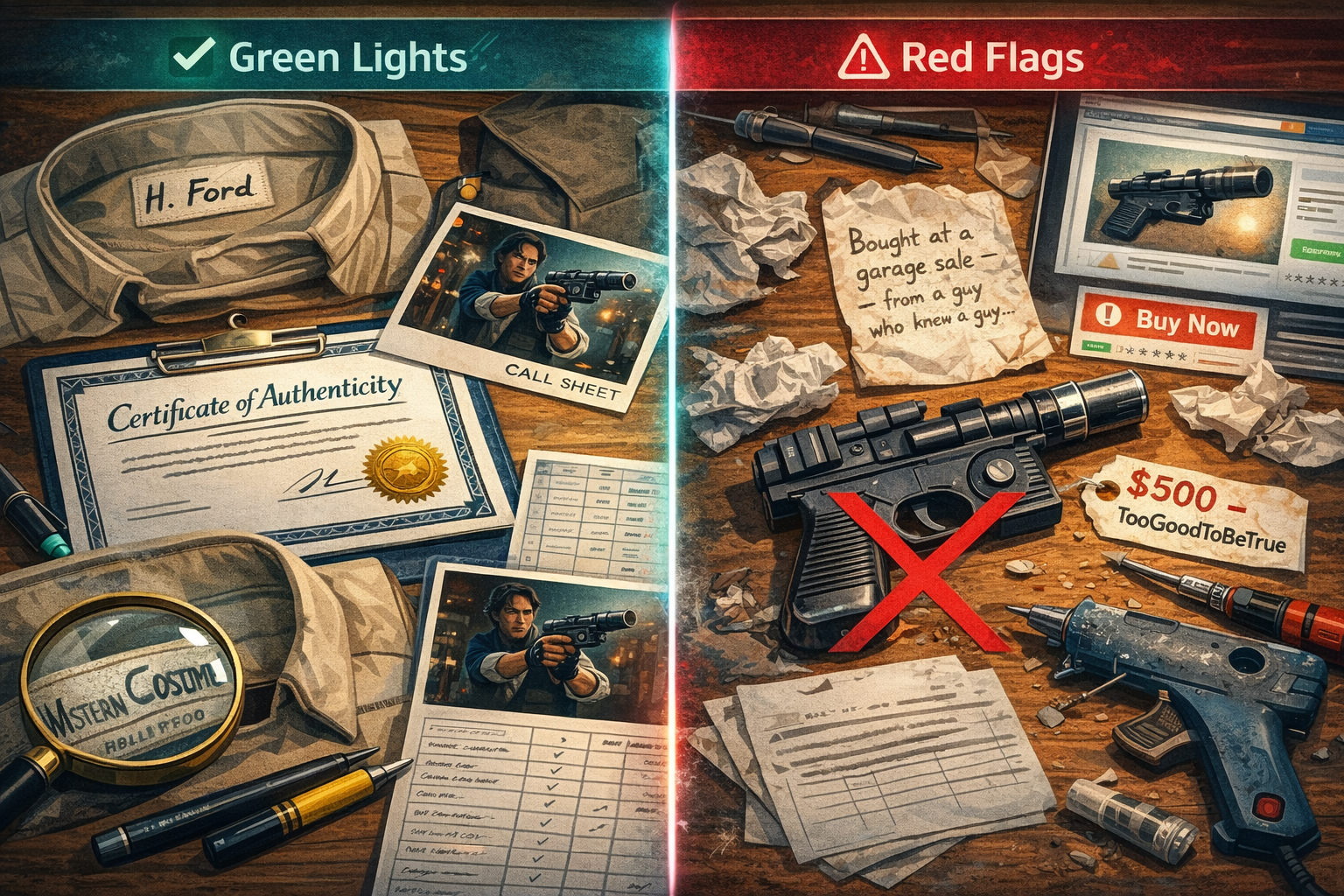
Understanding value drivers leads directly to the critical question: authentication. Start with your paperwork. What documentation came with the item? Studio tags sewn into costumes, Western Costume Company labels, actor names handwritten in collars, call sheets, continuity photographs, and prop department receipts all support authenticity. For firearms, check for serial numbers and rental agreements. If you inherited the item, try to trace who owned it before you.
Once you've gathered your documentation, compare it against film footage yourself. Pull up high-resolution images of the film. Take detailed photographs of your item and literally place them side-by-side with screen captures. If you find matches, document them.
While conducting this research, watch for red flags that signal fakes. Materials that are inconsistent with the production era are a major warning sign. For instance, modern plastics on supposedly vintage items. Other warning signs are missing production markings, prices significantly below market value, vague provenance stories without names or details and situations where sellers pair “Guaranteed Authentic" with "All Sales Final.” That's a contradiction because legitimate sellers confident in authenticity offer money-back guarantees.
Appraisal Tip: Costumes are particularly complex. Productions often made multiple identical costumes for a single character. Unless you can screen-match yours or have documentation specifying which filming days it was used, you have one of many. This dramatically affects value compared to a one-of-one item.
The IRS requires professional appraisals for tax deductions. If you're donating movie props to a museum or nonprofit and claiming a deduction above $5,000, you must have a qualified appraisal from a USPAP-compliant appraiser. For items above $20,000, you must attach the complete signed appraisal to your tax return. The appraiser must be independent and properly credentialed.
Insurance companies also require documentation above certain thresholds. Standard homeowners policies typically limit collectibles coverage to just $500–$2,000. If your collection exceeds that you need specialized collectibles insurance with scheduled items. Most insurers require professional appraisals for individual items above $25,000 to $100,000 depending on the carrier.
Beyond insurance and taxes, estate settlements and divorce proceedings demand defensible valuations, courts require professionally prepared appraisals that meet legal standards.
Appraisal Tip: Even without legal requirements, you should get professional appraisal if you suspect you have something extremely valuable.
At AppraiseItNow, you get certified, USPAP-compliant appraisers who specialize in movie and TV memorabilia. Whether you need appraisal for insurance coverage, IRS charitable donations, estate settlements, divorce proceedings, or pre-sale valuation, we provide legally defensible documentation that stands up to scrutiny.
Contact AppraiseItNow today for certified movie and TV memorabilia appraisal services. We'll match you with the right specialist, provide transparent pricing, and deliver the professional documentation you need to protect your investment.
How much does it cost to get a movie prop appraised?
Professional appraisals typically cost $300–$1,500 for a single item, while quick online services charge $17–30 for preliminary estimates.
Can I appraise my own movie props?
You can self-document for basic insurance under $25,000, but self-appraisals have no legal weight for tax deductions, estate settlements, or court proceedings.
How are movie collectibles taxed?
Movie props held over one year face a maximum capital gains rate of 28%, plus potential 3.8% Medicare surtax, for an effective maximum of 31.8%.
What documentation do I need for a movie prop?
Studio tags, production labels, call sheets, continuity photos, prop department receipts, chain of ownership records, and Certificates of Authenticity from reputable sources establish provenance.
Are movie props a good investment?
The entertainment memorabilia market has grown to $330 million with record-breaking sales, but values depend entirely on authentication, provenance, and changing collector demand for specific franchises.




