When you're holding a painting and wondering whether it's from the 1800s or the 1980s, you're facing one of the most critical questions in art appraisal. The age of a painting directly impacts its value, authenticity, and insurability. Getting it wrong can mean the difference between a valuable asset and a worthless reproduction.
Whether you're an estate executor needing to appraise inherited artwork, an insurance professional assessing coverage values, or a collector verifying a purchase, understanding how to determine the age of a painting gives you the foundation for accurate valuation. This guide walks you through the practical methods experts use, from visual inspection you can do yourself to scientific testing that provides definitive answers.
What Are the Most Obvious Signs of Age in a Painting?
The surface of an aged painting tells its own story through visible deterioration patterns that develop over decades. When you examine a painting's front, you're looking for specific physical evidence that time leaves behind.
Craquelure
Craquelure is the network of fine cracks across the paint surface. Genuine age cracks have sharp, angular edges with irregular spacing and depth. If you can examine the painting under magnification, authentic cracking shows a broken profile where paint layers have actually separated, while artificial cracks created by forgers appear more uniform and lack this three-dimensional character. You'll typically find the most pronounced cracking at corners and edges where the canvas experiences the greatest stress, while the center remains relatively smooth.
Yellowed varnish
Yellowed varnish is another telltale sign of age. Natural resin varnishes like dammar and mastic yellow progressively over time through chemical oxidation. Under ultraviolet light, aged natural varnish fluoresces a distinctive yellowish-green color, while modern synthetic varnishes glow pale blue or milky white. This makes UV examination one of the quickest screening methods available.
Oil paint itself becomes increasingly transparent with age, especially lead white pigments. If you can see ghostly images of underdrawings, compositional changes, or even the wood grain of a panel support showing through the paint, you're likely looking at a painting that's at least several decades old. This transparency develops because the oil binder polymerizes and cross-links over time, fundamentally changing the paint's optical properties.
Why Should You Always Check the Back of the Canvas?
The back of a painting often provides more reliable dating evidence than the front. The way the canvas attaches to its frame immediately reveals the era. Hand-wrought nails with irregular heads point to pre-industrial times, typically before the mid-1800s. Machine-cut nails became standard in the nineteenth century. Staples didn't appear until around 1940, so if you find them on a supposedly older work, something's wrong. Those small wooden wedges in the corners called canvas keys weren't invented until after 1850.
The canvas fabric also provides dating clues. Before machines took over, artisans wove linen by hand, creating irregular patterns in the thread spacing. Machine-made canvas shows perfect uniformity. Old canvas also darkens dramatically on the reverse side, turning deep brown or black, and the fibers become brittle with time.
In addition, always look for any labels, stamps, or writing on the back. Galleries attach labels when paintings are exhibited. Auction houses add inventory numbers. Canvas manufacturers stamped their products, and researchers have catalogued these marks going back to 1785 for British suppliers. Even the style of handwriting matters because people abbreviated words differently across countries and time periods.
Appraisal Tip: Sometimes you'll find customs stamps showing when a painting crossed international borders. These can be remarkably specific. For example, Austrian export stamps changed to Nazi symbols after 1938, pinpointing exactly when a work left that country.
What Do Frames Tell You About a Painting's Age?
Frames evolved through distinct styles that mirror art history movements. Renaissance frames look architectural with columns and pediments. Baroque frames are heavily carved and ornate. Rococo frames feature playful asymmetry. Victorian frames often used molded composition material rather than hand-carving, while Art Deco frames went geometric and minimal.
Real antique frames feel noticeably heavier than reproductions because of traditional materials and solid construction. Authentic gold leafing involves applying thin sheets of real gold over multiple preparatory layers, creating a warm glow that metallic paint can't match.
Note: Genuine antique frames are notably heavier than modern reproductions due to traditional materials and construction methods.
What Mistakes Lead People to Wrong Conclusions?
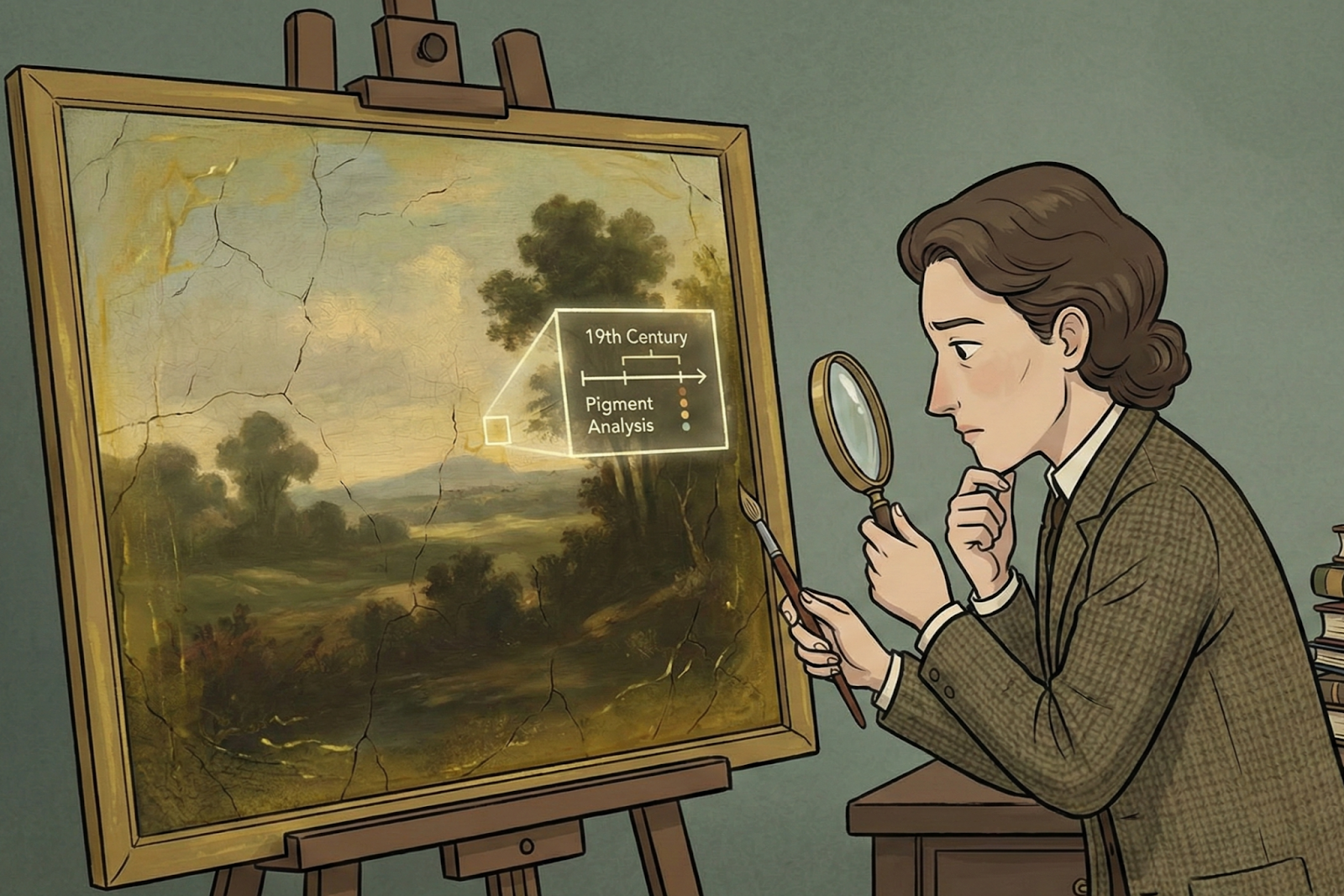
The biggest error you can make is trusting a single piece of evidence. Any one detail can be faked, but creating a completely consistent forgery across all elements is extraordinarily difficult.
Signatures mean almost nothing by themselves because they can be easily copied. Old canvas doesn't guarantee an old painting if someone scraped off the original work and painted something new. Yellowed varnish might be artificially tinted. Cracks can be induced with heat or chemicals. Each deception targets people who stop investigating after one reassuring sign. The critical test is whether all components tell the same chronological story. Comprehensive examination across multiple types of evidence protects you from expensive mistakes.
When Do You Need a Professional Appraiser?
For insurance, estate settlement, charitable donations, or legal matters, you need certified documentation from a qualified professional. This protects your interests and satisfies legal requirements.
Certified appraisers follow strict standards and ethics codes. They know which scientific tests your situation requires and can coordinate laboratory work. More importantly, they understand that insurance appraisals require different approaches than estate tax valuations or charitable donation documentation. Using the wrong approach can invalidate insurance claims or trigger tax problems.
Appraisal Warning: Appraisals for insurance, estate, and tax purposes each require specific methodologies and documentation standards. When the age of a painting affects financial or legal decisions, professional expertise is essential.
AppraiseItNow provides fast, certified appraisals from qualified professionals who understand both traditional authentication methods and modern scientific analysis. Our appraisers know which tests your specific situation requires and deliver documentation that meets legal, insurance, and tax standards. Contact AppraiseItNow today for a certified appraisal you can trust.
Frequently Asked Questions
How can you tell if a painting is an original or a print?
Originals show textured brushstrokes under magnification, while prints display uniform dot patterns and lack three-dimensional paint buildup.
Why is the back of a painting important for dating?
The reverse shows fastening methods, canvas weave, manufacturer stamps, and labels that are harder to fake and provide specific time markers.
Can modern technology detect art forgeries?
Yes, radiocarbon dating identifies post-1955 forgeries within a two-year accuracy range, pigment analysis reveals impossible materials, and AI analyzes artistic style with 98% accuracy.
What is the most accurate way to date an old painting?
Combining radiocarbon dating, pigment analysis, and provenance research provides the most reliable authentication, as no single method is definitive alone.