
Why a Roth Conversion of Pre-IPO Shares Triggers Tax Today, Not Later
Converting a traditional IRA holding privately held, pre-IPO company stock into a Roth IRA is a taxable event, and the tax is based on the fair market value of those shares on the date of conversion. That's the core rule, and it's the one point every IRA owner holding illiquid startup equity needs to internalize before they file anything.
Roth conversions are authorized under 26 U.S.C. Section 408A, and the amount you convert is treated as ordinary income in the year of conversion. Treasury regulations addressing IRA conversions confirm that the amount treated as distributed is the fair market value of the asset on the date it is converted, not its original purchase price and not a number the company assigned for some other purpose. The conversion gets reported on your tax return using the custodian-reported value, but the custodian is relying on you (or the IRA holder) to supply a defensible number for anything that doesn't trade on an exchange.
Here's the practical problem: IRS guidance on valuing retirement plan assets is clear that plan and IRA assets must be reported at fair market value, not cost, but it does not hand you a formula for pricing a block of Series C preferred shares in a company that has never traded publicly. That gap is exactly why an independent appraisal exists: it supplies the documented, methodology-driven value that the tax return depends on.
Watch out: A custodian will often accept whatever FMV figure you provide for annual reporting purposes. That does not mean the figure will hold up if the IRS later examines the conversion. The custodian's acceptance and the IRS's acceptance are two different things.
Waiting for the IPO Won't Change What You Owe
Some IRA owners assume they can sidestep the valuation problem by converting now and letting the eventual IPO price settle the question later. It doesn't work that way. The taxable amount is fixed at the fair market value on the conversion date, and IRS guidance on IRA distributions confirms that this valuation moment, not any later liquidity event, is what determines the taxable amount.
Example: Say an IRA holds 10,000 shares of a private company acquired years earlier at $2 per share. If the company later goes public at $40 per share, that $40 figure has no bearing on the Roth conversion that happened three years before the IPO. The taxable amount was whatever a qualified appraisal determined the shares were worth on the day of conversion, discounted for the realities of holding an illiquid, non-controlling position in a private company.
This cuts both ways. It means you cannot defer the valuation question until a cleaner number appears, but it also means a properly discounted, well-supported appraisal completed while the company is still private can meaningfully lower the taxable amount compared to waiting until shares are marketable.
How an Appraisal Establishes Fair Market Value for Illiquid Shares
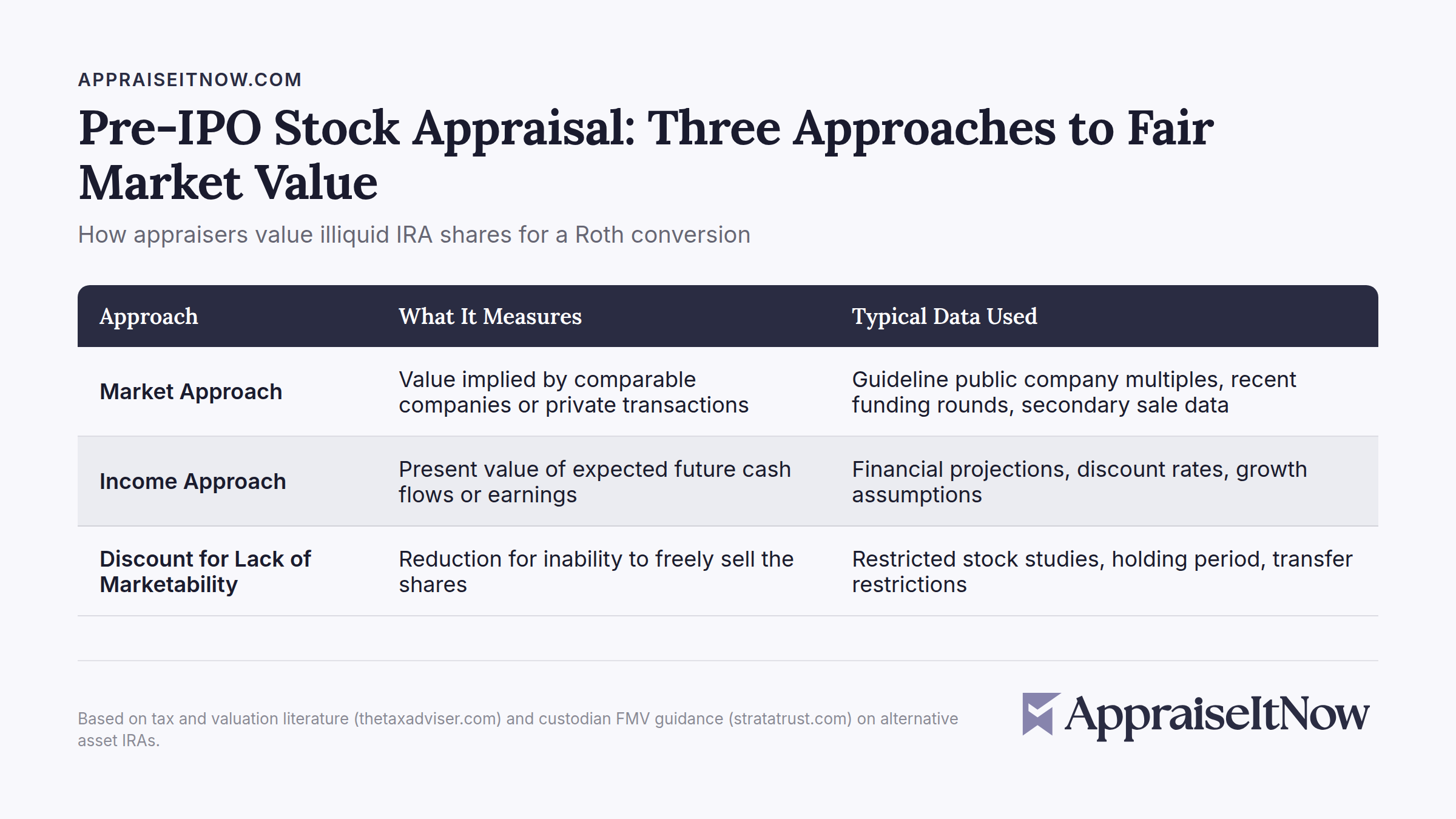
An appraisal of pre-IPO equity for a Roth conversion typically applies the same recognized approaches used for closely held business interests generally, adapted to the specific rights and restrictions attached to the shares held in the IRA.
| Approach | What It Measures | Typical Data Used |
|---|---|---|
| Market approach | Value implied by comparable companies or comparable private transactions | Guideline public company multiples, recent funding rounds, secondary sale data |
| Income approach | Present value of expected future cash flows or earnings | Financial projections, discount rates, growth assumptions |
| Discount for lack of marketability | Reduction reflecting the inability to freely sell the shares | Restricted stock studies, holding period, transfer restrictions |
Tax and valuation literature on pricing privately held stock consistently applies these income, market, and asset-based approaches to closely held businesses, and the same logic governs an IRA conversion appraisal. Custodians handling self-directed IRAs with alternative assets generally expect FMV to be supported by documented, well-reasoned evidence reflecting what a willing buyer would pay a willing seller, not a single unsupported number.
Example (illustrative only): Consider a hypothetical IRA holding a small block of preferred shares in a privately held, pre-IPO artificial intelligence research lab, the kind of company in the same broad category as Anthropic or other frontier AI firms that have raised large private funding rounds but have no public trading market. An appraiser would look at the price of the most recent funding round, comparable public AI and software companies, the specific preference and conversion rights attached to that share class, and then apply a discount for lack of marketability because the shares cannot be sold on any exchange. The result is very likely a lower per-share value than the headline price reported in the press for that funding round, since press coverage typically quotes the price paid by new institutional investors for preferred shares with rights the IRA's shares may not carry.
Why a 409A Valuation or Broker Estimate Isn't Sufficient IRS Support
A company's internal Section 409A valuation, prepared for stock option pricing, is not built for this purpose and generally should not be treated as sufficient documentation for a Roth conversion on its own. It's prepared under a different set of assumptions, for a different purpose, often by a firm retained by the company rather than by the IRA owner, and it may not reflect the specific rights of the exact share class sitting in the IRA.
A broker's informal estimate carries even less weight. Neither one is an independent, third-party appraisal prepared specifically to establish the value of the shares actually held in the account on the conversion date.
Treasury guidance on IRA assets that lack a daily market price directs that fair market value be determined through documented, periodic valuation procedures rather than an ad hoc figure. An independent appraisal, prepared in accordance with the Uniform Standards of Professional Appraisal Practice (USPAP), is the standard that holds up: it applies recognized methodology, documents its assumptions, and is prepared by someone with no stake in the outcome. That independence is precisely what a company-commissioned 409A report and a broker's ballpark figure both lack.
Key takeaway: The IRS doesn't publish a formula for valuing private company stock in an IRA conversion, but it does expect the number to be defensible. An independent, USPAP-compliant appraisal is what makes it defensible.
How We Prepare Pre-IPO Stock Appraisals for Roth Conversions
Our team prepares business valuation reports for IRA owners converting privately held equity, including pre-IPO shares in venture-backed companies, applying the income, market, and asset-based approaches alongside appropriate marketability and minority-interest discounts. Our appraisers hold credentials with organizations such as the ASA and NACVA, and every report is prepared in accordance with USPAP so it can stand up to scrutiny from the IRS or a plan custodian.
Business valuation engagements are quoted as a fixed fee after we scope the assignment, based on the complexity of the cap table, the completeness of the company's financial records, and whether the report needs to meet an IRS-qualified standard. Our published business valuation pricing starts at $4,500 for a standard report and $5,500 for an IRS-qualified report, with most engagements involving privately held equity falling in the $7,500 to $12,000 range depending on the number of share classes and the depth of analysis required. Engagements are never billed hourly.
If you're planning a Roth conversion involving privately held stock, get the appraisal scoped before you initiate the conversion. The valuation date matters, and a report prepared after the fact carries less weight than one timed to the actual conversion.
This article is provided for general informational purposes only and does not constitute legal, tax, or financial advice. Readers should consult a qualified attorney or CPA regarding their specific circumstances.