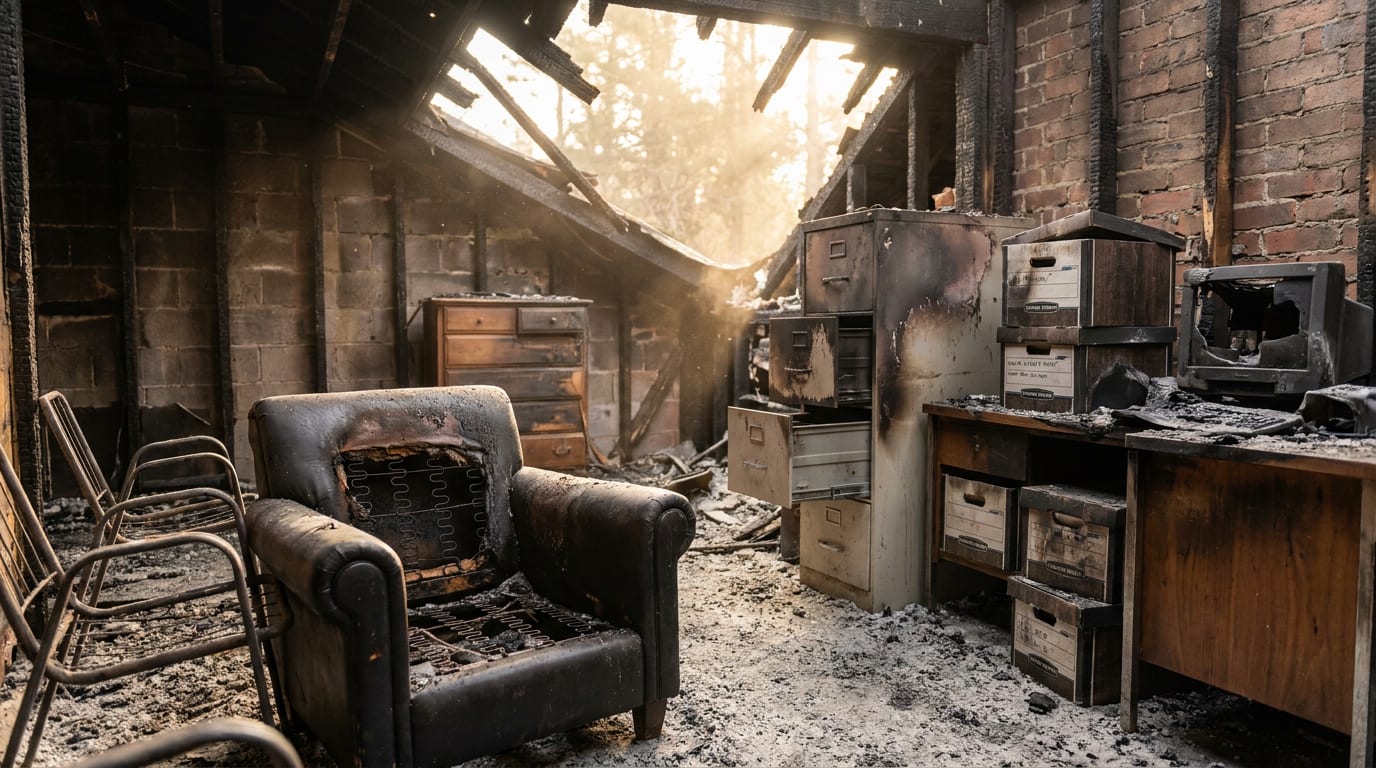
Fire destroys more than furniture and inventory. It usually destroys the paperwork that would normally prove what those things were worth. A fire damage appraisal for insurance claims has to answer a hard question with almost none of the usual evidence: what did this household, business, or equipment fleet look like the day before the fire?
This work has become its own niche for a reason. Individual homeowners and business owners need documentation to support a claim. At the same time, large fire events, wildfires, utility-caused fires, and the class actions and mass tort settlements that follow them, require the same kind of valuation work at a much bigger scale. We prepare valuations for both, and our lane is specific: personal property, business personal property, and equipment. Structural and land value after a fire is handled by separate real property appraisers, and we do not perform that work.
Why Fire Damage Appraisal Demand Keeps Growing
Two distinct but related situations drive the need for a fire damage appraisal.
The first is the ordinary insurance claim. A homeowner or business owner has a policy that covers contents, inventory, or equipment, and the insurer needs a documented, defensible value for what burned. That could mean a household's furnishings and collectibles, a restaurant's kitchen equipment, or a machine shop's tooling.
The second is larger and newer: fire-related mass tort litigation and class action settlements arising from wildfires and utility liability cases. When a single fire event damages hundreds or thousands of properties, claimants are often represented by attorneys or a claims administrator who must substantiate destroyed personal property and business asset values as part of a damages calculation or settlement allocation. Someone with a valuable collection of firearms, for instance, needs the same kind of documentation in a mass settlement that they would in an individual insurer's claim; our guide on what a gun appraisal for an estate involves covers a similar documentation problem for a different context, but the underlying valuation discipline is the same.
The Core Challenge: When the Records Burn Too
A fair market value or replacement cost conclusion is normally built on receipts, photographs, a home inventory, purchase dates, and condition notes. Fire claims routinely have none of that. The items are gone, and so is the proof that they ever existed in the form and quality the owner remembers.
This is the single hardest part of a fire damage appraisal for insurance claims. Claimants are asked to reconstruct, from memory and secondary evidence, a list of items an adjuster or opposing counsel can trust. Boats and other titled personal property present a related but distinct issue: a marine survey documents a vessel's physical condition, while an appraisal establishes its value, and after a fire there may be nothing left to survey at all. Our explainer on how a boat appraisal differs from a survey walks through that distinction in more detail.
Watch out: Insurers and opposing parties in litigation will scrutinize any inventory that looks reconstructed after the fact from memory alone. The strength of a fire damage appraisal comes from how well it corroborates the owner's account with independent evidence, not from the owner's testimony by itself.
How Appraisers Reconstruct Value Without the Original Records
When direct proof of a specific item is gone, appraisers build a defensible opinion of value from whatever secondary evidence survives, combined with comparable sales and market data research for equivalent items. The NAIC's post-disaster claims guidance confirms that insurers typically still expect a room-by-room contents inventory and receipts even after a total loss, which means the appraiser's job is often to help rebuild that inventory from what remains.
Sources commonly used to rebuild a pre-loss picture include:
- Tax records and insurance schedules: Prior tax filings, depreciation schedules, and scheduled personal property riders often list specific high-value items and their declared amounts.
- Financial records: Bank and credit-card statements, along with digital purchase histories from retailers, can establish what was bought, when, and roughly for how much.
- Recovered photos and video: Images pulled from cloud backups, social media posts, or family members' phones frequently show rooms, collections, or equipment in the background of unrelated photos.
- Aerial and satellite imagery history: Historical imagery can confirm property characteristics and the presence of structures, vehicles, or equipment over time.
- Owner interviews and affidavits: Direct interviews, documented carefully and consistently, fill gaps that no paper trail can.
- Contractor and repair estimates: Prior repair or renovation invoices can corroborate the condition and quality of built-in fixtures, furnishings, or equipment before the loss.
Appraisers also lean on general documentation practices that fire restoration professionals recommend to claimants immediately after a loss, including recording brand, model, age, quantity, and condition for every item that can be recalled (general fire loss documentation guidance). When the specific item cannot be verified, the appraiser extrapolates from comparable, similarly situated properties or items with a documented sales history, and discloses that assumption clearly in the report.
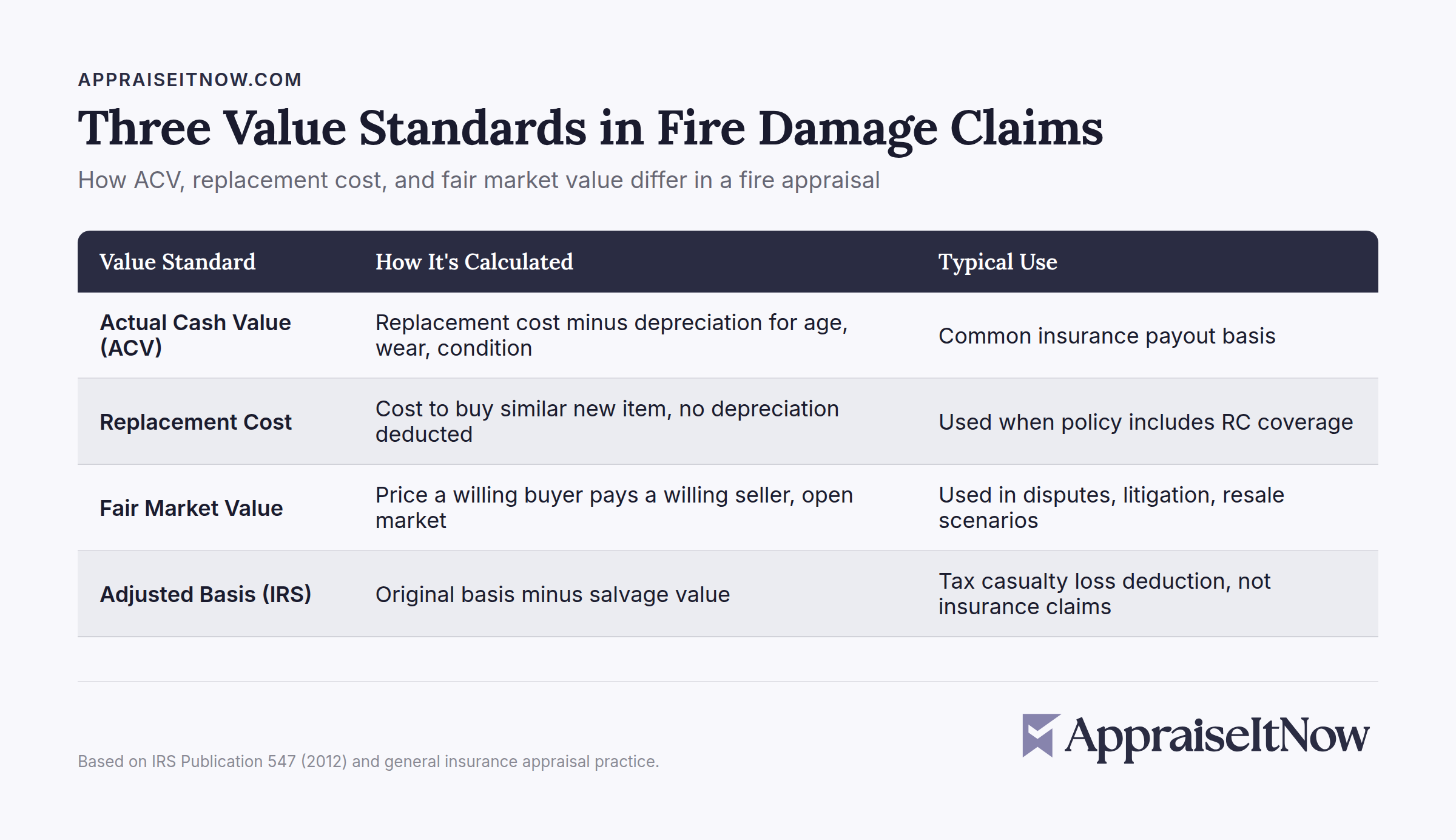
All of this work happens within a specific framework. The appraisal is a retrospective valuation, meaning the opinion of value is dated to the moment immediately before the fire, not the appraisal date. The report also has to distinguish clearly between three different value concepts:
- Actual cash value (ACV): Replacement cost minus depreciation for age, wear, and condition.
- Replacement cost: What it would cost to buy an item of similar kind and quality new, without a deduction for depreciation.
- Fair market value: What a willing buyer would pay a willing seller in the open market, neither compelled to act.
The IRS's casualty loss guidance uses a related but distinct measure, generally the property's adjusted basis reduced by any salvage value, which is a tax concept and not an insurance claim standard (IRS Publication 547). Confusing these standards is one of the most common ways a fire claim gets delayed or disputed, so every report we prepare states plainly which standard applies to the assignment and why.
Valuing Business Inventory and Equipment After a Fire
Businesses face the same evidence problem as homeowners, just with more moving parts. Inventory counts, fixed-asset schedules, and equipment maintenance logs are often stored on-site and destroyed along with the physical assets.
When that happens, appraisers rebuild the picture from whatever business records survive off-site or in cloud systems: prior tax returns and depreciation schedules, vendor invoices, point-of-sale and accounting software exports, insurance schedules that listed scheduled equipment, and photographs from marketing materials, listings, or social media that happen to show the shop floor or storefront. A machine shop's CNC equipment or a restaurant's kitchen line can usually be identified by make and model even without the original purchase paperwork, which lets the appraiser research comparable sales and current replacement cost for equivalent equipment.
This is the same skill set our appraisers apply on the equipment and business inventory appraisal side of our work generally: identify the asset, document its condition and specification as of the loss date from the best available evidence, and support the conclusion with real market data rather than assumption alone.
Mass-Tort and Wildfire Settlement Appraisals: A Different Scale
A single house fire produces one appraisal assignment. A wildfire or utility-caused fire can produce hundreds or thousands of claimants with damaged or destroyed personal property and business assets, all needing documentation for a settlement or litigation process at roughly the same time.
That scale changes the working method without changing the underlying standards. Appraisers coordinate directly with attorneys and claims administrators to build litigation-ready reports on a compressed timeline, and often apply a mass-appraisal or sampling-based approach when many claimants own similar categories of property, such as household furnishings in comparable homes within the same fire perimeter. Fire-related mass tort matters generally require this kind of allocation work across property types, separating real property, contents, business interruption, and personal property into distinct valuation lanes so that each can be substantiated on its own evidence.
Pro tip: In a mass tort or class action context, keep every assumption and data source separate and documented by claimant. A methodology that works for one household does not automatically transfer cleanly to the next, even within the same fire event, and litigation counsel will need to show that each individual value opinion rests on its own evidence.
What Makes a Fire Damage Appraisal Litigation-Ready
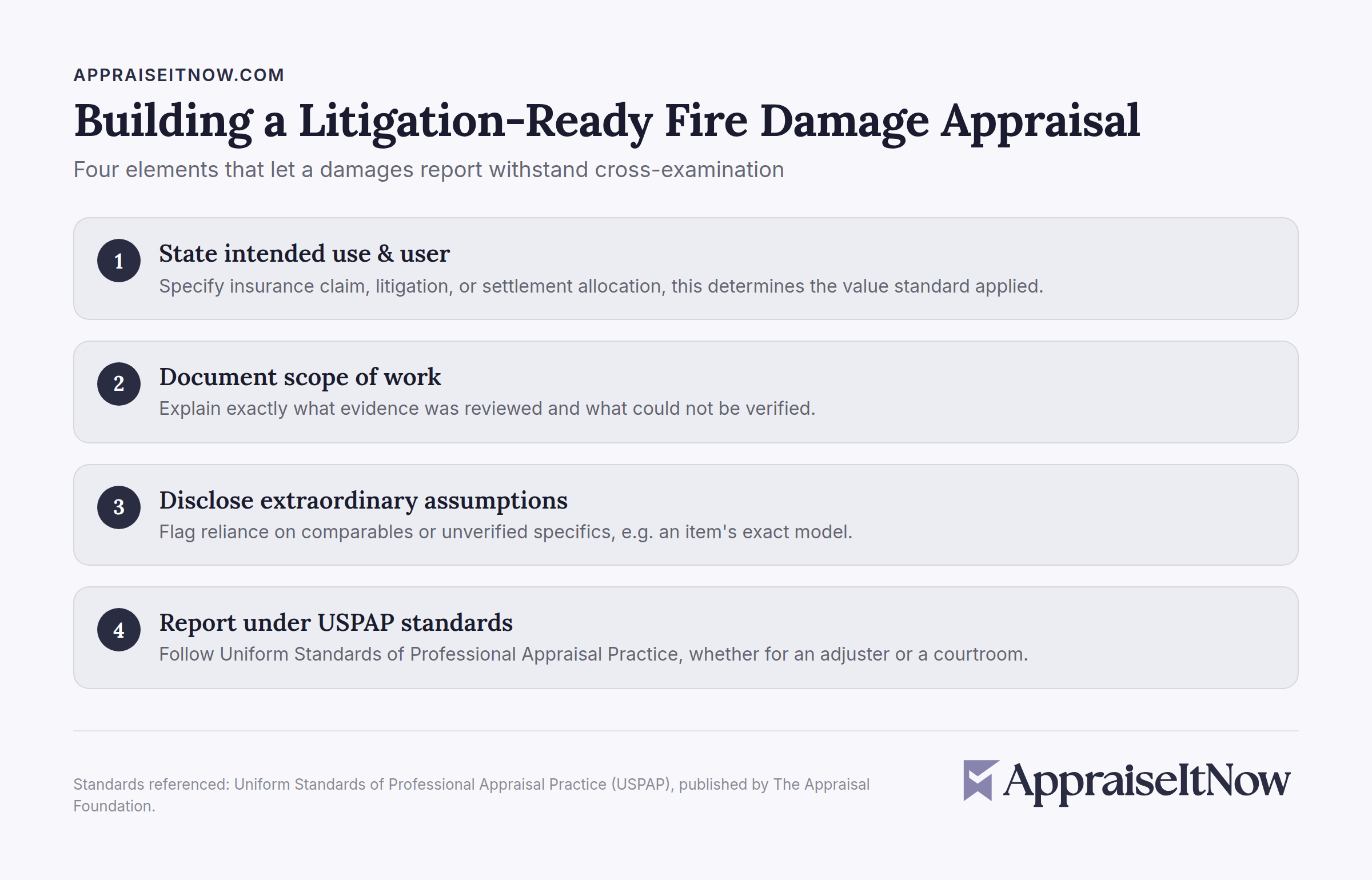
An appraisal prepared for litigation or a mass settlement has to survive cross-examination, not just satisfy an adjuster. That means the scope of work, the assumptions, and the data sources all need to be stated plainly enough that an opposing expert can follow the reasoning line by line.
Reports prepared for this kind of work generally include:
- A clearly stated intended use and intended user (insurance claim, litigation, or settlement allocation), since that determines which value standard applies.
- A documented scope of work explaining exactly what evidence was reviewed and what could not be verified.
- Full disclosure of any extraordinary assumptions, such as relying on a comparable item where the specific item's exact model could not be confirmed.
- Valuation conclusions prepared in accordance with the Uniform Standards of Professional Appraisal Practice (USPAP), published by The Appraisal Foundation, regardless of whether the report is headed for an adjuster's desk or a courtroom.
Consistent, standards-based reporting also matters because damage and mass-tort disputes frequently involve competing experts. General industry commentary on fire-related tort litigation notes that consistent methodology and clear documentation are what allow a damages allocation to hold up when multiple parties are reviewing the same evidence pool.
How Our Appraisers Approach Fire Loss Assignments
Our appraisers hold credentials with organizations including the ASA, ISA, AAA, and CAGA, and every fire damage report we prepare follows USPAP regardless of whether it supports an individual insurance claim or a coordinated wildfire settlement effort. We work with claimants, attorneys, and claims administrators nationwide, and we are comfortable stepping into a file where the original records are gone and the evidence has to be rebuilt from whatever survives.
Our scope covers personal property such as household contents, collections, and furnishings, along with business personal property including inventory, fixtures, and equipment. We do not appraise buildings, homes, or land; that work belongs with separate real property appraisers, and a full fire loss claim often needs both types of professionals working from their own lanes.
Fees for this work are quoted as a fixed fee after we scope the assignment, based on factors like the number of items or categories involved, the intended use of the report, and how much reconstruction work the missing records require. For a household personal property claim, our published pricing for personal property appraisals starts at $195 for a standard report and $295 for an IRS-qualified or litigation-grade report, with typical assignments running $395 to $2,200 depending on complexity. Business inventory appraisals start at $495, with typical assignments in the $695 to $3,500 range. Every engagement is quoted before work begins and billed as a fixed fee, never by the hour.
If you are managing a fire damage insurance claim, or you are an attorney or claims administrator coordinating a wildfire or utility liability settlement, our appraisers can help you document what was lost with a defensible, USPAP-compliant valuation. Reach out to discuss your assignment and get a fixed-fee quote.
This article is provided for general informational purposes only and does not constitute legal, tax, or financial advice. Readers should consult a qualified attorney or CPA regarding their specific circumstances.