








When you sell a home, investment property, or valuable asset for a profit, you may be celebrating a windfall, until tax season arrives with an unexpected bill from the IRS. Whether you’re selling a longtime family home or managing an inherited estate, understanding capital gains tax is essential for protecting your profits.
Many people don’t realize that a professional appraisal is one of the most powerful tools for minimizing tax liability and ensuring accurate reporting. This guide will walk you through how capital gains tax works and explain how proper appraisal documentation can protect your financial interests.
Capital gains tax is a federal tax on the profit realized when you sell an asset for more than you paid for it. The IRS defines your capital gain as the difference between the sale price and your adjusted cost basis; the original purchase price plus the cost of qualifying improvements and certain expenses. For example, if you bought a rental property for $200,000, invested $50,000 in renovations, and sold it for $400,000, your capital gain would be $150,000 ($400,000 sale price minus your $250,000 adjusted basis).
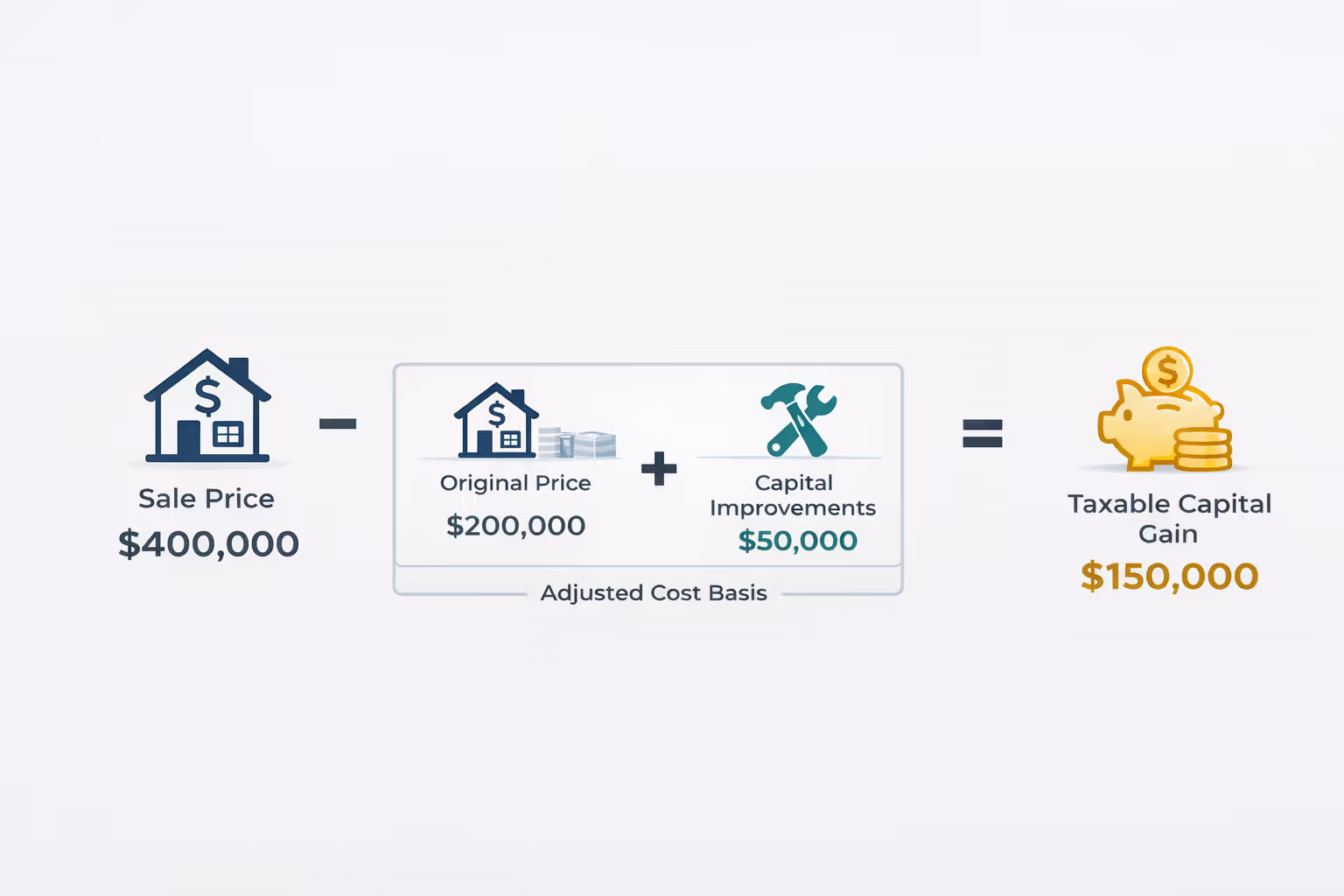
Your adjusted cost basis is the key to lowering your tax bill. The higher you can legitimately claim your basis to be, the lower your taxable gain will be.
This tax applies to a wide range of people, including homeowners selling their primary residence, real estate investors, beneficiaries selling inherited property, and individuals selling valuable personal property like art, antiques, or jewelry. The amount you owe depends on how long you held the asset, your taxable income, and the type of asset sold.
The IRS applies different rates based on your holding period. Gains on assets held for one year or less are considered short-term capital gains and are taxed at your ordinary income tax rates, which can range from 10% to 37%. In contrast, gains on assets held for more than one year are long-term capital gains. These receive preferential treatment, with tax rates of 0%, 15%, or 20%, depending on your taxable income. For most middle-income earners, the long-term rate is 15%. Additionally, high-income taxpayers may face a 3.8% Net Investment Income Tax (NIIT) on top of their capital gains rate.
While you can’t always eliminate capital gains tax, the IRS provides several legitimate strategies to reduce your liability.
The most significant tax benefit for homeowners is the primary residence exclusion. This rule allows you to exclude a substantial amount of gain from taxation when selling your main home.
Single filers can exclude up to $250,000 of gain, while married couples filing jointly can exclude up to $500,000 from the sale of their main home.
To qualify, you must meet both an ownership test and a use test: you must have owned and used the property as your principal residence for at least two of the five years leading up to the sale. These two years do not need to be consecutive, and you generally cannot claim this exclusion more than once every two years.
Your cost basis directly reduces your taxable gain, so accurate documentation is crucial. You can increase your basis by adding the cost of capital improvements that have a useful life of more than one year, such as a new roof, a kitchen renovation, or a room addition. You can also include certain costs associated with the purchase and sale, like legal fees, real estate commissions, and appraisal costs. It’s important to distinguish these from regular maintenance and repairs, which do not increase your basis.
For instance, imagine you bought a home for $300,000 with $15,000 in closing costs. Over the years, you invested $75,000 in a new kitchen and finished basement. Your adjusted cost basis becomes $390,000. If you sell for $650,000 and have $39,000 in selling expenses, your realized amount is $611,000, and your capital gain is $221,000. As a single filer, this entire gain would be covered by the $250,000 exclusion, resulting in zero tax. Without documentation for your improvements, your reported gain would be much higher, leaving a significant portion subject to tax.
For real estate investors, a 1031 exchange allows you to defer capital gains taxes by exchanging one investment property for another “like-kind” property. To use this strategy, the transaction must be for business or investment properties, not a personal residence. You must identify a replacement property within 45 days of the sale and complete the purchase within 180 days, using a qualified intermediary to handle the funds. This powerful tool allows you to defer taxes indefinitely as you continue to reinvest in real estate.
Many people ask about a “3-year rule” for capital gains, but they are typically thinking of the 2-out-of-5-years rule for the primary residence exclusion. Understanding this rule is critical for any homeowner planning to sell.
To qualify for the home sale exclusion, you must have owned the property for at least two years and lived in it as your main home for at least two years within the five-year period immediately before the sale.
The two years of use do not need to be consecutive. You could live in the home for one year, rent it out for two, and then move back in for another year before selling and still qualify.

A professional appraisal serves as authoritative, third-party documentation of your property’s value at a specific point in time. This evidence is crucial for supporting your tax position and can significantly reduce your tax liability.
When you inherit property, the IRS grants a “step-up in basis.” This means your cost basis is not the original purchase price but the property’s fair market value (FMV) on the date of the owner’s death. This can eliminate decades of appreciation from being taxed.
The “step-up in basis” for inherited property can save you tens or even hundreds of thousands of dollars in taxes, but you must have a credible appraisal to prove the property’s value.
For example, if your parents bought a home for $80,000 and it was worth $550,000 when you inherited it, your basis is $550,000. If you sell it for $560,000, your taxable gain is only $10,000. However, you must have credible evidence to support this stepped-up basis. A professional, retrospective appraisal provides the defensible documentation the IRS requires.
If you’ve lost receipts for major renovations completed years ago, an appraisal can help substantiate their value. An appraiser can identify improvements through inspection and estimate their contributory value to the property. This provides strong supporting evidence to include those costs in your basis, even without the original paperwork.
In the event of an IRS audit, a professional appraisal from a qualified appraiser is your best defense. The IRS gives significant weight to appraisals that are prepared by a credentialed, independent appraiser and conform to the Uniform Standards of Professional Appraisal Practice (USPAP). An appraisal demonstrates a good-faith effort to determine an accurate value, which can help you avoid penalties even if the IRS disagrees with your figure.
If you used part of your home for a business or rented out a portion, you must allocate the gain between personal and non-qualified use. An appraisal helps determine the value of each portion, ensuring you correctly calculate the gain eligible for the Section 121 exclusion. Similarly, an appraisal is vital when converting a rental property to a primary residence (or vice versa) to establish the property’s value at the time of conversion.
Timing is key. You should obtain a professional appraisal in these critical situations:
Q: Can I use the county tax assessment instead of an appraisal?
A: No. The IRS does not consider tax assessments to be reliable indicators of fair market value. They often lag behind the market and are used for a different purpose. A qualified appraisal is required for accurate valuation.
Q: What if I can’t find receipts for old improvements?
A: A professional appraiser can identify past improvements and estimate their contributory value. While receipts are ideal, an appraisal report can serve as strong supporting documentation for your basis adjustment.
Q: Does depreciation affect my capital gains?
A: Yes. If you claimed depreciation deductions for rental or business use, you must “recapture” that amount when you sell. Depreciation recapture is taxed at a maximum rate of 25% and cannot be excluded under the primary residence rule.
Q: Can an appraisal help if I’ve already sold the property?
A: Yes. A retrospective appraisal can determine a property’s value as of a past date. A qualified appraiser uses historical data and comparable sales from that time to create a defensible report, which can be invaluable for tax filings or audits.
Capital gains tax can be a significant expense, but with strategic planning and proper documentation, you can minimize your liability. A professional appraisal is a critical tool for protecting your assets and ensuring compliance.
At Appraise It Now, our team provides thorough, defensible valuations that withstand IRS scrutiny. Our credentialed appraisers adhere strictly to USPAP standards and understand the specific documentation required for capital gains reporting. Whether you’re selling a home, managing an estate, or planning an exchange, we provide the documentation you need for accurate tax reporting and peace of mind.
Ready to protect your investment? Don’t risk overpaying your taxes or facing IRS penalties.
Contact Appraise It Now today to discuss your capital gains appraisal needs. Our team will guide you through the process and provide a comprehensive report that gives you confidence in your tax filing.
Disclaimer: This article provides general information and is not intended as tax or legal advice. Tax laws are complex and subject to change. We recommend consulting with a qualified tax professional or attorney regarding your specific situation.




