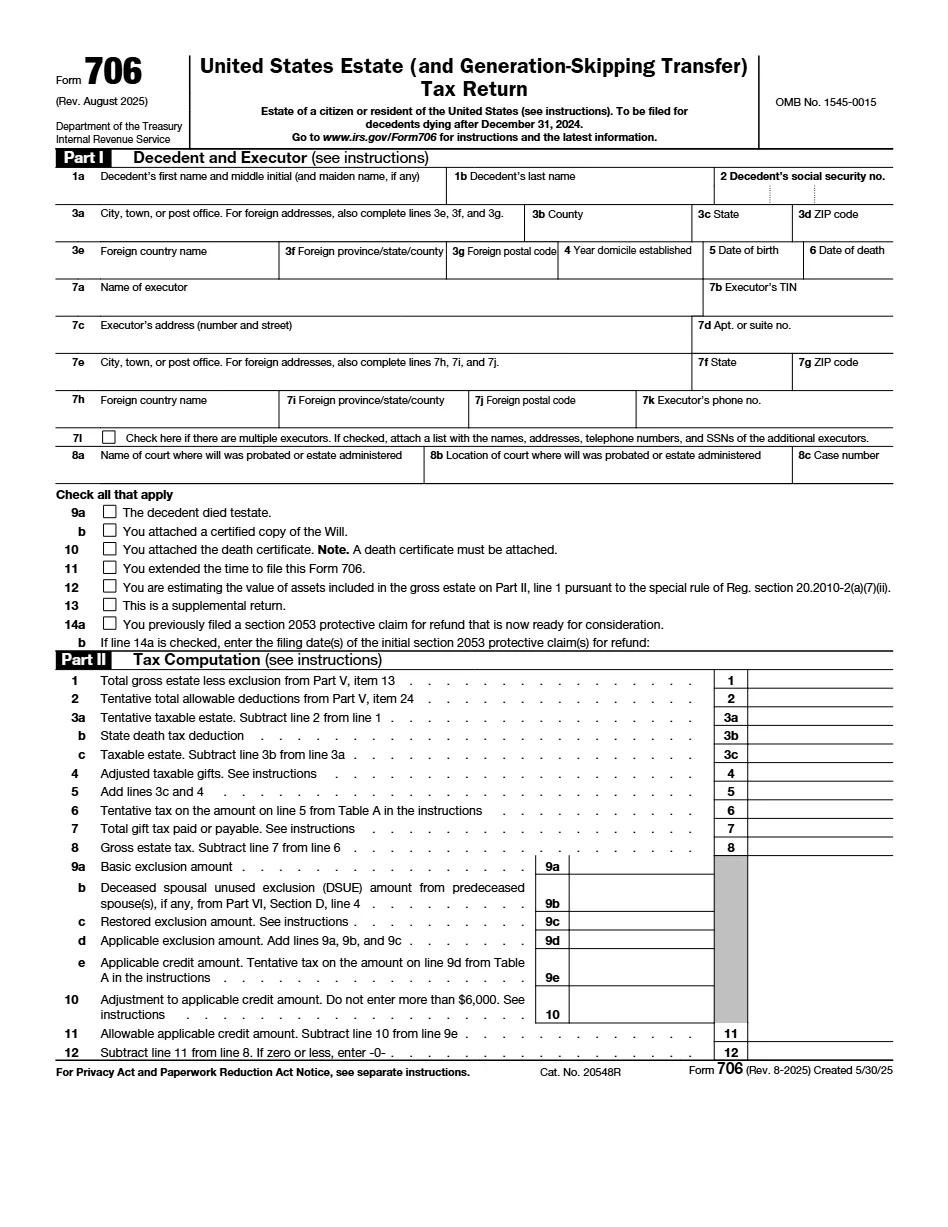
IRS Form 706 appraisals in Tennessee for personal property, equipment and machinery, fine art, business interests, boats and watercraft, and automobiles and vehicles. AppraiseItNow provides credentialed, USPAP-compliant IRS Form 706 appraisals online and onsite across Tennessee, including Nashville, Memphis, and Knoxville.


No Frequently Asked Questions Found.
AppraiseItNow provides qualified appraisals for IRS Form 706 filings throughout Tennessee, covering estates that exceed the federal gross estate threshold of $13,990,000 for 2025 decedents. Even estates below that threshold may require appraisals to elect portability of the unused exclusion for a surviving spouse, a consideration particularly relevant in Tennessee's growing retiree population. All appraisals are USPAP-compliant and prepared by qualified appraisers to meet IRS standards and withstand scrutiny. Our mission is to deliver defensible, USPAP-compliant valuations with exceptional speed, professionalism, and client service.
AppraiseItNow offers both remote and onsite appraisal services, making it easy to complete estate valuations regardless of where assets are located across the state. Our appraisers in Tennessee serve clients in Nashville, Memphis, Knoxville, Chattanooga, and communities throughout the state.
AppraiseItNow covers the full range of non-cash estate assets commonly requiring valuation for Form 706 filings in Tennessee, including:
AppraiseItNow serves estate attorneys, executors, personal representatives, and surviving family members across Tennessee who need qualified appraisals to support accurate and defensible IRS Form 706 filings. This includes estates involving family-owned businesses, manufacturing assets, farm equipment, fine art collections, and other non-cash property common throughout the state.
Yes, AppraiseItNow provides qualified appraisals for Tennessee estates filing IRS Form 706. Our appraisers are experienced with federal estate tax requirements and can support executors and attorneys across the state.
We appraise a wide range of non-cash assets commonly found in Tennessee estates, including closely held businesses, vehicles, machinery and equipment, artwork, collectibles, jewelry, and personal property. Each appraisal is completed by a qualified appraiser and meets IRS standards for estate tax purposes.
Yes, all of our appraisals follow the Uniform Standards of Professional Appraisal Practice, which the IRS requires for qualified appraisals submitted with IRS Form 706. Our appraisers also meet the IRS definition of a qualified appraiser, including education, experience, and designation requirements.
Tennessee repealed its state inheritance tax in 2016, so estates are now governed entirely by federal rules, making IRS Form 706 the primary concern for larger estates. Tennessee's growing wealth in areas like Nashville and its strong agricultural heritage mean many estates include closely held businesses, farm equipment, and valuable personal property that require qualified appraisals to establish fair market value at the date of death.
Yes, many of our appraisals can be completed remotely using photographs, documentation, and records provided by the executor or estate attorney. For certain asset types, an in-person inspection may be recommended, but our team works with clients across Tennessee regardless of location.
Fees depend on the asset type and scope of the assignment. Visit our pricing page for ranges or contact us.
Turnaround times vary by asset type:
Reports are prepared by credentialed appraisers with relevant experience in the specific asset type being valued. Each appraiser meets IRS qualified appraiser standards, including professional designations, education, and documented appraisal experience.
Since Tennessee repealed its inheritance tax effective January 1, 2016, there are no state-specific appraisal requirements for IRS Form 706 filings. Executors follow federal IRS standards exclusively, including USPAP-compliant qualified appraisals for applicable non-cash assets.
You will generally need the date of death, a description of the assets to be appraised, any available records such as purchase receipts, prior appraisals, or financial statements, and the contact information for the executor or estate attorney. The more documentation you can provide upfront, the faster we can complete the assignment.
Yes, our appraisals are prepared to meet IRS requirements for qualified appraisals, including USPAP compliance, proper appraiser credentials, and the required content for supporting IRS Form 706. Tennessee estates follow federal standards exclusively, and our reports are structured accordingly.
No, Tennessee's repeal of its inheritance tax in 2016 eliminated all state-specific appraisal requirements, so executors comply solely with federal IRS standards. This means qualified appraisals for non-cash assets must meet USPAP requirements and the IRS definition of a qualified appraiser, with no additional Tennessee mandates layered on top.
IRS Form 706 Schedule T allows qualified family farms to be valued at their actual agricultural use rather than highest-and-best fair market value, with a 2025 reduction ceiling of $1,420,000. To qualify, the estate must meet thresholds including 50% gross estate qualification and 25% from qualifying real property used in farming by family members for 7 or more years after the election. Supporting documentation includes a detailed farm description, income and expense statements, comparable sales data, and affidavits from a qualified appraiser confirming use and projections.
Yes, executors can file IRS Form 706 solely to elect portability of the deceased spousal unused exclusion to the surviving spouse, even when no estate tax is owed. The return must be filed within 9 months of death, with a 6-month extension available via Form 4768. Given Tennessee's lack of a state estate tax and its growing retiree population, portability elections are a common reason for sub-threshold filings.
The IRS requires qualified appraisers to hold a recognized professional appraisal designation, complete relevant college-level education, have at least two years of full-time appraisal experience in the property type, and have conducted 10 or more appraisals of similar assets in the prior three years. They must also comply with USPAP and certify that they have no prohibited financial relationships with the estate. No Tennessee-specific credentials apply, as federal standards govern all IRS Form 706 appraisals uniformly.
IRS Form 706 is due within 9 months of death, with an automatic 6-month extension available via Form 4768, though the extension does not delay payment deadlines. Late filing carries a penalty of 5% per month up to 25%, and late payment accrues at 0.5% per month up to 25%, plus interest. Tennessee provides no additional relief beyond federal rules, as the state's inheritance tax repeal left IRS Form 706 entirely under federal jurisdiction.
Fair market value for IRS Form 706 is the price a willing buyer and seller would agree upon under no compulsion, determined using the sales comparison, income capitalization, or cost approach as appropriate for the asset and date-of-death conditions. For Tennessee assets like rural farm equipment or closely held business interests, appraisers also consider local market trends such as agribusiness demand and regional economic conditions. No Tennessee regulations alter these federal valuation methods following the repeal of the state inheritance tax.